24/7 Space News
SOLAR SCIENCE
Webb maps Uranus upper atmosphere in 3D
illustration only

Webb maps Uranus upper atmosphere in 3D

by Sophie Jenkins
London (SDX) Feb 23, 2026

A Northumbria University PhD student has led an international collaboration to construct the first three-dimensional view of Uranus upper atmosphere, showing how the planet's unusual magnetic field sculpts bright auroras thousands of kilometers above its clouds.

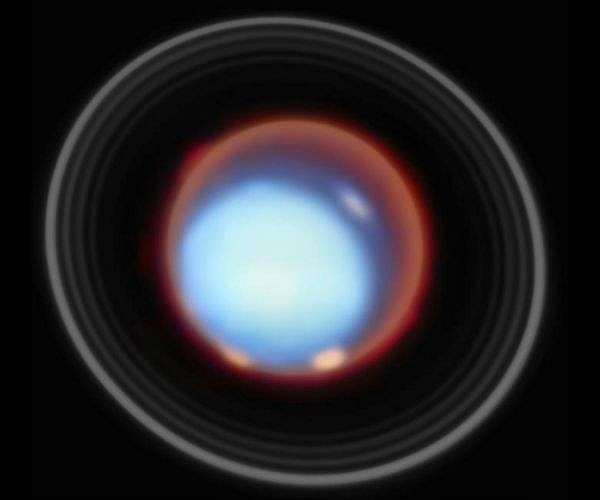
Using the James Webb Space Telescope, operated by NASA with ESA and CSA, lead author Paola Tiranti and colleagues observed Uranus for nearly a full rotation and detected faint infrared emissions from molecules located as high as 5,000 kilometers above the visible cloud tops.

The new observations deliver the most detailed picture so far of where auroras form at Uranus and how energy is transported vertically through its upper atmosphere and ionosphere.

The study, published in Geophysical Research Letters, also confirms that Uranus upper atmosphere has continued to cool over the past three decades, extending a long-standing and puzzling trend in the ice giant's climate.

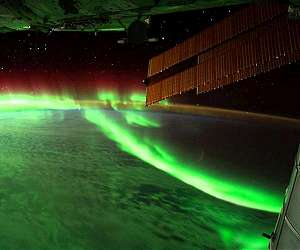
Auroras occur when charged particles are funneled along a planet's magnetic field lines and collide with atoms and molecules in the upper atmosphere, releasing energy as light across a range of wavelengths.

By using Webb's Near-Infrared Spectrograph in its Integral Field Unit mode, the team mapped the temperature and density of ions in Uranus ionosphere, the region where the atmosphere becomes ionized and is strongly coupled to the magnetic field.

They found that temperatures in the upper atmosphere peak between roughly 3,000 and 4,000 kilometers above the cloud tops, while ion densities reach their maximum closer to 1,000 kilometers altitude.

"This is the first time we've been able to see Uranus upper atmosphere in three dimensions. With Webb's sensitivity, we can trace how energy moves upward through the planet's atmosphere and even see the influence of its lopsided magnetic field," said Tiranti.

Uranus magnetosphere ranks among the most unusual in the Solar System. Unlike Earth, where the magnetic field is closely aligned with the rotation axis, Uranus field is tilted by nearly 60 degrees and offset from the planet's center, causing its auroras to sweep across the planet in complex patterns.

Webb data revealed two bright auroral bands near the planet's magnetic poles, separated by a narrow region where emissions and ion densities are depleted, a structure the team links to the way magnetic field lines channel charged particles through the atmosphere.

Similar darkened regions have been identified at Jupiter, where the geometry of the magnetic field determines how particles flow and where they precipitate into the upper atmosphere.

The Webb measurements show that Uranus upper atmosphere is still cooling, with an average temperature of about 426 kelvins, or roughly 150 degrees Celsius, which is lower than temperatures recorded by previous spacecraft and ground-based observations.

Explaining why the upper atmosphere is cooling, despite Uranus distance from the Sun and internal heat sources, could offer important clues to how ice giant planets control their energy budgets and atmospheric temperatures.

"By revealing Uranus vertical structure in such detail, Webb is helping us understand the energy balance of the ice giants. This is a crucial step towards characterising giant planets beyond our Solar System," Tiranti said.

The results come from JWST General Observer program 5073, led by Dr Henrik Melin of Northumbria University, which used Webb's Integral Field Unit to monitor Uranus for about 15 hours on 19 January 2025.

Research Report:JWST Discovers the Vertical Structure of Uranus' Ionosphere

Related Links
Northumbria University
Solar Science News at SpaceDaily

Subscribe Free To Our Daily Newsletters
Tweet

RELATED CONTENT
The following news reports may link to other Space Media Network websites.
SOLAR SCIENCE
Alfven waves drive stable electric fields that power auroras
Tokyo, Japan (SPX) Feb 08, 2026
The shimmering curtains of the aurora form when energetic electrons plunge into Earths upper atmosphere and collide with atoms and molecules, releasing light across the polar skies. For decades, scientists have known that these electrons are accelerated by intense electric fields above the auroral regions, but they lacked a clear explanation for how those fields are generated and sustained in near-Earth space. A new study led by researchers at the University of Hong Kong (HKU) and the University o ... read more

SOLAR SCIENCE
Texas AM partners with Aegis to orbit TAMU SPIRIT research hub on ISS

Sophie Adenot, the second French woman to fly to space

International crew arrives at space station

Chinese visitors to Japan slump as spat rumbles on

SOLAR SCIENCE
Russian era ends at abandoned launchpad in South American jungle

NASA teams set for second Artemis II wet dress rehearsal

Vietnam licenses Musk's satellite internet firm Starlink

Latvian startup advances nuclear-fueled power for satellites and future Moon missions

SOLAR SCIENCE
Curiosity Blog, Sols 4798-4803: Back for More Science

Mars relay orbiter seen as backbone for future exploration

UAE extends Mars probe mission until 2028

Mars' 'Young' Volcanoes Were More Complex Than Scientists Once Thought

SOLAR SCIENCE
Dragon spacecraft gears up for crew 12 arrival and station science work

China prepares offshore test base for reusable liquid rocket launches

Retired EVA workhorse to guide China's next-gen spacesuit and lunar gear

Tiangong science program delivers data surge

SOLAR SCIENCE
AAC Clyde Space adds Sedna satellites to boost maritime data services

China tests AI satellite swarm for space-based computing

BlackSky expands Gen 3 Assured deals with new defense customer

Muon Space ramps up multi-mission satellite constellations

SOLAR SCIENCE
ST Engineering iDirect and G&S SatCom align network and service management on Intuition

Light based computing module aims to cut AI power demand

KSAT prepares Hyperion in orbit relay test for satellite data

Pale Blue opens Tsukuba site to scale satellite propulsion production

SOLAR SCIENCE
Hydrogen sulfide detected in distant gas giant exoplanets for the first time

Cheops spots inside out exoplanet quartet

Study revisits chances of detecting alien technosignatures

Engineered microbes use light to build new molecules

SOLAR SCIENCE
Jupiter size refined by new radio mapping

Polar weather on Jupiter and Saturn hints at the planets' interior details

Europa ice delamination may deliver nutrients to hidden ocean

Birth conditions fixed water contrast on Jupiters moons

Subscribe Free To Our Daily Newsletters


The content herein, unless otherwise known to be public domain, are Copyright 1995-2024 - Space Media Network. All websites are published in Australia and are solely subject to Australian law and governed by Fair Use principals for news reporting and research purposes. AFP, UPI and IANS news wire stories are copyright Agence France-Presse, United Press International and Indo-Asia News Service. ESA news reports are copyright European Space Agency. All NASA sourced material is public domain. Additional copyrights may apply in whole or part to other bona fide parties. All articles labeled "by Staff Writers" include reports supplied to Space Media Network by industry news wires, PR agencies, corporate press officers and the like. Such articles are individually curated and edited by Space Media Network staff on the basis of the report's information value to our industry and professional readership. Advertising does not imply endorsement, agreement or approval of any opinions, statements or information provided by Space Media Network on any Web page published or hosted by Space Media Network. General Data Protection Regulation (GDPR) Statement Our advertisers use various cookies and the like to deliver the best ad banner available at one time. All network advertising suppliers have GDPR policies (Legitimate Interest) that conform with EU regulations for data collection. By using our websites you consent to cookie based advertising. If you do not agree with this then you must stop using the websites from May 25, 2018. Privacy Statement. Additional information can be found here at About Us.