





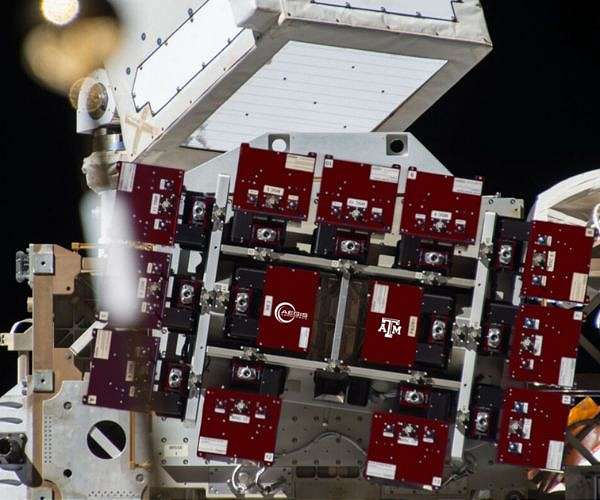
TAMU SPIRIT, short for the Texas A and M and Aegis Aerospace Multi Use Space Platform Integrating Research and Innovative Technology, is designed as a "satellite campus in space." It will host projects across disciplines that include advanced materials manufacturing, robotics testing, space surveillance, tracking technologies and other in space research activities, consolidating them on a single external ISS facility.
Texas A and M System researchers will have exclusive priority rights to send experiments for installation on the TAMU SPIRIT flight facility. That guaranteed access is intended to accelerate concept maturation from campus laboratories to the orbital environment, while giving students hands on experience with flight hardware development, integration and operations.
The first mission, TAMU SPIRIT 1, already has an initial manifest of selected experiments spanning engineering, physical sciences, life sciences and agriculture. "Chitosan in Space: Assessing Biopolymer Durability Under Vacuum and Radiation" will be led by principal investigator Dr. Justin W. Wilkerson of the J. Mike Walker '66 Department of Mechanical Engineering, with co principal investigator Dr. Jeffery K. Tomberlin from the Department of Entomology. Their project will study how the biopolymer chitosan responds to the combined stresses of vacuum and space radiation, data that could shape future materials and coatings.
Another investigation, "Dexterous Robotics Avionics and Component Testing and Validation," will be led by principal investigator Dr. Robert Ambrose at the Texas A and M Engineering Experiment Station. This experiment will use the ISS platform to test robotic avionics and components in the actual space environment, gathering performance data that can guide the design of next generation dexterous robots for orbital and planetary applications.
The "Grape Seeds in Space" experiment, led by principal investigator Dr. Justin Sheiner of the Department of Horticulture Sciences, will examine how microgravity and space conditions influence grape seed biology. Insights from this work could inform plant science and crop improvement strategies, especially for traits that respond strongly to environmental stress.
Materials and thermal management research will fly under the title "In Orbit Thermal Insulation of Printed Aerogels and Microgravity Printability of Magnetic Responsive Resins." Principal investigator Dr. Emily Pentzer of the Department of Chemistry, together with co principal investigators Dr. Peiran Wei and Dr. Jung Bin Ahn at the Texas A and M Engineering Experiment Station, will investigate how printed aerogels perform as thermal insulators in orbit and how magnetic responsive resins behave during 3D printing in microgravity.
Biomedical and radiation effects will be addressed by "The Spaceflight Endothelial and Coagulation Biology Experiment (SECoBE) Initiative: Engineering Demonstration and Microbial Survivability." Principal investigator Dr. Jeffery C. Chancellor, Director of Aerospace Medicine in the College of Medicine, will work with co investigators Dr. Serena M. Aunon Chancellor, Dr. John Ford, Dr. Walter Cromer, Dr. Travis R. Hein and Dr. Mariappan Muthuchamy. Their initiative will combine an engineering demonstration with studies of microbial survivability, endothelial function and coagulation biology under spaceflight conditions relevant to astronaut health.
Thermal control technology will be explored in "Shape Memory Alloy Torque Tube Based Morphing Radiator," led by principal investigator Dr. Darren Hartl of the Department of Aerospace Engineering with co principal investigator Thomas Cognata from NASA Johnson Space Center. This project will test a radiator concept that uses shape memory alloy torque tubes to change configuration in response to temperature, potentially enabling adaptive thermal management systems for spacecraft.
The "Shield 2" experiment will focus on protective materials and radiation shielding. Principal investigator Dr. Kalyan Raj Kota of the Texas A and M Engineering Experiment Station will collaborate with co investigators Dr. Robert Kelley Bradley of Lamar University, Dr. Merlyn Pulikkathara of Prairie View A and M University, Dr. Masoumeh Ozmaeian of MatterMind Analytics LLC and Justin Carter of the Texas A and M Engineering Experiment Station. Their work will assess material performance in the radiation and debris environment of low Earth orbit.
Optoelectronic materials are the focus of "Solar Induced Hot Electron Current Measurements via Quantum Dot Upconversion." Principal investigator Dr. Dong Hee Son of the Department of Chemistry and co principal investigator Ian Murray, also of the Department of Chemistry, will measure hot electron currents generated through quantum dot based upconversion under solar illumination in space. Results from this study may inform future high efficiency photovoltaic and photonic devices.
Texas A and M and Aegis Aerospace plan additional TAMU SPIRIT missions after the initial flight, with a new call for experiment proposals scheduled for the spring. That call will extend opportunities for researchers and students across the Texas A and M System to develop and fly experiments, building a pipeline of space based investigations that take advantage of the dedicated ISS platform.
Investigators interested in learning more about TAMU SPIRIT capabilities and in planning a future flight experiment can contact the program team at the dedicated email address TAMU [email protected]. The orbital research platform is intended to become a long term asset that anchors Texas A and M System participation in space based research and technology development on the International Space Station.
Related Links
Texas A and M University
Space Tourism, Space Transport and Space Exploration News
| Subscribe Free To Our Daily Newsletters |
| Subscribe Free To Our Daily Newsletters |







