24/7 Space News
SPACE TRAVEL
NASA announces overhaul of Artemis lunar program amid technical delays

NASA announces overhaul of Artemis lunar program amid technical delays

By Miguel J Rodriguez Carrillo with Maggy Donaldson in New York
Cape Canaveral (AFP) Feb 27, 2026
NASA on Friday abruptly said it was shaking up its Artemis lunar program that has suffered multiple delays in recent years, a bid to ensure Americans can return to the Moon's surface by 2028.

That goal remains unchanged, but the US space agency is shifting its flight lineup to include a test mission before an eventual lunar landing to improve launch "muscle memory," NASA administrator Jared Isaacman said.

That strategic revision comes amid repeated delays to the Artemis 2 mission, which was originally due to take off as early as February, but now will not launch before April. It is meant to see the first flyby of the Moon in more than half a century.

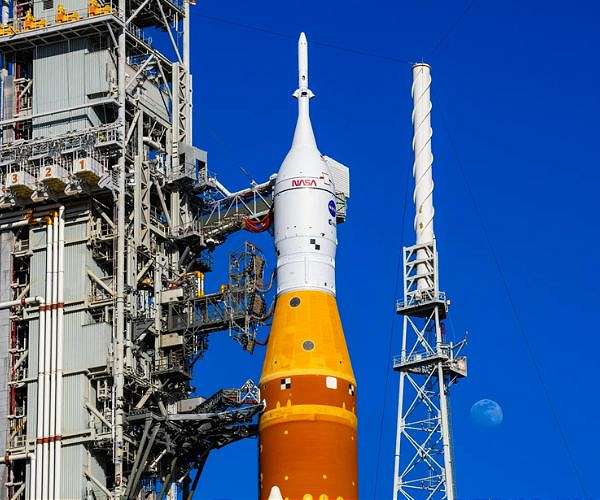
Earlier this week that mission faced another setback when NASA rolled back its towering SLS rocket and Orion spacecraft off the launchpad to investigate problems and make necessary repairs.

The announced changes mean that Artemis 3, which was meant to send astronauts to the Moon's surface, will now have the different test goal of "rendezvous in low-Earth orbit" of at least one lunar lander.

The next phase, Artemis 4, will aim for a lunar landing in early 2028. Isaacman said he hoped that mission could be followed relatively quickly by a second landing within the year.

"We're not necessarily committing to launching two missions in 2028," he told a briefing, "but we want to have the opportunity to be able to do that."

- 'Back to basics' -

The announcement comes two days after NASA's independent Aerospace Safety Advisory Panel said in its annual report that the Artemis 3 Moon landing plan carried "significant risk" including for the number of "firsts" it was attempting.

The NASA chief said Friday speeding up the cadence of Artemis launches would allow for building more institutional knowledge in the model of the Apollo program, which originally put Americans on the Moon.

"Mercury, Gemini, Apollo, through the shuttle program -- I don't think it would surprise many of the folks in the room that our average launch cadence was closer to three months throughout all those programs, not three years," he said. "We need to start getting back to basics and moving in this direction."

"Launching every three years, your skills atrophy, you lose muscle memory."

Scott Pace, director of the Space Policy Insistute, told AFP at first glance it seemed Isaacman was "making some realistic and necessary decisions."

But Clayton Swope of the Center for Strategic and International Studies told AFP it left him with "a lot of question marks," namely in terms of both the SLS rocket or the SpaceX landing system being ready according to NASA's timeline.

Still, with the revised architecture, "you will potentially be buying down some risk that we would have carried all the way to the Moon had we gone straight to the Moon with the original plan," he said.

- 'Space race'? -

During his first term President Donald Trump announced he wanted Americans to once again set foot on the lunar surface.

NASA hopes to put humans back on the Moon as China forges ahead with its own effort, which is targeting 2030 at the latest for a first crewed mission.

China's uncrewed Chang'e 7 mission is expected to be launched in 2026 for an exploration of the Moon's south pole, and testing of its crewed spacecraft Mengzhou is also set to go ahead this year.

Queried on the so-called "space race," Isaacman said Friday that "I think competition is good."

"We're here talking to you about what is a common-sense approach to achieve the objective, whether we had a great rival in the running or not."

But delays to space travel are not uncommon -- and could also stem from the progress of NASA's private partners.

SpaceX and Blue Origin, the respective space companies of dueling billionaires Elon Musk and Jeff Bezos, are contracted to develop lunar landers used in the Artemis program.

Both companies posted praise of NASA's plans on social media Friday.

"We're all in!" wrote Blue Origin on X, while SpaceX said it "shares the same goal as NASA of returning to the Moon with a permanent presence as expeditiously and safely as possible."

"Frequent human exploration flights help establish a sustainable presence for humans in space," SpaceX said.

mdo-cha/sms

ORION

Related Links
Space Tourism, Space Transport and Space Exploration News

Subscribe Free To Our Daily Newsletters
Tweet

RELATED CONTENT
The following news reports may link to other Space Media Network websites.
ASIA NEWS
Georgia takes out loan to purchase French air defense systems
Washington (UPI) Dec 30, 2015
Georgia lawmakers ratified a loan agreement outlining a $90 million loan from France to purchase air defense systems from the country. The loan, worth 82.82 million euros, was presented to the Georgia Parliament by the Georgia Ministry of Defense as part of their planned reforms for the country's armed forces and related programs. Agenda.ge reports the bulk of the loan will be used to purchase the air defense systems, while the remaining money will be used to fund other risk management e ... read more

ASIA NEWS
Texas AM partners with Aegis to orbit TAMU SPIRIT research hub on ISS

Sophie Adenot, the second French woman to fly to space

International crew arrives at space station

Regrowing marginal farmland can curb emissions without cutting food output

ASIA NEWS
Prometheus starts work on new Indiana solid rocket motor campus

NASA prepares Artemis II rocket for rollback after upper stage issue

Superconducting thruster cuts power and mass for space propulsion

Lithium trace in upper air linked to Falcon 9 rocket breakup

ASIA NEWS
Perseverance rover now self-locates precisely on Mars

Curiosity Blog, Sols 4798-4803: Back for More Science

Mars relay orbiter seen as backbone for future exploration

UAE extends Mars probe mission until 2028

ASIA NEWS
Dragon spacecraft gears up for crew 12 arrival and station science work

China prepares offshore test base for reusable liquid rocket launches

Retired EVA workhorse to guide China's next-gen spacesuit and lunar gear

Tiangong science program delivers data surge

ASIA NEWS
Infleqtion lists shares on NYSE as neutral atom quantum firm

AAC Clyde Space adds Sedna satellites to boost maritime data services

China tests AI satellite swarm for space-based computing

BlackSky expands Gen 3 Assured deals with new defense customer

ASIA NEWS
India chases 'DeepSeek moment' with homegrown AI models

Swift observatory changes operations ahead of planned orbit reboost

Pale Blue opens Tsukuba site to scale satellite propulsion production

AST SpaceMobile deploys record low orbit cellular array on BlueBird 6

ASIA NEWS
Cheops spots inside out exoplanet quartet

Study questions assumptions about hidden alien technosignals

Study revisits chances of detecting alien technosignatures

Hydrogen sulfide detected in distant gas giant exoplanets for the first time

ASIA NEWS
Simple collapse may build cosmic snowman worlds

Jupiter size refined by new radio mapping

Polar weather on Jupiter and Saturn hints at the planets' interior details

Europa ice delamination may deliver nutrients to hidden ocean


The content herein, unless otherwise known to be public domain, are Copyright 1995-2026 - SpaceDaily.com. All websites are published in Australia and are solely subject to Australian law and governed by Fair Use principals for news reporting and research purposes. AFP, UPI and IANS news wire stories are copyright Agence France-Presse, United Press International and Indo-Asia News Service. ESA news reports are copyright European Space Agency. All NASA sourced material is public domain. Additional copyrights may apply in whole or part to other bona fide parties. All articles labeled "by Staff Writers" include reports supplied to Space Media Network by industry news wires, PR agencies, corporate press officers and the like. Such articles are individually curated and edited by Space Media Network staff on the basis of the report's information value to our industry and professional readership. Advertising does not imply endorsement, agreement or approval of any opinions, statements or information provided by Space Media Network on any Web page published or hosted by Space Media Network. General Data Protection Regulation (GDPR) Statement Our advertisers use various cookies and the like to deliver the best ad banner available at one time. All network advertising suppliers have GDPR policies (Legitimate Interest) that conform with EU regulations for data collection. By using our websites you consent to cookie based advertising. If you do not agree with this then you must stop using the websites from May 25, 2018. Privacy Statement. Additional information can be found here at About Us.
Subscribe Free To Our Daily Newsletters