24/7 Space News
STELLAR CHEMISTRY
Dynamic terrain model boosts airborne gamma ray survey accuracy
illustration only

Dynamic terrain model boosts airborne gamma ray survey accuracy

by Clarence Oxford
Los Angeles CA (SPX) Feb 18, 2026

A research team led by Professor Hexi Wu and Dr Weicheng Li has developed a dynamic three dimensional terrain correction method that significantly improves the quantitative inversion accuracy of airborne gamma ray spectrometer surveys. The approach combines a novel sourceless efficiency calibration technique with a flight path based terrain model to tackle long standing challenges caused by overlapping measurement areas and rapidly varying topography.

Deep penetration effects are a major source of uncertainty in airborne gamma ray spectrometry because gamma rays can travel long distances through air and interact with detectors at a wide range of incident angles. To address this, the team designed a fast sourceless efficiency calibration algorithm that uses Geant4 based ray deposition modeling and Boolean operations to simulate how gamma rays deposit energy in the detector. By capturing intrinsic efficiency variations with incident direction, the method provides a more realistic detector response model without relying on physical calibration sources.

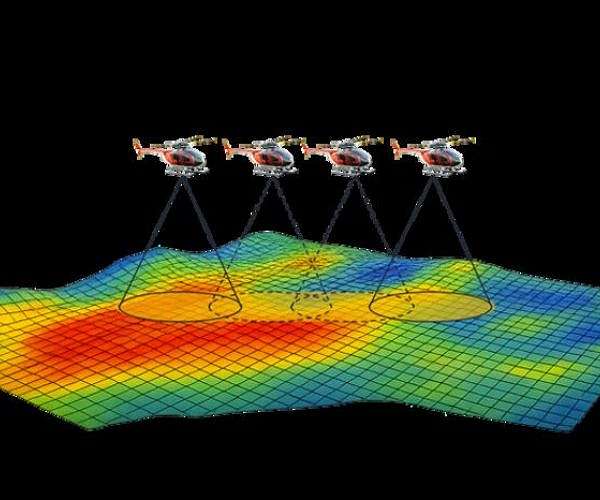
Traditional correction schemes often treat the survey area with uniform assumptions or simple two dimensional approximations. In contrast, the new method constructs a fully three dimensional terrain correction model dynamically along the aircraft flight path, allowing the inversion process to respond to real time changes in terrain height and surface geometry. This dynamic response matrix improves the stability of inversion results and reduces systematic bias in quantitative estimates of ground radioelement distributions.

Comparative experiments reported by the researchers show that the dynamic terrain correction approach outperforms conventional altitude based corrections, especially in mountainous and undulating regions where terrain effects are strongest. By better accounting for overlapping fields of view and changing detector geometry relative to the ground, the method yields more spatially consistent results across flight lines. The improved performance is particularly evident in tests of equivalent uranium content inversion, where dynamic terrain correction produces distributions that more closely match ground measurements.

Accurate airborne mapping of natural radionuclides such as potassium, uranium and thorium is essential for geological mapping, mineral resource exploration and environmental baseline studies. The higher quantitative reliability achieved with the combined sourceless calibration and dynamic terrain modeling approach supports clearer anomaly delineation and more robust interpretation of radiometric data. This is especially important in complex landscapes where conventional corrections can introduce artifacts or mask subtle geological signals.

The research team is now focusing on refining theoretical models of airborne gamma ray measurements and radiation field inversion under increasingly complex radiation environments. Their goal is to further enhance the adaptability of airborne gamma ray spectrometry for diverse survey conditions, including variable flight geometries and heterogeneous geological settings. Professor Hexi Wu commented that "This study further enhances the practical applicability of airborne gamma-ray measurements and represents a key step toward accurate quantitative analysis."

Research Report:Research on dynamic three dimensional terrain correction methods of quantitative inversion for airborne gamma ray spectrometer

Related Links
SINAP - Nuclear Science and Techniques
Stellar Chemistry, The Universe And All Within It

Subscribe Free To Our Daily Newsletters
Tweet

RELATED CONTENT
The following news reports may link to other Space Media Network websites.
STELLAR CHEMISTRY
Swift observatory changes operations ahead of planned orbit reboost
Los Angeles CA (SPX) Feb 16, 2026
NASA has adjusted operations of the Neil Gehrels Swift Observatory to reduce atmospheric drag and prepare the spacecraft for a planned orbit-raising mission. On Feb. 11 the mission team temporarily suspended most science activities so controllers can keep the satellite in an orientation that minimizes drag and slows its gradual loss of altitude. Swift normally slews rapidly to observe transient targets such as gamma ray bursts with its suite of telescopes. Principal investigator S. Bradley Cenko a ... read more

STELLAR CHEMISTRY
Texas AM partners with Aegis to orbit TAMU SPIRIT research hub on ISS

Sophie Adenot, the second French woman to fly to space

International crew arrives at space station

Chinese visitors to Japan slump as spat rumbles on

STELLAR CHEMISTRY
Russian era ends at abandoned launchpad in South American jungle

NASA teams set for second Artemis II wet dress rehearsal

Vietnam licenses Musk's satellite internet firm Starlink

Latvian startup advances nuclear-fueled power for satellites and future Moon missions

STELLAR CHEMISTRY
Curiosity Blog, Sols 4798-4803: Back for More Science

Mars relay orbiter seen as backbone for future exploration

UAE extends Mars probe mission until 2028

Mars' 'Young' Volcanoes Were More Complex Than Scientists Once Thought

STELLAR CHEMISTRY
Dragon spacecraft gears up for crew 12 arrival and station science work

China prepares offshore test base for reusable liquid rocket launches

Retired EVA workhorse to guide China's next-gen spacesuit and lunar gear

Tiangong science program delivers data surge

STELLAR CHEMISTRY
Hidden Legal Infrastructure Behind Commercial Space Industry

AAC Clyde Space adds Sedna satellites to boost maritime data services

China tests AI satellite swarm for space-based computing

BlackSky expands Gen 3 Assured deals with new defense customer

STELLAR CHEMISTRY
ST Engineering iDirect and G&S SatCom align network and service management on Intuition

Light based computing module aims to cut AI power demand

KSAT prepares Hyperion in orbit relay test for satellite data

Pale Blue opens Tsukuba site to scale satellite propulsion production

STELLAR CHEMISTRY
Hydrogen sulfide detected in distant gas giant exoplanets for the first time

Cheops spots inside out exoplanet quartet

Study revisits chances of detecting alien technosignatures

Engineered microbes use light to build new molecules

STELLAR CHEMISTRY
Jupiter size refined by new radio mapping

Polar weather on Jupiter and Saturn hints at the planets' interior details

Europa ice delamination may deliver nutrients to hidden ocean

Birth conditions fixed water contrast on Jupiters moons

Subscribe Free To Our Daily Newsletters


The content herein, unless otherwise known to be public domain, are Copyright 1995-2024 - Space Media Network. All websites are published in Australia and are solely subject to Australian law and governed by Fair Use principals for news reporting and research purposes. AFP, UPI and IANS news wire stories are copyright Agence France-Presse, United Press International and Indo-Asia News Service. ESA news reports are copyright European Space Agency. All NASA sourced material is public domain. Additional copyrights may apply in whole or part to other bona fide parties. All articles labeled "by Staff Writers" include reports supplied to Space Media Network by industry news wires, PR agencies, corporate press officers and the like. Such articles are individually curated and edited by Space Media Network staff on the basis of the report's information value to our industry and professional readership. Advertising does not imply endorsement, agreement or approval of any opinions, statements or information provided by Space Media Network on any Web page published or hosted by Space Media Network. General Data Protection Regulation (GDPR) Statement Our advertisers use various cookies and the like to deliver the best ad banner available at one time. All network advertising suppliers have GDPR policies (Legitimate Interest) that conform with EU regulations for data collection. By using our websites you consent to cookie based advertising. If you do not agree with this then you must stop using the websites from May 25, 2018. Privacy Statement. Additional information can be found here at About Us.