24/7 Space News
MARSDAILY
Perseverance rover now self-locates precisely on Mars
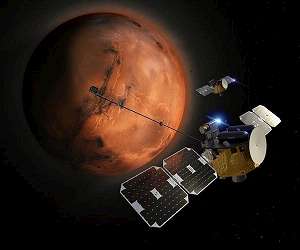
illustration only

Perseverance rover now self-locates precisely on Mars

by Silas Korrin
New York (SDX) Feb 23, 2026

NASA's Perseverance rover can now determine its exact position on Mars without relying on ground teams, using a new system called Mars Global Localization that compares navigation camera panoramas to orbital terrain maps. Running on a powerful processor originally dedicated to the Ingenuity Mars Helicopter, the algorithm can pinpoint the rover's location to within about 25 centimeters in roughly two minutes and was first used in routine operations on Feb. 2 and Feb. 16, 2026.

Until this upgrade, Perseverance depended on a combination of inertial measurements and visual odometry to track its movements, with operators on Earth periodically correcting its position based on orbital imagery. Over long drives, tiny errors accumulated so that the rover could be off by more than 35 meters, forcing it to halt early when it judged that it might be too close to hazardous terrain and wait for updated instructions. With Mars Global Localization, the rover can now stop, autonomously match a newly acquired 360 degree panorama to maps from Mars Reconnaissance Orbiter, and then continue along a preplanned route without waiting for human confirmation.

Mission engineers describe the new capability as the rough equivalent of providing the rover with GPS on a planet that has no satellite navigation network. Vandi Verma, chief engineer of robotics operations at NASA's Jet Propulsion Laboratory, said the system means Perseverance can drive much longer distances autonomously, allowing the mission to explore more terrain and gather more science while reducing demands on the ground team. The technology is designed to be adaptable to other rovers that need to travel quickly and over large distances on Mars or other worlds.

Mars Global Localization builds on Perseverance's AutoNav self-driving system, which already enables the rover to re-plan routes around obstacles on the way to a designated destination. In practice, AutoNav's performance has been limited less by onboard path-planning and more by uncertainties in the rover's absolute position. By removing that constraint, the new localization process allows the team to command drives of effectively unlimited length between communication sessions, provided terrain and power considerations allow.

The algorithm's orbital matching requires more computing power than Perseverance's two main radiation-hardened computers can efficiently provide, so engineers turned to the Helicopter Base Station mounted on the rover. That unit, used as a radio relay for the Ingenuity Mars Helicopter, carries a commercial processor similar to those in mid-2010s smartphones and runs more than 100 times faster than the rover's primary avionics. Ingenuity flew 72 times instead of its originally planned five, demonstrating that commercial processors can survive and function effectively in the Martian environment and inspiring engineers to reuse the hardware for surface navigation.

To ensure reliability when using the commercial processor, the team implemented a "sanity check" process in which the localization algorithm runs multiple times on the Helicopter Base Station before one of the main computers verifies the consistency of the results. During development, engineers discovered that a small region of memory equivalent to about 25 bits in the processor's 1 gigabyte had been damaged, causing a consistent 1 millimeter error in the reported position. They responded by isolating those bits from use while the algorithm runs, restoring accurate performance.

The Mars Global Localization system was validated with a campaign that began in 2023, using data from 264 previous rover stops to test its accuracy. For each stop, the algorithm matched rover panoramas to Mars Reconnaissance Orbiter images and successfully recovered the rover's true position. Jeremy Nash, the JPL robotics engineer who led the implementation under Verma's supervision, noted that global localization has been an open problem in robotics for decades and called the deployment of the solution on Mars a first in space exploration.

Mars Global Localization complements another recent software enhancement on Perseverance that applies generative artificial intelligence to drive planning. In that earlier upgrade, an AI system selected waypoints for the rover's route, a task traditionally handled by human planners, similarly intended to increase daily drive distances and reduce the workload on operators. Together, the AI waypoint planning and the new localization capability are intended to help Perseverance cover more ground, more quickly, as it continues its campaign to explore Jezero Crater and collect samples for possible return to Earth.

The team expects that techniques developed for Mars Global Localization, including robust image matching and error checking on commercial processors, will prove useful for future missions. Engineers are already looking toward applications on the Moon, where extreme lighting conditions, long nights, and rugged terrain will make accurate, independent navigation critically important for both robotic and crewed vehicles. As more missions adopt faster commercial-grade computing hardware, the experience gained with Perseverance may guide designs that balance performance with the need for fault detection and mitigation in harsh space environments.

Related Links
Mars Global Localization - PDF Primer
Mars News and Information at MarsDaily.com
Lunar Dreams and more

Subscribe Free To Our Daily Newsletters
Tweet

RELATED CONTENT
The following news reports may link to other Space Media Network websites.
MARSDAILY
Perseverance rover completes landmark AI guided trek across Jezero rim
Los Angeles CA (SPX) Feb 06, 2026
NASA's Perseverance Mars rover has completed the first AI planned drives ever carried out on another planet, using a vision capable generative AI system to map out safe routes across the rim of Jezero Crater without human route planners intervening in the usual way. The demonstration, run on Dec 8 and Dec 10, 2025, used generative AI to create waypoints for the six wheeled rover, taking over a complex decision making task that mission teams have traditionally handled manually at NASA's Jet Propuls ... read more

MARSDAILY
Texas AM partners with Aegis to orbit TAMU SPIRIT research hub on ISS

Sophie Adenot, the second French woman to fly to space

International crew arrives at space station

Chinese visitors to Japan slump as spat rumbles on

MARSDAILY
Russian era ends at abandoned launchpad in South American jungle

NASA teams set for second Artemis II wet dress rehearsal

Vietnam licenses Musk's satellite internet firm Starlink

Latvian startup advances nuclear-fueled power for satellites and future Moon missions

MARSDAILY
Curiosity Blog, Sols 4798-4803: Back for More Science

Mars relay orbiter seen as backbone for future exploration

UAE extends Mars probe mission until 2028

Mars' 'Young' Volcanoes Were More Complex Than Scientists Once Thought

MARSDAILY
Dragon spacecraft gears up for crew 12 arrival and station science work

China prepares offshore test base for reusable liquid rocket launches

Retired EVA workhorse to guide China's next-gen spacesuit and lunar gear

Tiangong science program delivers data surge

MARSDAILY
AAC Clyde Space adds Sedna satellites to boost maritime data services

China tests AI satellite swarm for space-based computing

BlackSky expands Gen 3 Assured deals with new defense customer

Muon Space ramps up multi-mission satellite constellations

MARSDAILY
ST Engineering iDirect and G&S SatCom align network and service management on Intuition

Light based computing module aims to cut AI power demand

KSAT prepares Hyperion in orbit relay test for satellite data

Pale Blue opens Tsukuba site to scale satellite propulsion production

MARSDAILY
Hydrogen sulfide detected in distant gas giant exoplanets for the first time

Cheops spots inside out exoplanet quartet

Study revisits chances of detecting alien technosignatures

Engineered microbes use light to build new molecules

MARSDAILY
Jupiter size refined by new radio mapping

Polar weather on Jupiter and Saturn hints at the planets' interior details

Europa ice delamination may deliver nutrients to hidden ocean

Birth conditions fixed water contrast on Jupiters moons

Subscribe Free To Our Daily Newsletters


The content herein, unless otherwise known to be public domain, are Copyright 1995-2024 - Space Media Network. All websites are published in Australia and are solely subject to Australian law and governed by Fair Use principals for news reporting and research purposes. AFP, UPI and IANS news wire stories are copyright Agence France-Presse, United Press International and Indo-Asia News Service. ESA news reports are copyright European Space Agency. All NASA sourced material is public domain. Additional copyrights may apply in whole or part to other bona fide parties. All articles labeled "by Staff Writers" include reports supplied to Space Media Network by industry news wires, PR agencies, corporate press officers and the like. Such articles are individually curated and edited by Space Media Network staff on the basis of the report's information value to our industry and professional readership. Advertising does not imply endorsement, agreement or approval of any opinions, statements or information provided by Space Media Network on any Web page published or hosted by Space Media Network. General Data Protection Regulation (GDPR) Statement Our advertisers use various cookies and the like to deliver the best ad banner available at one time. All network advertising suppliers have GDPR policies (Legitimate Interest) that conform with EU regulations for data collection. By using our websites you consent to cookie based advertising. If you do not agree with this then you must stop using the websites from May 25, 2018. Privacy Statement. Additional information can be found here at About Us.