24/7 Space News
TECH SPACE
KSAT prepares Hyperion in orbit relay test for satellite data
illustration only

KSAT prepares Hyperion in orbit relay test for satellite data

by Robert Schreiber
Berlin, Germany (SPX) Feb 18, 2026
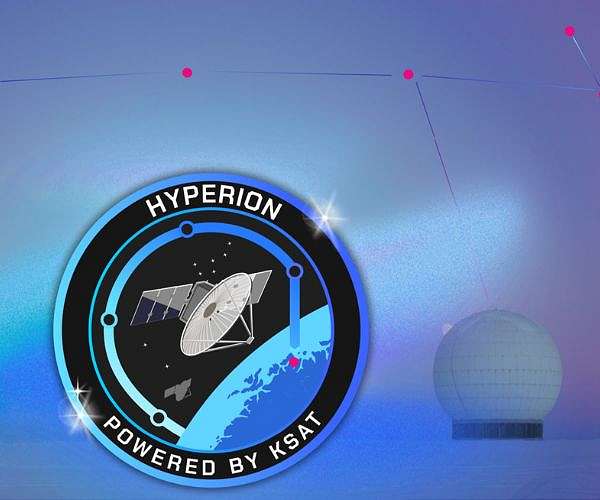
Hyperion will move KSATs HYPER concept from design into on orbit demonstration, using relay satellites to act as ground stations in space and shorten the time it takes operators to receive satellite data when speed is critical.

Announced at the SmallSat Symposium in Silicon Valley, the Hyperion mission will extend KSATs global ground network into low Earth orbit and test how an in orbit relay layer can cut latency and increase contact opportunities for customer spacecraft.

HYPER is KSATs answer to growing demand for faster and more resilient satellite data access, adding a space based relay segment that complements the companys existing network of several hundred antennas at more than 40 sites worldwide.

Customers already flying with KSATlite will be able to interface with HYPER through familiar systems, since satellites compatible with KSATlite will also be compatible with the new relay service.

The Hyperion satellites will validate the core functions of HYPER by transmitting to and receiving data from customer spacecraft, relaying that data through the Hyperion system, and exercising inter satellite links within the overall architecture.

The mission will also verify end to end data flow from a customer satellite, through Hyperion, and down to ground in near real time, while showing that the in orbit layer can slot into existing ground infrastructure and mission operations workflows.

Each Hyperion spacecraft will support S band links for telemetry, tracking and command, and Ka band for high throughput payload data, mirroring the service model customers know from KSATlite while adding additional resilience via space based routing.

KSAT plans to deploy Hyperion on high performing satellites of around 300 kilograms, providing the power, pointing agility and communications capacity needed to demonstrate the full HYPER concept at operationally relevant scale.

The company notes that 2026 marks ten years of KSATlite operations, and positions HYPER as the next stage in automating and hardening ground segment services for an increasingly crowded and demanding orbital environment.

HYPER will draw on the full KSAT global ground network as its backbone, using established sites in locations such as Svalbard and Antarctica to close the loop between space based relays and terrestrial downlink stations.

In describing the mission, Arnulf Kjeldsen, EVP Strategy and Technology at KSAT, said that in an increasingly complex operational environment, resilience and speed are as important as coverage, and that Hyperion is a key step in proving how HYPER can strengthen secure data delivery and give customers more control over when and where their data reaches the ground.

Hyperion will host multiple customer demonstrations and early testing campaigns so operators can explore how low latency relay services might enhance their missions and prepare for onboarding to the full commercial HYPER offering.

KSAT has signed a launch contract for the first Hyperion satellites and is targeting initial deployment in late 2027, paving the way for an operational in orbit relay service that sits on top of its established ground network.

Related Links
Kongsberg Satellite Services
Space Technology News - Applications and Research

Subscribe Free To Our Daily Newsletters
Tweet

RELATED CONTENT
TECH SPACE
Mohe ground station boosts polar satellite data coverage
Beijing, China (SPX) Feb 16, 2026
For engineer Shi Shengpu and his colleagues, this Spring Festival will be their first spent at the Mohe Satellite Data Receiving Station of the China Remote Sensing Satellite Ground Station, which began operations on Dec 12 in Mohe, China's northernmost city in Heilongjiang province. Developed by the Aerospace Information Research Institute of the Chinese Academy of Sciences, the Mohe facility is the country's highest latitude satellite data receiving station and marks a major step forward in nati ... read more

TECH SPACE
Texas AM partners with Aegis to orbit TAMU SPIRIT research hub on ISS

Sophie Adenot, the second French woman to fly to space

International crew arrives at space station

Chinese visitors to Japan slump as spat rumbles on

TECH SPACE
Russian era ends at abandoned launchpad in South American jungle

NASA teams set for second Artemis II wet dress rehearsal

Vietnam licenses Musk's satellite internet firm Starlink

Latvian startup advances nuclear-fueled power for satellites and future Moon missions

TECH SPACE
Curiosity Blog, Sols 4798-4803: Back for More Science

Mars relay orbiter seen as backbone for future exploration

UAE extends Mars probe mission until 2028

Mars' 'Young' Volcanoes Were More Complex Than Scientists Once Thought

TECH SPACE
Dragon spacecraft gears up for crew 12 arrival and station science work

China prepares offshore test base for reusable liquid rocket launches

Retired EVA workhorse to guide China's next-gen spacesuit and lunar gear

Tiangong science program delivers data surge

TECH SPACE
AAC Clyde Space adds Sedna satellites to boost maritime data services

China tests AI satellite swarm for space-based computing

BlackSky expands Gen 3 Assured deals with new defense customer

Muon Space ramps up multi-mission satellite constellations

TECH SPACE
ST Engineering iDirect and G&S SatCom align network and service management on Intuition

Light based computing module aims to cut AI power demand

KSAT prepares Hyperion in orbit relay test for satellite data

Pale Blue opens Tsukuba site to scale satellite propulsion production

TECH SPACE
Hydrogen sulfide detected in distant gas giant exoplanets for the first time

Cheops spots inside out exoplanet quartet

Study revisits chances of detecting alien technosignatures

Engineered microbes use light to build new molecules

TECH SPACE
Jupiter size refined by new radio mapping

Polar weather on Jupiter and Saturn hints at the planets' interior details

Europa ice delamination may deliver nutrients to hidden ocean

Birth conditions fixed water contrast on Jupiters moons


The content herein, unless otherwise known to be public domain, are Copyright 1995-2026 - SpaceDaily.com. All websites are published in Australia and are solely subject to Australian law and governed by Fair Use principals for news reporting and research purposes. AFP, UPI and IANS news wire stories are copyright Agence France-Presse, United Press International and Indo-Asia News Service. ESA news reports are copyright European Space Agency. All NASA sourced material is public domain. Additional copyrights may apply in whole or part to other bona fide parties. All articles labeled "by Staff Writers" include reports supplied to Space Media Network by industry news wires, PR agencies, corporate press officers and the like. Such articles are individually curated and edited by Space Media Network staff on the basis of the report's information value to our industry and professional readership. Advertising does not imply endorsement, agreement or approval of any opinions, statements or information provided by Space Media Network on any Web page published or hosted by Space Media Network. General Data Protection Regulation (GDPR) Statement Our advertisers use various cookies and the like to deliver the best ad banner available at one time. All network advertising suppliers have GDPR policies (Legitimate Interest) that conform with EU regulations for data collection. By using our websites you consent to cookie based advertising. If you do not agree with this then you must stop using the websites from May 25, 2018. Privacy Statement. Additional information can be found here at About Us.
Subscribe Free To Our Daily Newsletters