





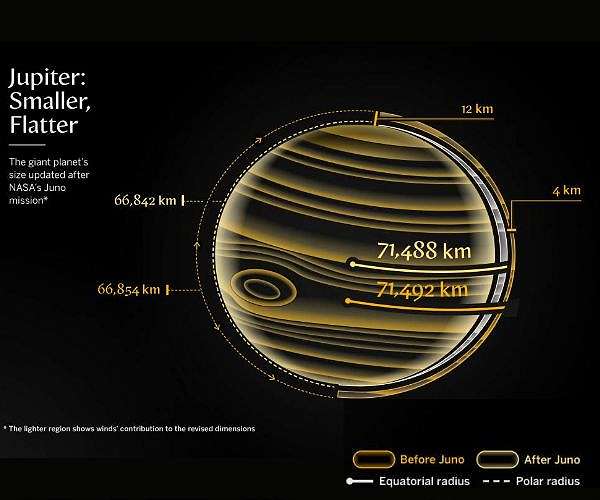
The study, published in Nature Astronomy, replaces six measurements from NASA's Voyager and Pioneer missions with 26 carefully analyzed passes by Juno. Those earlier flybys sent radio beams between the spacecraft and Earth to infer Jupiter's outline, but they left several open questions about the planet's exact dimensions and internal structure that have persisted for decades.
"Just by knowing the distance to Jupiter and watching how it rotates, it is possible to figure out its size and shape," says Prof. Yohai Kaspi of Weizmann's Earth and Planetary Sciences Department. "But making really accurate measurements calls for more sophisticated methods." The Juno extension approved in 2021, which placed the spacecraft on a new trajectory, provided exactly that opportunity.
As Juno's orbit was adjusted, it began passing behind Jupiter from Earth's perspective, causing its radio signal to be blocked and bent by the planet's atmosphere. "Juno's passing behind Jupiter provides an opportunity for new science objectives. When the spacecraft passes behind the planet, its radio communication signal is blocked and bent by Jupiter's atmosphere. This enables an accurate measurement of Jupiter's size," says Juno Principal Investigator Dr. Scott J. Bolton of the Southwest Research Institute in San Antonio, Texas.
The Weizmann group, led by senior staff scientist Dr. Eli Galanti, took the lead in converting these occultation events into a refined global figure for the planet. "Jupiter's shape, as understood until now, was derived by researchers from just six measurements made almost five decades ago by NASA's Voyager and Pioneer missions, which sent radio beams from the spacecraft to Earth," Galanti explains. "Those missions provided a foundation, but now we got the rare opportunity to spearhead the analysis of as many as 26 new measurements made by NASA's Juno spacecraft."
Team member and PhD student Maria Smirnova developed a specialized technique to process the new Juno radio data. By tracking how the signals bent as they passed through layers of Jupiter's atmosphere, the researchers reconstructed detailed temperature and density profiles and, from these, the most accurate map so far of the planet's overall size and shape.
The results show that Jupiter is slightly smaller and more flattened than earlier estimates suggested. The new analysis indicates that the planet's equatorial diameter is about 8 kilometers less than before, while the polar diameter is about 24 kilometers smaller, making the difference between equator and poles larger than previously calculated. "Textbooks will need to be updated," Kaspi says. "The size of Jupiter has not changed, of course, but the way we measure it has."
Although a few kilometers sound minor for a planet more than 140,000 kilometers wide, the adjustment significantly improves the fit between theory and observation. "These few kilometers matter," Galanti notes. "Shifting the radius by just a little lets our models of Jupiter's interior fit both the gravity data and atmospheric measurements much better." Using advanced interior density models, PhD student Maayan Ziv tested how the updated shape brings simulated interiors into closer agreement with measurements.
Jupiter serves as a benchmark for gas giants across the Solar System and exoplanet systems, so the improved profile has implications beyond a single world. A more accurate match between the observed gravity field, atmospheric structure and planet shape feeds directly into models of how gas giants form, cool and transport heat and material in their deep interiors.
The new work also corrects a long-standing oversight in earlier shape determinations: the effect of Jupiter's powerful winds. Those earlier analyses effectively treated the atmosphere as if it were static, but the Weizmann team explicitly accounted for the influence of strong zonal winds and giant storms on the planet's figure. "It is difficult to see what is happening beneath the clouds of Jupiter, but the radio data give us a window into the depth of Jupiter's zonal winds and powerful hurricanes," Kaspi explains.
That wind-focused effort connects directly to a recent study by Kaspi and former group member Dr. Nimrod Gavriel on Jupiter's immense polar cyclones. Using Juno observations of the cyclones' motion, they estimated how far these coherent structures extend into the planet's interior. Their predictions were recently confirmed by microwave measurements from Juno, reinforcing the picture that atmospheric dynamics and interior structure are tightly coupled.
From a broader perspective, the refined shape and wind profiles help scientists understand how Jupiter's rapid rotation, internal layering and atmospheric circulation work together. The updated measurements show that Jupiter's equatorial radius is roughly 7 percent greater than its polar radius, while Earth's equatorial radius exceeds its polar radius by only about 0.33 percent. In practical terms, Jupiter is about 20 times more flattened than Earth, a consequence of its fast spin, gaseous composition and complex internal dynamics.
"This research helps us understand how planets form and evolve," Kaspi says. Jupiter probably formed first among the Solar System's planets, and its internal structure preserves clues about the early distribution of gas and solids in the disk that surrounded the young Sun. "By studying what is happening inside it, we get closer to understanding how the solar system, and planets like ours, came to be."
The methods pioneered in the new study will not be limited to Jupiter. The team plans to apply similar techniques as data arrive from the European Space Agency's JUICE mission, launched in 2023 to explore the Jovian system in detail. JUICE carries a Weizmann-designed instrument that will probe the giant planet's atmosphere more deeply, offering fresh opportunities to tie together radio occultations, gravity fields and atmospheric structures on a wider range of worlds.
The research involved collaborators from universities and institutes in Italy, the United States, France and Switzerland, including the University of Bologna, NASA's Jet Propulsion Laboratory at the California Institute of Technology, the University of Arizona, the University of California at Berkeley, the Observatoire de la Cote d'Azur, the University of Zurich, the Georgia Institute of Technology and Boston University. Kaspi's work is supported by the Helen Kimmel Center for Planetary Science, the Knell Family Institute of Artificial Intelligence and the Brenden-Mann Women's Innovation Impact Fund.
Related Links
Weizmann Institute of Science
The million outer planets of a star called Sol
| Subscribe Free To Our Daily Newsletters |
| Subscribe Free To Our Daily Newsletters |







