24/7 Space News
ROCKET SCIENCE
Superconducting thruster cuts power and mass for space propulsion
illustration only

Superconducting thruster cuts power and mass for space propulsion

by Riko Seibo
Singapore (SDX) Feb 25, 2026

Small satellites have become attractive for space missions because they offer low cost and flexibility, but their growth has been limited by the lack of compact, efficient propulsion systems that work well in the vacuum of space. In orbit, spacecraft can only change their motion through reaction force, and traditional chemical rockets produce thrust by burning fuel to generate high temperature gases that are expelled at high speed. This approach is highly inefficient, with more than 90 percent of a rocket's launch mass often devoted to propellant, which restricts payload capacity and drives up mission costs.

Electric propulsion offers a different path by acting like a space electric vehicle that uses electrical energy to accelerate charged particles, or plasma, to generate thrust. By relying on electromagnetic forces rather than chemical energy release, electric propulsion systems can achieve much higher efficiency than conventional chemical engines and can sustain thrust over longer periods. That makes them especially attractive for deep space missions, orbit raising, and station keeping for advanced satellite constellations, where propellant savings translate directly into longer mission lifetimes and reduced launch mass.

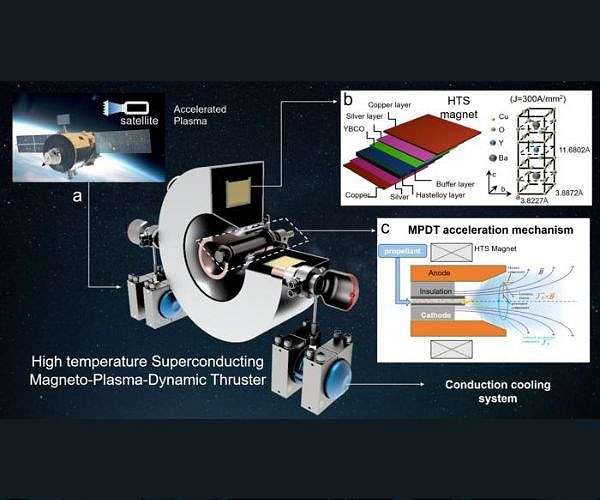
Within electric propulsion, magnetoplasmadynamic thrusters, or MPDTs, stand out as a high performance option that uses strong magnetic fields interacting with electric currents to accelerate plasma to extremely high velocities. In simple terms, an MPDT functions like a space electromagnetic cannon that directs and accelerates hot plasma using magnetic fields, delivering propulsion efficiency eight to ten times higher than traditional chemical rockets. However, conventional MPDTs depend on massive copper electromagnetic coils that are typically heavier than 150 kilograms and draw 200 to 300 kilowatts of power, comparable to the electricity consumption of a small community, which makes them difficult to integrate on miniature spacecraft platforms.

A research team led by Professor Jinxing Zheng at the Institute of Plasma Physics, Hefei Institute of Physical Sciences, Chinese Academy of Sciences, has now reported a major advance by developing China's first compact high temperature superconducting magnetoplasmadynamic thruster. The team replaced the bulky, energy intensive copper coils with YBCO superconducting material that operates at liquid nitrogen temperatures of about minus 196 degrees Celsius. This change allowed them to cut power consumption from 285 kilowatts to less than 1 kilowatt and reduce system mass from 220 kilograms to 60 kilograms, enabling lighter and more affordable satellite propulsion systems that place less demand on on board power supplies.

According to the authors, these reductions in mass and power open the way for small and medium satellites to carry a powerful, efficient propulsion heart without the penalty of oversized electrical systems and heavy structures. Lighter propulsion hardware and lower power draw can ease spacecraft thermal management, simplify system integration, and support more flexible mission profiles. The work, published in the journal National Science Review under the title "High performance in high-temperature superconducting MPD thrusters: Analytical MHD modeling and experimental demonstration," highlights how high temperature superconductors can solve long standing bottlenecks for advanced electric propulsion.

Experimental results from the new thruster show that it achieved a specific impulse of 3,265 seconds with an input power of 12 kilowatts, indicating that it can deliver sustained thrust with very low propellant consumption. For comparison, typical chemical rockets offer specific impulses of about 300 seconds, so the superconducting MPDT provides an order of magnitude improvement in propellant efficiency. This performance can sharply reduce fuel requirements and launch costs for spacecraft, especially for missions that require large velocity changes or extended operational lifetimes.

Beyond the hardware demonstration, the research team established a comprehensive analytical magnetohydrodynamic model that links magnetic field strength, mass flow rate, and thrust performance in the high temperature superconducting MPDT. The model provides a detailed description of how plasma behavior and electromagnetic forces work together inside the thruster channel, and it offers a predictive tool to guide future design optimization. By accurately capturing the interplay between operating parameters and performance, the model can help engineers tailor thrusters to specific mission requirements and spacecraft constraints.

The breakthrough indicates that future spacecraft equipped with high temperature superconducting MPDTs could meet mission objectives with significantly lower propellant mass and reduced overall system weight. That capability could support more ambitious deep space exploration, enable agile maneuvering for satellite constellations, and lower barriers to entry for emerging space actors. As high temperature superconducting materials and cryogenic support technologies continue to mature, compact superconducting thrusters may become a key component of next generation, high efficiency space transportation architectures.

Research Report:High performance in high-temperature superconducting MPD thrusters: Analytical MHD modeling and experimental demonstration

Related Links
Hefei Institute of Physical Sciences
Rocket Science News at Space-Travel.Com

Subscribe Free To Our Daily Newsletters
Tweet

RELATED CONTENT
The following news reports may link to other Space Media Network websites.
ROCKET SCIENCE
Hypersonica completes milestone hypersonic missile flight test in Norway
Los Angeles CA (SPX) Feb 17, 2026
Hypersonica has completed its first hypersonic test flight at Andoya Space in Norway, marking what the company describes as a major step toward a European sovereign hypersonic strike capability by 2029. The Anglo-German defense and aerospace company reported that its missile prototype accelerated to speeds above Mach 6 and flew more than 300 kilometers during the mission. All systems performed nominally during ascent and on the vehicle's high-speed descent through the atmosphere, and engineers val ... read more

ROCKET SCIENCE
Texas AM partners with Aegis to orbit TAMU SPIRIT research hub on ISS

Sophie Adenot, the second French woman to fly to space

International crew arrives at space station

Regrowing marginal farmland can curb emissions without cutting food output

ROCKET SCIENCE
Prometheus starts work on new Indiana solid rocket motor campus

NASA prepares Artemis II rocket for rollback after upper stage issue

Lithium trace in upper air linked to Falcon 9 rocket breakup

NASA delivers harsh assessment of botched Boeing Starliner test flight

ROCKET SCIENCE
Perseverance rover now self-locates precisely on Mars

Curiosity Blog, Sols 4798-4803: Back for More Science

Mars relay orbiter seen as backbone for future exploration

UAE extends Mars probe mission until 2028

ROCKET SCIENCE
Dragon spacecraft gears up for crew 12 arrival and station science work

China prepares offshore test base for reusable liquid rocket launches

Retired EVA workhorse to guide China's next-gen spacesuit and lunar gear

Tiangong science program delivers data surge

ROCKET SCIENCE
Infleqtion lists shares on NYSE as neutral atom quantum firm

AAC Clyde Space adds Sedna satellites to boost maritime data services

China tests AI satellite swarm for space-based computing

BlackSky expands Gen 3 Assured deals with new defense customer

ROCKET SCIENCE
India chases 'DeepSeek moment' with homegrown AI models

Swift observatory changes operations ahead of planned orbit reboost

Pale Blue opens Tsukuba site to scale satellite propulsion production

AST SpaceMobile deploys record low orbit cellular array on BlueBird 6

ROCKET SCIENCE
Cheops spots inside out exoplanet quartet

Study questions assumptions about hidden alien technosignals

Study revisits chances of detecting alien technosignatures

Hydrogen sulfide detected in distant gas giant exoplanets for the first time

ROCKET SCIENCE
Simple collapse may build cosmic snowman worlds

Jupiter size refined by new radio mapping

Polar weather on Jupiter and Saturn hints at the planets' interior details

Europa ice delamination may deliver nutrients to hidden ocean

Subscribe Free To Our Daily Newsletters


The content herein, unless otherwise known to be public domain, are Copyright 1995-2024 - Space Media Network. All websites are published in Australia and are solely subject to Australian law and governed by Fair Use principals for news reporting and research purposes. AFP, UPI and IANS news wire stories are copyright Agence France-Presse, United Press International and Indo-Asia News Service. ESA news reports are copyright European Space Agency. All NASA sourced material is public domain. Additional copyrights may apply in whole or part to other bona fide parties. All articles labeled "by Staff Writers" include reports supplied to Space Media Network by industry news wires, PR agencies, corporate press officers and the like. Such articles are individually curated and edited by Space Media Network staff on the basis of the report's information value to our industry and professional readership. Advertising does not imply endorsement, agreement or approval of any opinions, statements or information provided by Space Media Network on any Web page published or hosted by Space Media Network. General Data Protection Regulation (GDPR) Statement Our advertisers use various cookies and the like to deliver the best ad banner available at one time. All network advertising suppliers have GDPR policies (Legitimate Interest) that conform with EU regulations for data collection. By using our websites you consent to cookie based advertising. If you do not agree with this then you must stop using the websites from May 25, 2018. Privacy Statement. Additional information can be found here at About Us.