24/7 Space News
MARSDAILY
Curiosity Blog, Sols 4798-4803: Back for More Science
illustration only

Curiosity Blog, Sols 4798-4803: Back for More Science

by Michelle Minitti | MAHLI Deputy Principal Investigator
Pasadena CA (JPL) Feb 17, 2026

The results from our first visit to the "Nevado Sajama" drill location were intriguing enough to motivate our return to do a deeper dive into the minerals and compounds locked in this rock with SAM (the Sample Analysis at Mars instrument suite).

As explained in the last blog, that deeper dive involves using the second of two vials of a chemical reagent, tetramethylammonium hydroxide (TMAH), that helps makes molecules detectable to SAM that would otherwise be undetectable. This week was focused on completing the many carefully-coordinated steps to apply the TMAH reagent to the rock powder from a drill hole and then analyze the treated sample.

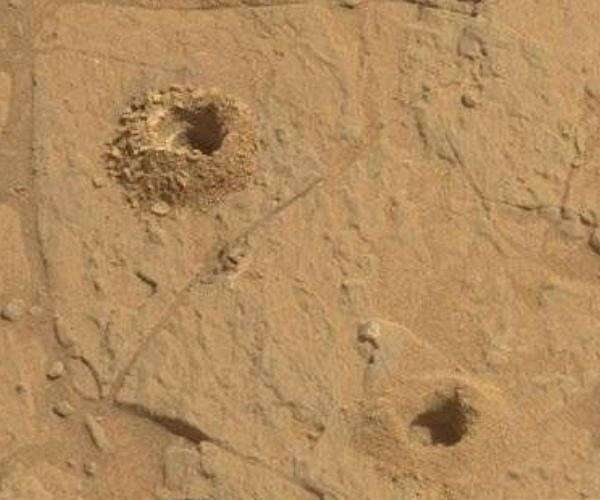
As you can see in the image above, we know the drilling necessary to collect the sample was successful, as was delivery of the sample to SAM. We are awaiting word about the first part of the SAM analysis, and are running the second part in the weekend plan.

As you can imagine, running a mass spectrometer and chemistry experiment remotely on another planet takes a lot of energy, but throughout the week, the team took advantage of whatever spare power there was to include additional science observations. ChemCam planned two attempts at targeting the Nevado Sajama2 drill-hole interior, analyzed "Tiquipaya," one of the family of rocks broken by the rover wheels that expose bright white material, and measured the chemistry of the atmosphere with a passive sky observation.

They also planned an RMI mosaic of layers near the base of the "Mishe Mokwa" butte to our east. MAHLI and APXS paired up to image and analyze the ground-up tailings around the drill hole for the most direct measure of chemistry of what SAM analyzes. As Mastcam acquired a full 360-degree mosaic the first time we were at Nevado Sajama, they did not have many rock observations to plan.

Instead, they turned their eyes toward the sky to measure the amount of dust in the atmosphere. Navcam made complementary measurements of atmospheric dust and planned movies and imaging surveys of clouds and dust devils. Ever watchful, RAD and REMS made their regular measurements of the Martian environment while DAN regularly monitored the Martian subsurface.

Related Links
Mars Science Laboratory Mission Team Members
Mars News and Information at MarsDaily.com
Lunar Dreams and more

Subscribe Free To Our Daily Newsletters
Tweet

RELATED CONTENT
The following news reports may link to other Space Media Network websites.
MARSDAILY
Curiosity Blog, Sols 4788-4797: Welcome Back from Conjunction
Pasadena CA (SPX) Feb 08, 2026
Mars has emerged from its holiday behind the Sun, and we here on Earth have been able to reconnect with Curiosity and get back to work on Mars. Our first planning day last Friday gave Curiosity a full weekend of activities, which wrapped up with getting us ready for our next drill. We checked out a broken white rock in the workspace with APXS, MAHLI, and ChemCam's laser spectrometer and finished up imaging a sandy area we've kept an eye on during conjunction to see if we could catch any wind motio ... read more

MARSDAILY
Launch to ISS pushed to Thursday over weather: NASA

NASA crew set for flight to ISS

Voyager wins NASA ISS mission management role through 2030

Sophie Adenot, the second French woman to fly to space

MARSDAILY
xAI sees key staff exits, Musk promises moon factories

Vietnam licenses Musk's satellite internet firm Starlink

UK space firm Skyrora explores buying assets of struggling rival Orbex

Ariane 6 four booster launcher completes on schedule mission

MARSDAILY
Mars' 'Young' Volcanoes Were More Complex Than Scientists Once Thought

Curiosity Blog, Sols 4788-4797: Welcome Back from Conjunction

NASA Study: Non-biologic Processes Don't Fully Explain Mars Organics

Martian toxin found to toughen microbe built bricks

MARSDAILY
Dragon spacecraft gears up for crew 12 arrival and station science work

China prepares offshore test base for reusable liquid rocket launches

Retired EVA workhorse to guide China's next-gen spacesuit and lunar gear

Tiangong science program delivers data surge

MARSDAILY
China tests AI satellite swarm for space-based computing

BlackSky expands Gen 3 Assured deals with new defense customer

Muon Space ramps up multi-mission satellite constellations

ESA member states back SWISSto12 HummingSat with fresh funding round

MARSDAILY
Abundant element alloy enables rare earth free cryogenic cooling

JUNO VR system brings detector events into immersive 3D space

Astroscale Japan to mature electric refueling for future GEO servicing

Anthropic unveils new AI model as OpenAI rivalry heats up

MARSDAILY
Debris disc oddities point to hidden outer planets

Hydrogen sulfide detected in distant gas giant exoplanets for the first time

JWST study links sulfur rich gas giants to core growth in distant HR 8799 system

Cheops spots inside out exoplanet quartet

MARSDAILY
Jupiter size refined by new radio mapping

Polar weather on Jupiter and Saturn hints at the planets' interior details

Europa ice delamination may deliver nutrients to hidden ocean

Birth conditions fixed water contrast on Jupiters moons

Subscribe Free To Our Daily Newsletters


The content herein, unless otherwise known to be public domain, are Copyright 1995-2024 - Space Media Network. All websites are published in Australia and are solely subject to Australian law and governed by Fair Use principals for news reporting and research purposes. AFP, UPI and IANS news wire stories are copyright Agence France-Presse, United Press International and Indo-Asia News Service. ESA news reports are copyright European Space Agency. All NASA sourced material is public domain. Additional copyrights may apply in whole or part to other bona fide parties. All articles labeled "by Staff Writers" include reports supplied to Space Media Network by industry news wires, PR agencies, corporate press officers and the like. Such articles are individually curated and edited by Space Media Network staff on the basis of the report's information value to our industry and professional readership. Advertising does not imply endorsement, agreement or approval of any opinions, statements or information provided by Space Media Network on any Web page published or hosted by Space Media Network. General Data Protection Regulation (GDPR) Statement Our advertisers use various cookies and the like to deliver the best ad banner available at one time. All network advertising suppliers have GDPR policies (Legitimate Interest) that conform with EU regulations for data collection. By using our websites you consent to cookie based advertising. If you do not agree with this then you must stop using the websites from May 25, 2018. Privacy Statement. Additional information can be found here at About Us.