24/7 Space News
EXO WORLDS
Survey of 80 near Earth asteroids sharpens view of their origins and risks
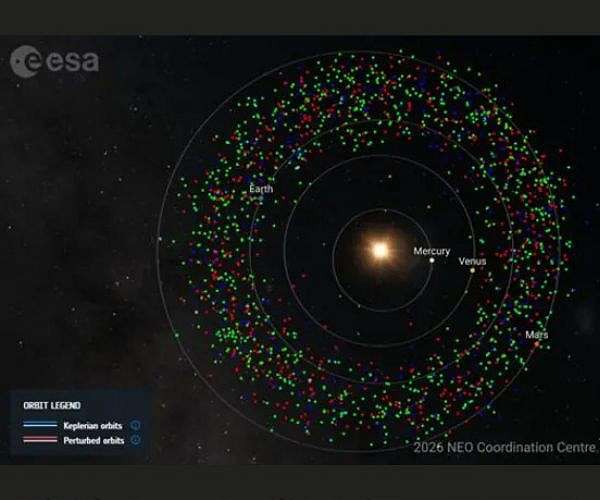
illustration only

Survey of 80 near Earth asteroids sharpens view of their origins and risks

by Riko Seibo
Tokyo, Japan (SPX) Mar 02, 2026
Near Earth asteroids are small bodies whose orbits cross or come close to Earth, making them key tracers of Solar System formation and evolution as well as potential impact hazards for our planet.

An international team led by researchers at the Purple Mountain Observatory, Chinese Academy of Sciences, has completed a one year observing campaign to better classify these objects. From October 2023 to October 2024 they used the Johnson Cousins BVRI broadband photometric system on two facilities, the Purple Mountain Observatory Yaoan High Precision Telescope in China and the Kottamia Astronomical Observatory 1.88 meter telescope in Egypt, to observe dozens of near Earth asteroids.

After calibration and data reduction, the team derived multicolor photometric indices for 84 near Earth asteroids and then carried out taxonomic classification for 80 of them. The new dataset significantly expands the number of small, faint objects with secure taxonomic types, which have been difficult to classify because they are only observable for short periods after discovery.

The survey finds that nearly half of the classified objects, 46.3 percent, belong to the S complex, which is associated with stony, silicate rich compositions. Another 26.3 percent are in the darker, carbon rich C complex, 15.0 percent fall into the X complex, and 6 percent are in the D complex, with the remaining few identified as A type and V type asteroids.

By examining the distribution of types with size, the researchers show that C and X complex asteroids are more common among smaller near Earth asteroids with absolute magnitude greater than 17.0. In this size range the fraction of C and X complex objects is roughly double that found among larger bodies, suggesting different source regions or evolutionary pathways for small near Earth asteroids.

The team also notes that X complex objects tend to cluster at sub kilometer diameters, while C and S complex asteroids appear more evenly distributed across the sampled size range. These contrasting patterns point to differences in collisional evolution, surface processing, or delivery mechanisms from the main belt.

Analysis of orbital parameters highlights further structure in the population. For near Earth asteroids with Jovian Tisserand parameter less than 3.1, C and D complex objects dominate, hinting at a possible link to cometary reservoirs. This dynamical signature, combined with their dark, primitive surfaces, supports the idea that some near Earth asteroids originated as extinct or dormant comets.

One object in the sample, near Earth asteroid 385268, stands out as a likely example of this pathway. Its spectral properties resemble those of Jupiter family comets, and dynamical modeling indicates it may have been delivered from the Themis family in the outer main belt via Jupiter's 2:1 mean motion resonance, illustrating how main belt material can be transported into Earth crossing orbits.

The work also examines 13 potentially hazardous asteroids contained in the sample, objects whose orbits bring them close enough to Earth to pose an elevated impact risk. Among these, C complex and S complex asteroids each contribute five bodies, a roughly equal split that differs from some earlier expectations focused more heavily on S type objects.

Because C complex asteroids are typically more porous and structurally weaker than S complex bodies, their presence among potentially hazardous asteroids raises important questions for planetary defense planning. Kinetic impact deflection strategies may couple less efficiently to such porous targets, and mission designers will need to account for this when planning future mitigation tests and campaigns.

Beyond the immediate implications for impact risk, the survey adds a new layer of detail to our picture of near Earth asteroid origins and evolution. The taxonomic and dynamical patterns offer constraints on how material is transported from different source regions, reshaped by collisions, and delivered into Earth crossing space over Solar System history.

The team plans to extend this work by targeting even fainter near Earth asteroids and by combining optical photometry with infrared measurements. Adding thermal infrared data will refine albedo and size estimates and improve taxonomic classification, further tightening the link between composition, size, and orbital characteristics in the near Earth population.

Research Report:Taxonomic classification of 80 near-Earth asteroids

Related Links
Purple Mountain Observatory
Lands Beyond Beyond - extra solar planets - news and science
Life Beyond Earth

Subscribe Free To Our Daily Newsletters
RELATED CONTENT
EXO WORLDS
Einstein effect clears planets from tight double star systems
Los Angeles CA (SPX) Mar 04, 2026
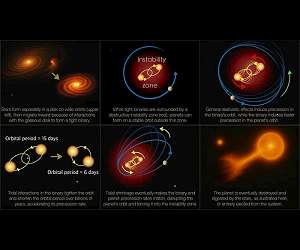
Of the more than 4,500 stars known to have planets, one puzzling statistic stands out. Even though nearly all stars are expected to have planets and most stars form in pairs, planets that orbit both stars in a pair are rare. Of the more than 6,000 extrasolar planets, or exoplanets, confirmed to date - most of them found by NASA's Kepler Space Telescope and the Transiting Exoplanet Survey Satellite (TESS) - only 14 are observed to orbit binary stars. There should be hundreds. Where are all the plan ... read more

EXO WORLDS
NASA announces overhaul of Artemis lunar program amid technical delays

Texas AM partners with Aegis to orbit TAMU SPIRIT research hub on ISS

Regrowing marginal farmland can curb emissions without cutting food output

Chinese visitors to Japan slump as spat rumbles on

EXO WORLDS
Prometheus starts work on new Indiana solid rocket motor campus

NASA prepares Artemis II rocket for rollback after upper stage issue

Superconducting thruster cuts power and mass for space propulsion

Lithium trace in upper air linked to Falcon 9 rocket breakup

EXO WORLDS
Perseverance rover now self-locates precisely on Mars

Curiosity Blog, Sols 4798-4803: Back for More Science

Mars relay orbiter seen as backbone for future exploration

UAE extends Mars probe mission until 2028

EXO WORLDS
Dragon spacecraft gears up for crew 12 arrival and station science work

China prepares offshore test base for reusable liquid rocket launches

Retired EVA workhorse to guide China's next-gen spacesuit and lunar gear

Tiangong science program delivers data surge

EXO WORLDS
Infleqtion lists shares on NYSE as neutral atom quantum firm

AAC Clyde Space adds Sedna satellites to boost maritime data services

China tests AI satellite swarm for space-based computing

BlackSky expands Gen 3 Assured deals with new defense customer

EXO WORLDS
Dynamic terrain model boosts airborne gamma ray survey accuracy

KSAT prepares Hyperion in orbit relay test for satellite data

India chases 'DeepSeek moment' with homegrown AI models

ST Engineering iDirect and G&S SatCom align network and service management on Intuition

EXO WORLDS
Debris disc oddities point to hidden outer planets

Hydrogen sulfide detected in distant gas giant exoplanets for the first time

JWST study links sulfur rich gas giants to core growth in distant HR 8799 system

Survey of 80 near Earth asteroids sharpens view of their origins and risks

EXO WORLDS
Simple collapse may build cosmic snowman worlds

Jupiter size refined by new radio mapping

Polar weather on Jupiter and Saturn hints at the planets' interior details

Europa ice delamination may deliver nutrients to hidden ocean


The content herein, unless otherwise known to be public domain, are Copyright 1995-2026 - SpaceDaily.com. All websites are published in Australia and are solely subject to Australian law and governed by Fair Use principals for news reporting and research purposes. AFP, UPI and IANS news wire stories are copyright Agence France-Presse, United Press International and Indo-Asia News Service. ESA news reports are copyright European Space Agency. All NASA sourced material is public domain. Additional copyrights may apply in whole or part to other bona fide parties. All articles labeled "by Staff Writers" include reports supplied to Space Media Network by industry news wires, PR agencies, corporate press officers and the like. Such articles are individually curated and edited by Space Media Network staff on the basis of the report's information value to our industry and professional readership. Advertising does not imply endorsement, agreement or approval of any opinions, statements or information provided by Space Media Network on any Web page published or hosted by Space Media Network. General Data Protection Regulation (GDPR) Statement Our advertisers use various cookies and the like to deliver the best ad banner available at one time. All network advertising suppliers have GDPR policies (Legitimate Interest) that conform with EU regulations for data collection. By using our websites you consent to cookie based advertising. If you do not agree with this then you must stop using the websites from May 25, 2018. Privacy Statement. Additional information can be found here at About Us.
Subscribe Free To Our Daily Newsletters