24/7 Space News
OUTER PLANETS
Simple collapse may build cosmic snowman worlds
illustration only

Simple collapse may build cosmic snowman worlds

by Silas Korrin
New York (SDX) Feb 23, 2026

Astronomers have puzzled over why many icy worlds in the distant Kuiper Belt look like snowmen, with two round lobes joined together. New work from Michigan State University points to a surprisingly simple explanation: these so called contact binaries can form directly through gravitational collapse.

Far beyond Neptune, the Kuiper Belt holds icy, largely untouched planetesimals that preserve conditions from the dawn of the solar system. Observations suggest that roughly one in ten of these building block objects are contact binaries, where two nearly spherical lobes rest against one another rather than forming a single smooth sphere.

Michigan State University graduate student Jackson Barnes has now created what is described as the first simulation that naturally produces these two lobed shapes through gravitational collapse. The study appears in the journal Monthly Notices of the Royal Astronomical Society under the title Direct contact binary planetesimal formation from gravitational collapse.

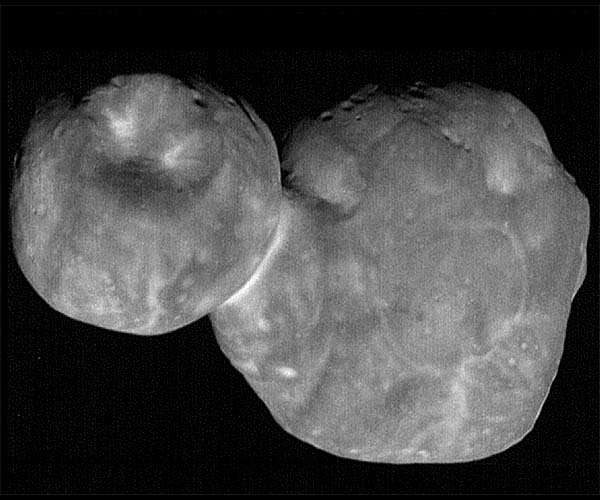
Earlier computer models treated colliding bodies as fluid blobs that quickly merged into single spheres. That approach made it impossible to form the distinctive snowman like profiles seen in New Horizons images of Kuiper Belt object 2014 MU69, informally known as Ultima Thule, and in other suspected contact binaries.

Barnes used the high performance computing resources of MSU's Institute for Cyber Enabled Research to construct simulations in which the building blocks retain internal strength. In this more realistic environment, solid chunks can pile up, rest against each other and maintain their shapes rather than flowing together.

Other ideas for how contact binaries form require special circumstances or rare events. These scenarios might work occasionally but struggle to explain why such objects make up a significant fraction of Kuiper Belt planetesimals.

"If we think 10 percent of planetesimal objects are contact binaries, the process that forms them cannot be rare," said Earth and Environmental Science Professor Seth Jacobson, senior author on the paper. "Gravitational collapse fits nicely with what we have observed."

NASA's New Horizons spacecraft provided the first close up views of a Kuiper Belt contact binary during its January 1, 2019 flyby of 2014 MU69. Those images prompted scientists to re examine data on other distant objects and concluded that contact binaries account for about 10 percent of Kuiper Belt planetesimals.

The Kuiper Belt preserves remnants of the early Milky Way when the solar system formed within a disc of dust and gas. Today the region hosts dwarf planets such as Pluto, comets and numerous smaller planetesimals that have remained relatively undisturbed and rarely collide.

Planetesimals are the first sizable bodies to assemble from a cloud of dust and pebble sized solids. Small particles stick together into pebbles, which then aggregate into larger clumps under their mutual gravity, much like individual snowflakes packed into a snowball.

Barnes' simulations show that as a rotating cloud of material collapses inward, it can tear apart an initial body and separate it into two planetesimals that orbit one another. Binary planetesimals of this type are observed in the Kuiper Belt, and in the model their mutual orbits gradually shrink until the two components gently touch and fuse.

Because the collision speeds are low and the lobes retain their internal strength, they preserve their roughly spherical shapes instead of flattening or shattering. Once formed, these contact binaries are unlikely to encounter other large objects in the sparse Kuiper Belt, which helps them survive for the age of the solar system.

Most known binaries in this region show few or no impact craters, supporting the view that they have lived in a relatively calm environment. With little external disturbance, gravitationally assembled snowman like worlds can persist for billions of years in the outer solar system.

Scientists have long suspected that gravitational collapse could build contact binaries, but previous models lacked the physics needed to follow the process in detail. Barnes' work is presented as the first to incorporate the necessary ingredients to reproduce their shapes in a self consistent way.

"We are able to test this hypothesis for the first time in a legitimate way," Barnes said. "That is what is so exciting about this paper." The team expects that similar methods can extend to even more complex multiple body systems in the future.

Barnes and colleagues are now developing a new generation of simulations that better track the collapse of pebble clouds and the evolution of binary and higher order systems. As upcoming NASA missions probe farther into the solar system, the researchers anticipate that many more distant snowman shaped worlds may come into view.

Research Report:Direct contact binary planetesimal formation from gravitational collapse

Related Links
Michigan State University
The million outer planets of a star called Sol

Subscribe Free To Our Daily Newsletters
Tweet

RELATED CONTENT
The following news reports may link to other Space Media Network websites.
OUTER PLANETS
Jupiter size refined by new radio mapping
Paris, France (SPX) Feb 05, 2026
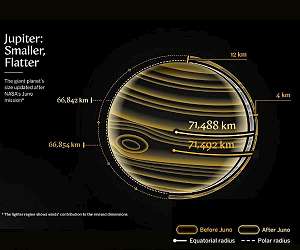
For more than half a century, planetary scientists relied on a handful of spacecraft flybys to pin down Jupiter's size and shape. Now, an international team led by the Weizmann Institute of Science has used a trove of new radio data from NASA's Juno mission to redraw the gas giant with unprecedented precision. The study, published in Nature Astronomy, replaces six measurements from NASA's Voyager and Pioneer missions with 26 carefully analyzed passes by Juno. Those earlier flybys sent radio beams ... read more

OUTER PLANETS
Texas AM partners with Aegis to orbit TAMU SPIRIT research hub on ISS

Sophie Adenot, the second French woman to fly to space

International crew arrives at space station

Chinese visitors to Japan slump as spat rumbles on

OUTER PLANETS
Russian era ends at abandoned launchpad in South American jungle

NASA teams set for second Artemis II wet dress rehearsal

Vietnam licenses Musk's satellite internet firm Starlink

Latvian startup advances nuclear-fueled power for satellites and future Moon missions

OUTER PLANETS
Curiosity Blog, Sols 4798-4803: Back for More Science

Mars relay orbiter seen as backbone for future exploration

UAE extends Mars probe mission until 2028

Mars' 'Young' Volcanoes Were More Complex Than Scientists Once Thought

OUTER PLANETS
Dragon spacecraft gears up for crew 12 arrival and station science work

China prepares offshore test base for reusable liquid rocket launches

Retired EVA workhorse to guide China's next-gen spacesuit and lunar gear

Tiangong science program delivers data surge

OUTER PLANETS
AAC Clyde Space adds Sedna satellites to boost maritime data services

China tests AI satellite swarm for space-based computing

BlackSky expands Gen 3 Assured deals with new defense customer

Muon Space ramps up multi-mission satellite constellations

OUTER PLANETS
ST Engineering iDirect and G&S SatCom align network and service management on Intuition

Light based computing module aims to cut AI power demand

KSAT prepares Hyperion in orbit relay test for satellite data

Pale Blue opens Tsukuba site to scale satellite propulsion production

OUTER PLANETS
Hydrogen sulfide detected in distant gas giant exoplanets for the first time

Cheops spots inside out exoplanet quartet

Study revisits chances of detecting alien technosignatures

Engineered microbes use light to build new molecules

OUTER PLANETS
Jupiter size refined by new radio mapping

Polar weather on Jupiter and Saturn hints at the planets' interior details

Europa ice delamination may deliver nutrients to hidden ocean

Birth conditions fixed water contrast on Jupiters moons

Subscribe Free To Our Daily Newsletters


The content herein, unless otherwise known to be public domain, are Copyright 1995-2024 - Space Media Network. All websites are published in Australia and are solely subject to Australian law and governed by Fair Use principals for news reporting and research purposes. AFP, UPI and IANS news wire stories are copyright Agence France-Presse, United Press International and Indo-Asia News Service. ESA news reports are copyright European Space Agency. All NASA sourced material is public domain. Additional copyrights may apply in whole or part to other bona fide parties. All articles labeled "by Staff Writers" include reports supplied to Space Media Network by industry news wires, PR agencies, corporate press officers and the like. Such articles are individually curated and edited by Space Media Network staff on the basis of the report's information value to our industry and professional readership. Advertising does not imply endorsement, agreement or approval of any opinions, statements or information provided by Space Media Network on any Web page published or hosted by Space Media Network. General Data Protection Regulation (GDPR) Statement Our advertisers use various cookies and the like to deliver the best ad banner available at one time. All network advertising suppliers have GDPR policies (Legitimate Interest) that conform with EU regulations for data collection. By using our websites you consent to cookie based advertising. If you do not agree with this then you must stop using the websites from May 25, 2018. Privacy Statement. Additional information can be found here at About Us.