24/7 Space News
OUTER PLANETS
Europa ice delamination may deliver nutrients to hidden ocean
illustration only

Europa ice delamination may deliver nutrients to hidden ocean

by Clarence Oxford
Los Angeles CA (SPX) Jan 21, 2026

A new geophysics study proposes a mechanism that could move life-sustaining nutrients from the battered surface of Europa down into its buried global ocean, improving the odds that the Jovian moon could support microbial life.

Europa, one of Jupiters largest moons, holds more liquid water beneath its frozen shell than all of Earths oceans combined, but the ocean is sealed away under thick ice that blocks sunlight and isolates it from the surface. That isolation creates a long standing puzzle: how materials processed by intense radiation at the surface could travel downward to feed any microbes that might inhabit the dark ocean.

Radiation from Jupiter constantly bombards Europas surface and reacts with salts and other materials to create oxidants and other useful nutrients. Several hypotheses have been advanced for how that nutrient rich ice might reach the ocean, but most focus on sideways or resurfacing motions of the shell rather than a sustained, downward transport.

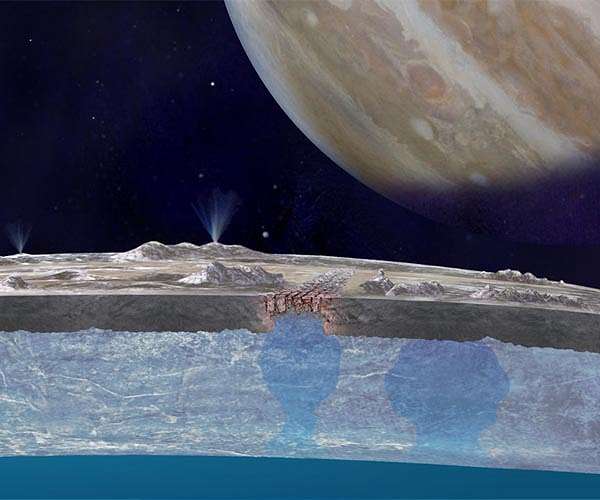
To address this problem, Washington State University researcher Catherine Cooper and then WSU doctoral student Austin Green turned to an Earth process known as crustal delamination. On Earth, delamination occurs when a dense, chemically altered portion of crust becomes heavy enough to detach and sink into the underlying mantle, recycling material into the planets interior.

The team recognized that a similar process could operate in Europas ice shell because some regions of the moons surface are enriched in salts that make the ice denser than the surrounding, purer ice. Laboratory and modeling work from prior studies has also shown that impurities weaken the crystalline structure of ice, making those saltier patches mechanically less stable than clean ice.

Building on these ideas, Green and Cooper proposed that bands or patches of salt rich surface ice on Europa could detach from the surrounding shell once they are sufficiently weakened. Under the pull of gravity, the denser material would begin to sink into the shell interior in a delamination like process, potentially carrying surface generated oxidants and nutrients toward the ocean.

The researchers used computer models to test whether such salty, nutrient bearing ice could actually descend through the shell and how far it might travel. Their simulations indicate that, over a broad range of salt concentrations, dense surface ice can sink all the way to the base of the ice shell as long as there is at least modest weakening of the ice in the source region.

Model results suggest this sinking can proceed on relatively short geological timescales, implying that delamination of salt laden surface ice could provide a sustained conveyor for delivering nutrients into the ocean. If this process operates across many regions of the shell, it would represent an efficient, continuous pathway to recycle surface material into the subsurface ocean.

The work directly addresses a key habitability question for Europa by linking its radiation processed surface to its hidden ocean in a physically plausible way. It also offers a concrete prediction for how compositional and structural variations in the shell might map to zones of active material exchange between the surface and interior.

The findings align with central objectives of NASAs Europa Clipper mission, launched in 2024, which will perform multiple close flybys of the moon to investigate its ice shell, subsurface ocean, and potential to support life. Instruments on Europa Clipper are designed to probe shell thickness, internal structure, composition, and geological activity, all of which are relevant to testing the proposed delamination mechanism.

The study appears in The Planetary Science Journal and highlights how concepts from terrestrial geology can inspire new models for icy worlds in the outer solar system. By adapting the well known framework of crustal delamination to Europas conditions, the researchers provide a new lens for interpreting surface features and interior dynamics on one of the most promising locations for extraterrestrial life.

The project received partial support from NASA under Grant NNX15AH91G and used computing resources provided by the Center for Institutional Research Computing at Washington State University.

Research Report:Dripping to Destruction: Exploring Salt-driven Viscous Surface Convergence in Europa's Icy Shell

Related Links
Washington State University
The million outer planets of a star called Sol

Subscribe Free To Our Daily Newsletters
Tweet

RELATED CONTENT
The following news reports may link to other Space Media Network websites.
OUTER PLANETS
Computer models let scientists peer into the mystery beneath Jupiter's clouds
Chicago IL (SPX) Jan 19, 2026
Spectacular clouds swirl across the surface of Jupiter. These clouds contain water, just like Earth's, but are much denser on the gas giant--so thick that no spacecraft has been able to measure exactly what lies beneath. But a new study led by University of Chicago and Jet Propulsion Lab scientists has given us a deeper look at the planet by creating the most complete model to date of Jupiter's atmosphere. Among other things, the analysis addresses a longstanding question about how much oxyg ... read more

OUTER PLANETS
Explore the World with These Travel Tips

The Quiet Transformation of GPS - What's Coming by 2026

NASA Back for Seconds with New Food System Design Challenge

New orbital mapping system targets Earth Moon libration traffic

OUTER PLANETS
NASA moves moon rocket to launch pad ahead of Artemis 2 mission

Interstellar raises major Series F funding to expand launch and satellite business

GE and Lockheed validate compact rotating detonation ramjet for hypersonic missiles

China tests Long March 12B reusable first stage at Jiuquan

OUTER PLANETS
Tiny Mars' big impact on Earth's climate

Ancient deltas reveal vast Martian ocean across northern hemisphere

The electrifying science behind Martian dust

Sandblasting winds sculpt Mars landscape

OUTER PLANETS
Tiangong science program delivers data surge

China tallies record launch year as lunar and asteroid plans advance

China harnesses nationwide system to drive spaceflight and satellite navigation advances

Shenzhou 21 crew complete eight hour spacewalk outside Tiangong station

OUTER PLANETS
ThinkOrbital raises seed funding to advance orbital defense and construction systems

Aerospacelab expands Pulsar navigation constellation work with new Xona satellite order

Multiple satellite filings demonstrate transparency, responsibility and ambition: China Daily editorial

China outlines mega constellations in ITU satellite filings

OUTER PLANETS
The decentralized future of space transactions

Top 5 Best Live Sports Betting Sites For North Carolina Sports Fans

How IVRT Testing Ensures Consistent Product Quality

How Path Social's AI Targeting Really Works: A Deep Dive into the Tech

OUTER PLANETS
Hidden magma oceans could shield rocky exoplanets from harmful radiation

Frozen hydrogen cyanide crystals may have helped spark early chemistry for life

Berkeley Scientists set to home in on 100 signals from Seti at Home

Scientist wins 'Environment Nobel' for shedding light on hidden fungal networks

OUTER PLANETS
Computer models let scientists peer into the mystery beneath Jupiter's clouds

Jupiter's moon Europa has a seafloor that may be quiet and lifeless

Uranus and Neptune may be rock rich worlds

SwRI links Uranus radiation belt mystery to solar storm driven waves

Subscribe Free To Our Daily Newsletters


The content herein, unless otherwise known to be public domain, are Copyright 1995-2024 - Space Media Network. All websites are published in Australia and are solely subject to Australian law and governed by Fair Use principals for news reporting and research purposes. AFP, UPI and IANS news wire stories are copyright Agence France-Presse, United Press International and Indo-Asia News Service. ESA news reports are copyright European Space Agency. All NASA sourced material is public domain. Additional copyrights may apply in whole or part to other bona fide parties. All articles labeled "by Staff Writers" include reports supplied to Space Media Network by industry news wires, PR agencies, corporate press officers and the like. Such articles are individually curated and edited by Space Media Network staff on the basis of the report's information value to our industry and professional readership. Advertising does not imply endorsement, agreement or approval of any opinions, statements or information provided by Space Media Network on any Web page published or hosted by Space Media Network. General Data Protection Regulation (GDPR) Statement Our advertisers use various cookies and the like to deliver the best ad banner available at one time. All network advertising suppliers have GDPR policies (Legitimate Interest) that conform with EU regulations for data collection. By using our websites you consent to cookie based advertising. If you do not agree with this then you must stop using the websites from May 25, 2018. Privacy Statement. Additional information can be found here at About Us.