





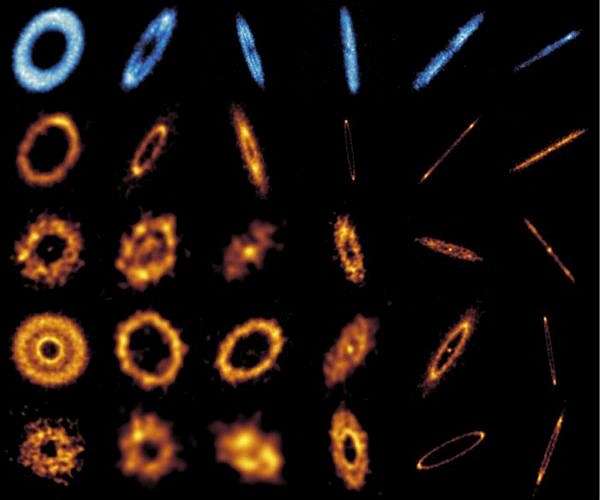
The study used the Atacama Large Millimeter/submillimeter Array (ALMA) in Chile to image 24 debris discs made of dust, gas and rocks orbiting stars in systems between roughly 10 million and two billion years old. The new observations, published in a suite of papers in the journal Astronomy and Astrophysics, capture faint thermal emission from the discs and resolve features that had not been visible before.
Debris discs form when leftover material from planet formation collides and grinds down into smaller particles that continue to orbit the star. In systems without planets in the disc, the material should settle into relatively smooth, symmetric rings with even brightness. Instead, the Johns Hopkins-led team found that nearly all of the discs in their sample showed some kind of irregularity in structure or brightness.
The researchers focused in particular on four systems whose discs appeared especially unusual. One standout example is the disc around the star HD121617, where ALMA images show a strongly uneven brightness pattern. The team interprets this as evidence that an object, possibly an unseen planet, has created a vortex that traps particles in certain regions, boosting the local dust density.
Regions with higher particle densities emit more thermal radiation and therefore appear brighter in millimeter images. By mapping these variations, astronomers can infer where gravitational perturbations may be concentrating dust, even when the perturbing planet cannot be seen directly with current instruments.
Co-author Meredith MacGregor of Johns Hopkins University compared the method to shining a flashlight at an object and studying its shadow on the wall. Exoplanets in the distant outskirts of their systems are effectively invisible with standard radial-velocity and transit techniques, but the distortions they imprint on surrounding debris can serve as indirect tracers of their presence.
Previous ALMA work under the DSHARP project imaged very young, protoplanetary discs in systems less than about two million years old, revealing ring and gap structures associated with nascent planets. In contrast, the new survey targets older, lower-mass teenage discs that are much fainter and harder to image, filling in a missing stage between early planet formation and mature planetary systems.
Because these older discs orbit at distances comparable to those of Saturn, Uranus, Neptune and beyond in our own solar system, they offer a way to search for analogs of the outer planets that current exoplanet catalogs largely lack. Most of the more than 6,000 known exoplanets have been discovered close to their stars, where radial-velocity and transit methods are most sensitive, biasing the census toward hot, gas giants.
Information on icy giant planets far from their host stars remains sparse, leaving big gaps in understanding how representative our solar system is compared to others. By examining debris disc shapes and substructures, the ARKS survey (the ALMA survey to Resolve exoKuiper belt Substructures) aims to identify systems that likely host outer planets similar to those in the Kuiper Belt region.
In the new observations, many discs show belts with multiple rings, wide smooth halos, sharp edges, unexpected arcs and clumps, and brightness asymmetries. These patterns suggest ongoing gravitational sculpting by unseen bodies, as well as complex interactions between dust, gas and stellar radiation over tens to hundreds of millions of years.
The ARKS team notes that the amber colors in processed images highlight the distribution and abundance of dust in the 24 discs surveyed, while blue hues trace carbon monoxide gas in the six discs that still contain significant gas. This combination allows astronomers to compare how solids and gas respond differently to planetary perturbations and other dynamical processes.
MacGregor said that being able to resolve these features at distances comparable to the orbits of Saturn, Uranus and Neptune is a major step forward. With detailed disc maps in hand, astronomers can prioritize specific systems for follow-up with even higher resolution facilities and future observatories to directly hunt for the suspected outer planets.
Until such planets are detected and characterized, the researchers caution that their existence remains inferred rather than confirmed. Even so, the new results show that faint, structured debris discs can serve as powerful signposts of hidden planetary architectures that traditional planet-hunting methods struggle to probe.
By bridging the gap between very young planet-forming discs and fully mature planetary systems, the ARKS survey provides a new window into how outer planetary systems evolve and how common systems like our own may be in the galaxy.
Related Links
Johns Hopkins University
Lands Beyond Beyond - extra solar planets - news and science
Life Beyond Earth
| Subscribe Free To Our Daily Newsletters |
| Subscribe Free To Our Daily Newsletters |







