





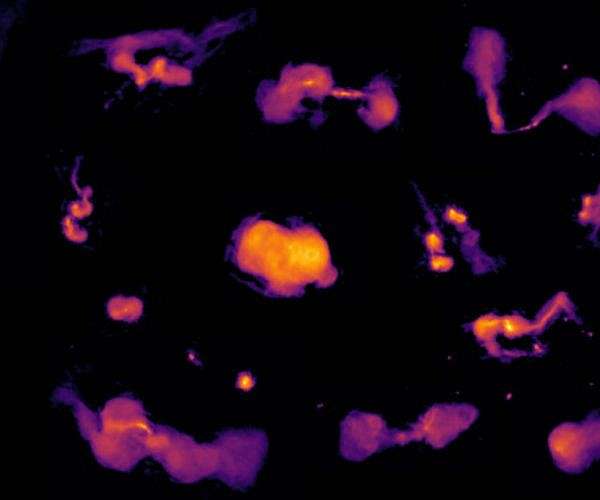
By tuning in to low frequency radio waves, the survey provides a strikingly different view of the cosmos than optical telescopes, tracing relativistic particles spiralling through magnetic fields. This allows astronomers to follow powerful jets launched by supermassive black holes, as well as galaxies undergoing intense bursts of star formation, over a wide range of cosmic history.
The exceptional depth and resolution of the new maps have exposed rare and elusive objects that are difficult to detect at other wavelengths. These include colliding clusters of galaxies, very faint remnants of exploded stars, and stars that flare or interact with close companions. The survey has already underpinned hundreds of new investigations, opening fresh lines of research into how cosmic structures grow, how particles are accelerated to extreme energies, and how magnetic fields thread the universe, while making the most sensitive wide area radio images yet publicly available.
The data release is the result of more than a decade of observing, large scale data processing and analysis by a broad international collaboration. Lead author Timothy Shimwell of ASTRON and Leiden University highlights that the project combines observations from 38 Dutch LOFAR stations with 14 international stations across Europe, with the most distant separated by nearly 2,000 kilometres. Together they form one of the largest, highest resolution and most sensitive radio telescope arrays now operating.
The LOFAR European Research Infrastructure Consortium model underpins the effort, pooling expertise from the Netherlands, Germany, France, the United Kingdom, Poland, Italy, Sweden, Ireland, Latvia and Bulgaria. This distributed network lets astronomers conduct a uniform, deep survey over a large swath of the sky, while sharing both the observing time and the computing resources needed to handle the huge data streams.
Researchers are now exploiting the scale and quality of the survey to transform radio studies of galaxies and black holes. Martin Hardcastle of the University of Hertfordshire notes that the new data allow scientists to examine large and diverse samples of supermassive black holes and their jets at many different evolutionary stages, and to link their properties to those of their host galaxies and larger scale environments. At the same time, the survey yields robust measurements of star formation rates in millions of galaxies, revealing how star building activity depends on galaxy characteristics and changes over time.
Studies of galaxy clusters are also benefiting, as the maps reveal giant shocks and turbulence that drive particle acceleration and amplify magnetic fields across regions spanning millions of light years. Andrea Botteon of INAF in Bologna reports that such processes now appear to be far more common in clusters than previously thought, reshaping views of how energy flows through these massive cosmic structures.
The team is systematically combing the data for rare and time variable phenomena. They have already identified transient and variable radio sources, previously unknown supernova remnants, and some of the largest and oldest radio galaxies yet seen. The survey also picks up radio emission consistent with interactions between exoplanets and their host stars, hinting at a new way to probe planetary systems beyond the solar system.
Achieving these results required major advances in data processing to overcome distortions introduced by the Earth's ionosphere, an electrically charged layer of the upper atmosphere that bends and blurs low frequency radio waves. Algorithm specialist Cyril Tasse of the Paris Observatory explains that it took years to design, refine and optimise new calibration and imaging techniques capable of delivering sharp, stable images over large sky areas, while also enabling searches for signals that vary in time.
Making sense of the enormous data volumes posed another challenge. Extracting 13,000 hours of observations from the telescope archives and distributing the workload across multiple high performance computing facilities demanded careful coordination. Alexander Drabent of Thuringian State Observatory notes that the project processed 18.6 petabytes of data over many years, consuming more than 20 million core hours of computing time and requiring continuous monitoring to keep the pipeline running smoothly.
The collaboration is now looking ahead to the upgraded LOFAR2.0 system, which will roughly double the survey speed and further enhance the scientific return. Improvements in calibration and imaging software are also making it increasingly practical to reprocess the survey at much higher angular resolution, allowing even more detailed studies of jets, galaxies and diffuse structures in the radio sky.
Square Kilometre Array Observatory scientist Wendy Williams stresses that the new data release should be seen as a major milestone rather than a final endpoint. With LOFAR2.0 and other forthcoming facilities, astronomers expect to build on the LoTSS-DR3 legacy by mapping the radio universe with even greater sensitivity and clarity, extending these insights into the life cycles of galaxies and black holes well into the future.
Research Report:The LOFAR Two-metre Sky Survey: Data Release 3
Related Links
NOVA Informatiecentrum
Understanding Time and Space
| Subscribe Free To Our Daily Newsletters |
| Subscribe Free To Our Daily Newsletters |








