





Physicists at CERNs Large Hadron Collider are recreating this primordial plasma by smashing together heavy ions at relativistic energies, briefly liberating quarks and gluons so they can probe how the early universe behaved in its first microseconds.
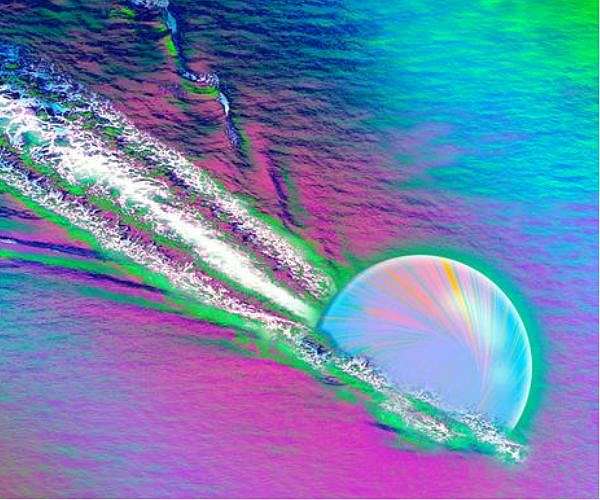
A team working on the Compact Muon Solenoid experiment and led by Massachusetts Institute of Technology physicists has now seen clear evidence that fast moving quarks generate wakes in the plasma, much like a duck leaves ripples on a lake, showing that the medium responds as a single flowing liquid rather than as a loose gas of particles.
The results demonstrate that quark gluon plasma is dense enough to slow energetic quarks and to produce splashes and swirls that mark it as a true primordial soup, resolving a long standing debate over how strongly the plasma reacts to passing particles.
To reach this conclusion, Yen Jie Lee and colleagues developed a new analysis technique that lets them isolate the response of the medium to a single quark, and they plan to apply it to larger data sets to extract properties such as how far the wakes extend and how quickly they dissipate.
Those measurements will help determine key characteristics of quark gluon plasma, including how it transports energy and momentum and how its fluid like behavior shaped the universes evolution during its first fractions of a second.
Previous work suggested that quark gluon plasma is the first liquid to have formed in the cosmos and also the hottest, reaching temperatures of a few trillion degrees Celsius while behaving as a nearly perfect liquid in which quarks and gluons flow together with very low internal friction.
That picture was supported by theory, including a hybrid model developed by MIT physicist Krishna Rajagopal and collaborators, which predicts that a jet of quarks crossing the plasma should drag the medium and leave a fluid wake in its trail.
Heavy ion collisions at the Large Hadron Collider can produce tiny droplets of quark gluon plasma that live for less than a quadrillionth of a second, and experimental teams have been searching these droplets for signs of the predicted wake structures.
Earlier efforts focused on quark and antiquark pairs produced in the collisions, on the assumption that each partner would generate a similar wake that might be visible in the final distribution of particles.
However, when both quark and antiquark move in opposite directions, the disturbance from one tends to overshadow the signal from the other, making it difficult to disentangle the individual wakes in the experimental data.
The CMS team realized the situation becomes much cleaner if they can find collisions that produce only one energetic quark inside the plasma, paired not with another quark but with a Z boson that leaves the medium essentially undisturbed.
A Z boson is an electrically neutral weak force carrier that interacts only faintly with surrounding matter, and because it appears at a characteristic energy it is relatively straightforward to identify it in the debris from heavy ion collisions.
In the dense soup of quarks and gluons, rare interactions create a high momentum Z boson and a quark moving back to back, so any splashing pattern in the plasma opposite the Z boson can be attributed to the single quark plowing through the medium.
Working with collaborators including Professor Yi Chens group at Vanderbilt University, the researchers used the Z boson as a tag for these special events and then mapped the distribution of energy in the plasma around the recoil direction.
Out of some 13 billion lead ion collisions, they found about 2,000 events containing a Z boson and, for each, reconstructed the energy flow in the short lived droplet of quark gluon plasma created in the interaction.
In these selected events they observed a consistent splash like pattern, with swirls and excess energy in the direction opposite the Z boson, matching the imprint expected from a single high energy quark dragging and disturbing the liquid like plasma around it.
The wake signatures align with the predictions of Rajagopals hybrid model, providing direct evidence that quark gluon plasma responds collectively and flows as a fluid when energetic particles traverse it, rather than behaving as a simple collection of independent particles.
Researchers say the observation confirms that fast quarks pull along additional plasma as they move, opening the way to measure how strongly the medium couples to hard probes and to determine transport properties that are otherwise difficult to access.
By tracking how the wakes bounce, spread, and fade, future studies can refine estimates of parameters such as viscosity and sound speed in quark gluon plasma and improve simulations of how the early universe expanded and cooled out of its primordial state.
The work draws on data from the CMS Collaboration, a global team operating one of the Large Hadron Colliders two general purpose detectors, and showcases how precision studies of rare signals such as Z bosons in heavy ion collisions can reveal subtle features of the strongest known form of matter.
This research was supported in part by the U.S. Department of Energy, and the full open access results appear in the journal Physics Letters B.
Research Report:Evidence of medium response to hard probes using correlations of Z bosons with hadrons in heavy ion collisions
Related Links
Massachusetts Institute of Technology
Understanding Time and Space
| Subscribe Free To Our Daily Newsletters |
| Subscribe Free To Our Daily Newsletters |








