24/7 Space News
MOON DAILY
Origami style lunar rover wheel expands to climb steep caves
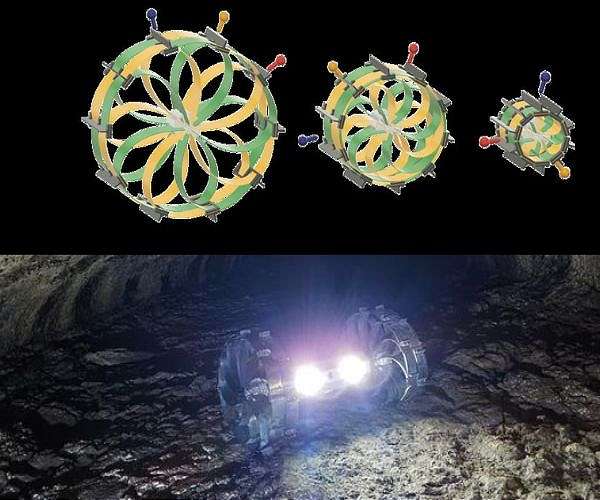
illustration only

Origami style lunar rover wheel expands to climb steep caves

by Riko Seibo
Tokyo, Japan (SPX) Dec 18, 2025

A joint team from the Korea Advanced Institute of Science and Technology KAIST and the Unmanned Exploration Laboratory UEL has developed a transformable airless wheel designed to help small rovers access steep lunar pits and lava tubes. The wheel targets subsurface sites considered promising for future human habitats because they shield against cosmic radiation and extreme temperature swings.

The study introduces an origami inspired deployable wheel that can change its diameter to overcome obstacles that would halt conventional fixed geometry rover wheels, and the research appears in the December issue of Science Robotics. The concept supports mission architectures that use multiple small rovers instead of a single large vehicle, providing redundancy so exploration can continue even if some units fail.

Small rovers typically struggle on the sharp slopes and rugged terrain at the entrances to lunar pits because their compact wheels limit traction and obstacle clearance. Variable diameter wheels have been proposed as a solution, but implementing them for lunar conditions has been difficult because hardware must remain light while withstanding abrasive dust and vacuum conditions that promote cold welding of metal parts.

To address this, the team led by Professor Dae-Young Lee of KAISTs Department of Aerospace Engineering created a compliant wheel that avoids complex mechanical joints. The design draws on the structural principles of the Da Vinci bridge and origami patterns so the wheel transforms through controlled deformation of its structure rather than through traditional hinge mechanisms.

The wheel can expand from a compact 230 millimeters to 500 millimeters in diameter, allowing a rover to stay small and low during transport but increase its effective size to climb larger obstacles once deployed on the Moon. The structure uses an elastic metal frame and fabric tensioners instead of conventional hinges, which supports reliable operation in vacuum and reduces the risk of cold welding and failures caused by fine lunar dust.

The researchers tested the wheel in artificial lunar soil simulants, where it showed strong traction on loose slopes. Drop tests indicated that the structure could withstand impact loads equivalent to a 100 meter fall under lunar gravity, demonstrating that the wheel can tolerate severe mechanical shocks during operations.

The project involved experts from several Korean space institutes to examine the technical feasibility for future missions. Prof. Lee described the wheel as a practical and reliable option for traversing demanding lunar terrain and noted that this technology could support Koreas participation in upcoming lunar exploration efforts even though challenges in areas such as communication and power remain.

From a scientific standpoint, Dr. Chae Kyung Sim, Head of the Planetary Science Group at the Korea Astronomy and Space Science Institute KASI, described lunar pits as "natural geological heritages" and stressed that the new wheel design lowers technical barriers to reaching these targets. Dr. Jongtae Jang, Principal Researcher at the Korea Aerospace Research Institute KARI, explained that the team optimized and verified the wheel with mathematical thermal models so it can endure temperature swings of about 300 degrees on the Moon.

Research Report:Soft deployable airless wheel for lunar lava tube intact exploration

Related Links
The Korea Advanced Institute of Science and Technology KAIST
Mars News and Information at MarsDaily.com
Lunar Dreams and more

Subscribe Free To Our Daily Newsletters
Tweet

RELATED CONTENT
The following news reports may link to other Space Media Network websites.
MOON DAILY
Lunar dust study links space weathering to changes in Moon ultraviolet brightness
Los Angeles CA (SPX) Dec 11, 2025
SAN ANTONIO - Southwest Research Institute (SwRI) scientists working with researchers at UT San Antonio have analyzed Apollo lunar soil samples to determine how space weathering alters the Moon's surface and affects its far-ultraviolet (FUV) reflectance. The team examined how exposure to solar wind and micrometeoroid impacts over long periods changes the FUV spectral response of lunar grains, using only a small number of particles from Apollo-era missions. Using modern instruments and methods, the ... read more

MOON DAILY
ISS to change commanders before Soyuz crew leaves orbit

Lodestar Space wins SECP support to advance AI satellite awareness system

Micro nano robots aim to cut carbon buildup in closed life support systems

NASA extends ISS National Lab management contract through 2030

MOON DAILY
Musk signals plan to launch IPO for SpaceX

Southern Launch to host INNOSPACE missions from South Australian spaceports

Rocket Lab completes first dedicated JAXA mission with Electron launch

Neutron Hungry Hippo fairing completes qualification ahead of first launch

MOON DAILY
HiRISE camera aboard Mars Reconnaissance Orbiter passes 100000 image milestone

GoMars model simulates Martian dust storms to improve mission safety

NASA JPL Unveils Rover Operations Center for Moon, Mars Missions

Ancient Martian brines left bromine rich fingerprints in jarosite minerals

MOON DAILY
Experts at Hainan symposium call for stronger global space partnership

Triple Long March launches mark record day for Chinese space program

China prepares Qingzhou cargo ship for low cost resupply flights

Foreign satellites ride Kinetica 1 on new CAS Space mission

MOON DAILY
Financing the Next Space Boom: Options for Retail Investors to Stay Ahead

K2 Space raises 250m to scale Mega class high power satellites

Private capital targets mission-critical software power and platforms in new space economy

Smart modeling framework targets 6G spectrum chaos in space air and ground networks

MOON DAILY
What General Contractors Must Know About AI-Powered Estimating Software

X-MAT introduces X-FOAM: A game-changing ceramic foam for extreme environments

Digital twin successfully launched and deployed into space

Engineered interlayers boost satellite insulation and flexible electronics

MOON DAILY
RISTRETTO spectrograph cleared for Proxima b atmospheric hunt

Clues to the migration path of hot Jupiters in their orbits

Webb maps carbon rich atmosphere on distorted pulsar planet

Ultra hot super Earth shows dense atmosphere over magma ocean

MOON DAILY
Uranus and Neptune may be rock rich worlds

SwRI links Uranus radiation belt mystery to solar storm driven waves

Looking inside icy moons

Saturn moon mission planning shifts to flower constellation theory

Subscribe Free To Our Daily Newsletters


The content herein, unless otherwise known to be public domain, are Copyright 1995-2024 - Space Media Network. All websites are published in Australia and are solely subject to Australian law and governed by Fair Use principals for news reporting and research purposes. AFP, UPI and IANS news wire stories are copyright Agence France-Presse, United Press International and Indo-Asia News Service. ESA news reports are copyright European Space Agency. All NASA sourced material is public domain. Additional copyrights may apply in whole or part to other bona fide parties. All articles labeled "by Staff Writers" include reports supplied to Space Media Network by industry news wires, PR agencies, corporate press officers and the like. Such articles are individually curated and edited by Space Media Network staff on the basis of the report's information value to our industry and professional readership. Advertising does not imply endorsement, agreement or approval of any opinions, statements or information provided by Space Media Network on any Web page published or hosted by Space Media Network. General Data Protection Regulation (GDPR) Statement Our advertisers use various cookies and the like to deliver the best ad banner available at one time. All network advertising suppliers have GDPR policies (Legitimate Interest) that conform with EU regulations for data collection. By using our websites you consent to cookie based advertising. If you do not agree with this then you must stop using the websites from May 25, 2018. Privacy Statement. Additional information can be found here at About Us.