24/7 Space News
MOON DAILY
Lunar dust study links space weathering to changes in Moon ultraviolet brightness
illustration only

Lunar dust study links space weathering to changes in Moon ultraviolet brightness

by Clarence Oxford
Los Angeles CA (SPX) Dec 11, 2025

SAN ANTONIO - Southwest Research Institute (SwRI) scientists working with researchers at UT San Antonio have analyzed Apollo lunar soil samples to determine how space weathering alters the Moon's surface and affects its far-ultraviolet (FUV) reflectance. The team examined how exposure to solar wind and micrometeoroid impacts over long periods changes the FUV spectral response of lunar grains, using only a small number of particles from Apollo-era missions.

Using modern instruments and methods, the researchers re-examined soil returned by NASA's Apollo 11, 16 and 17 missions in the late 1960s and early 1970s. "These Apollo-era samples continue to be a cornerstone of lunar science, providing the most direct link to the Moon's surface processes and evolution, including space weathering," said SwRI's Dr. Ujjwal Raut.

The project was led by Caleb Gimar, who recently completed a PhD in physics through the SwRI-UT San Antonio Joint Graduate Program with support from NASA's Lunar Data Analysis Program, with Raut serving as principal investigator. "We are investigating how space weathering drives physical and chemical changes in lunar grains that largely control their far-ultraviolet reflectance - explaining why soils with different degrees of weathering vary in brightness and the way they scatter light in this spectral region," Gimar said.

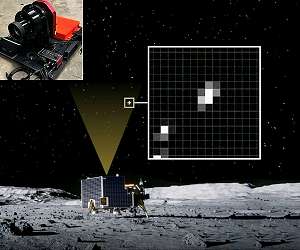
The findings help researchers interpret remote sensing data from the Lunar Reconnaissance Orbiter's Lyman-Alpha Mapping Project (LRO-LAMP), which has observed the Moon since 2009. "The SwRI-led LAMP instrument was designed to search for signs of water ice by peering into the permanently shadowed polar craters using far-ultraviolet light from stars instead of the Sun," said Dr. Kurt D. Retherford, principal investigator of the LAMP instrument. "Accurately identifying that ice and estimating its abundance depends on understanding the far-ultraviolet reflectance of the dry lunar soil - while accounting for any mineralogical differences caused by space weathering - to robustly isolate hydration signatures from the soil itself."

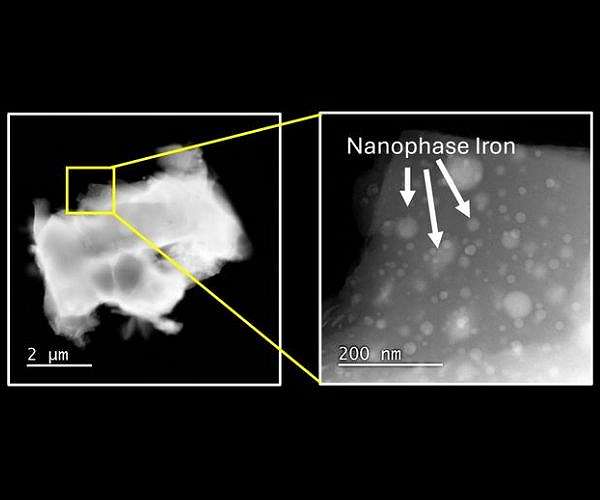
The work draws on SwRI's Center for Laboratory Astrophysics and Space Science Experiments (CLASSE) and UT San Antonio's Kleberg Advanced Microscopy Center (KAMC), which produced nanoscale images of the lunar grains. "We used a state-of-the-art transmission electron microscope - one that can actually image individual atoms," said Dr. Ana Stevanovic, KAMC director. "This microscope allows us to look deep inside individual grains of lunar dust and identify tiny minerals and space-weathering features while also measuring their chemical makeup."

Imaging shows that heavily weathered grain rims contain many nanophase iron particles, each with a width roughly one ten-thousandth that of a human hair, according to Stevanovic. Less weathered grains contain far fewer of these nanophase iron inclusions and appear brighter in the far-ultraviolet, linking the abundance of nanophase iron to darker FUV reflectance in more weathered soils.

The results are reported in the Journal of Geophysical Research: Planets. The paper, titled "The Influence of Space Weathering on the Far-Ultraviolet Reflectance of Apollo-Era Soils," was published on December 3, 2025.

Research Report:The Influence of Space Weathering on the Far-Ultraviolet Reflectance of Apollo-Era Soils

Related Links
Southwest Research Institute
Mars News and Information at MarsDaily.com
Lunar Dreams and more

Subscribe Free To Our Daily Newsletters
Tweet

RELATED CONTENT
The following news reports may link to other Space Media Network websites.
MOON DAILY
NASA prepares new lunar dust and seismic studies for Artemis IV
Washington DC (SPX) Dec 05, 2025
NASA has selected two science instruments for astronauts to deploy on the lunar surface during the Artemis IV mission to the Moon's south polar region, with the goal of improving understanding of the local environment to support future human and robotic exploration to the Moon and on to Mars. Nicky Fox, associate administrator for the Science Mission Directorate at NASA Headquarters in Washington, said the Apollo era showed that as missions travel farther from Earth, they become more reliant on sc ... read more

MOON DAILY
Lodestar Space wins SECP support to advance AI satellite awareness system

ISS to change commanders before Soyuz crew leaves orbit

Micro nano robots aim to cut carbon buildup in closed life support systems

NASA extends ISS National Lab management contract through 2030

MOON DAILY
Space shuttle design study maps path to breakthrough inventions

Neutron Hungry Hippo fairing completes qualification ahead of first launch

LandSpace reviews booster loss after Zhuque-3 reusable rocket test

UK plasma thruster test positions Pulsar Fusion for larger satellite propulsion

MOON DAILY
Martian sound study models acoustic signals in Jezero crater

Martian butterfly crater reveals low angle impact and buried lava history

Bacterial partnership offers pathway to produce Mars regolith bricks for future habitats

Chinese team runs long term Martian dust cycle simulation with GoMars model

MOON DAILY
Wenchang spaceport hits record cadence with double-digit launches in 2025

China consolidates new commercial space regulator and industry roadmap

Beijing space lab targets orbital data centers for AI era

China supports private space firms to expand global reach

MOON DAILY
Private capital targets mission-critical software power and platforms in new space economy

MDA Space plans C250 million senior unsecured note issue maturing 2030

SLI and AscendArc agree on 200 million GEO satellite leasing framework

Beyond Gravity positions new modular satellite platform for European LEO missions

MOON DAILY
Leading the Odds: Five Bookmakers Transforming Ireland's Modern Betting Landscape

Space operators urged to share costs of clearing orbital debris

X-MAT introduces X-FOAM: A game-changing ceramic foam for extreme environments

How Real-Time Follower Tracking Transforms Modern Social Media Analytics

MOON DAILY
Subaru OASIS survey uncovers massive planet and brown dwarf

The bacteria that wont wake up found in spacecraft cleanrooms

Supernova mixing traced as source of key life elements

RISTRETTO spectrograph cleared for Proxima b atmospheric hunt

MOON DAILY
SwRI links Uranus radiation belt mystery to solar storm driven waves

Looking inside icy moons

Saturn moon mission planning shifts to flower constellation theory

Could these wacky warm Jupiters help astronomers solve the planet formation puzzle?

Subscribe Free To Our Daily Newsletters


The content herein, unless otherwise known to be public domain, are Copyright 1995-2024 - Space Media Network. All websites are published in Australia and are solely subject to Australian law and governed by Fair Use principals for news reporting and research purposes. AFP, UPI and IANS news wire stories are copyright Agence France-Presse, United Press International and Indo-Asia News Service. ESA news reports are copyright European Space Agency. All NASA sourced material is public domain. Additional copyrights may apply in whole or part to other bona fide parties. All articles labeled "by Staff Writers" include reports supplied to Space Media Network by industry news wires, PR agencies, corporate press officers and the like. Such articles are individually curated and edited by Space Media Network staff on the basis of the report's information value to our industry and professional readership. Advertising does not imply endorsement, agreement or approval of any opinions, statements or information provided by Space Media Network on any Web page published or hosted by Space Media Network. General Data Protection Regulation (GDPR) Statement Our advertisers use various cookies and the like to deliver the best ad banner available at one time. All network advertising suppliers have GDPR policies (Legitimate Interest) that conform with EU regulations for data collection. By using our websites you consent to cookie based advertising. If you do not agree with this then you must stop using the websites from May 25, 2018. Privacy Statement. Additional information can be found here at About Us.