





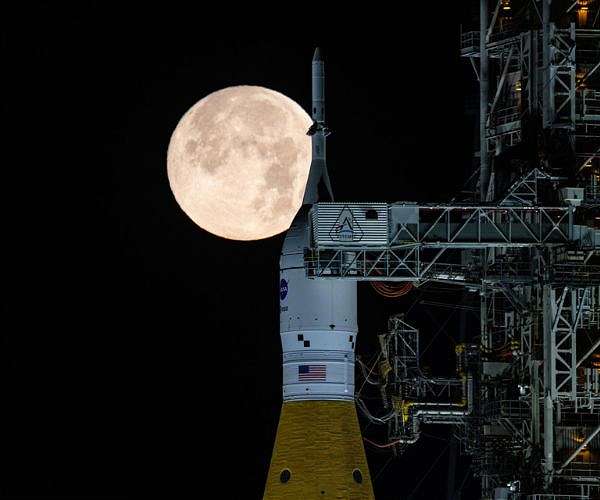
Teams spent the weekend replacing a filter in ground support equipment that was suspected of restricting liquid hydrogen flow during a partial fueling test on Feb. 12. Engineers gathered enough data from that earlier test to plan the full wet dress rehearsal and have since reconnected the liquid hydrogen line with the new filter while restoring the required environmental conditions around the hardware.
The upcoming rehearsal will take the launch team and supporting personnel through a complete sequence of launch operations. Controllers will load cryogenic liquid propellant into the SLS core and upper stage tanks, run a full launch countdown, demonstrate the ability to recycle the countdown clock, and then drain the tanks to practice procedures for a scrubbed launch attempt.
Launch controllers are scheduled to report to their consoles in the Launch Control Center at Kennedy at 6:40 p.m. EST on Feb. 17 to start a nearly 50 hour countdown. The simulated launch time for the rehearsal is set for 8:30 p.m. on Feb. 19, and the test will use a four hour window to accommodate the planned activities and any holds that may be inserted into the timeline.
Although the Artemis II crew will not participate directly in this ground test, NASA will send a dedicated team to the launch pad to rehearse Orion spacecraft closeout operations. These activities include securing the spacecraft by closing its hatches and practicing the steps that would be taken on an actual launch day when astronauts are aboard.
During the wet dress rehearsal, operators will carry out a detailed countdown, including two complete runs through the final 10 minutes known as terminal count. On the first run they will pause the clock at T minus 1 minute 30 seconds for up to three minutes before resuming to T minus 33 seconds, where they will hold again, mirroring the point where an automated launch sequence would normally hand off to the rocket.
After completing the first terminal count, the team will recycle the clock back to T minus 10 minutes and repeat the sequence. The second run will proceed to just inside T minus 30 seconds before ending the rehearsal. This approach allows engineers to simulate real world launch conditions and practice responses to potential scrubs driven by technical issues or changing weather.
NASA will not commit to a specific Artemis II launch date until the wet dress rehearsal is successfully completed and engineers finish reviewing the resulting data. In parallel, mission planners have been assessing additional viable launch opportunities and recently identified an extra option in the first week of March.
Program managers have concluded that March 6 is the earliest feasible launch opportunity that preserves time for this second wet dress rehearsal, post test data analysis, and the transition of the launch pad, SLS rocket, and Orion spacecraft from test configuration to full launch readiness. This schedule aims to balance thorough testing with maintaining momentum toward the first crewed flight of the Artemis campaign.
A continuous live stream showing the Artemis II SLS and Orion stack on the pad is available online for the public. For the wet dress rehearsal, NASA will provide an additional video feed with more camera views on the fueling day and will post status updates through the agency Artemis blog.
Related Links
Live stream of Artemis
Rocket Science News at Space-Travel.Com
| Subscribe Free To Our Daily Newsletters |
| Subscribe Free To Our Daily Newsletters |







