





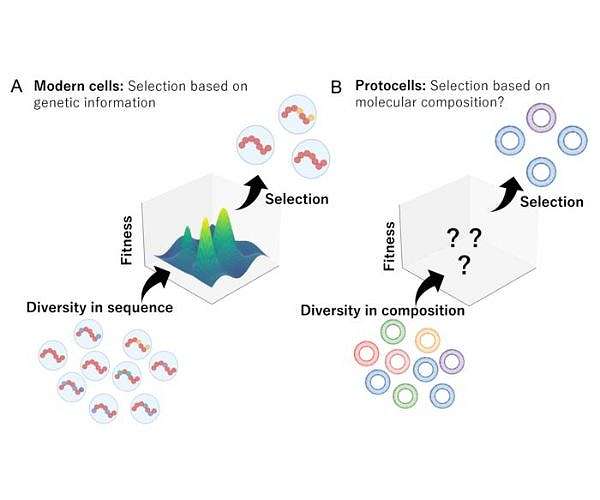
Researchers at the Earth-Life Science Institute (ELSI) at the Institute of Science Tokyo and collaborators investigated how mixed lipid membranes respond to repeated freeze thaw cycles that mimic temperature fluctuations on the early Earth. They focused on large unilamellar vesicles, or LUVs, made from three phospholipids that share a common phosphatidylcholine head group but differ in the number and arrangement of double bonds in their fatty acid tails.
The team prepared vesicles from POPC (1-palmitoyl-2-oleoyl-glycero-3-phosphocholine; 16:0-18:1 PC), PLPC (1-palmitoyl-2-linoleoyl-sn-glycero-3-phosphocholine; 16:0-18:2 PC), and DOPC (1,2-di-oleoyl-sn-glycero-3-phosphocholine; 18:1 (D9-cis) PC), either individually or in mixtures. Lead author and doctoral student Tatsuya Shinoda explained that phosphatidylcholine lipids were chosen because their structures connect naturally to those in modern cell membranes, they are plausible under prebiotic conditions, and they can retain essential internal contents.
Although these phospholipids are chemically similar, they form membranes with distinct physical properties. POPC has one unsaturated acyl chain with a single double bond, which yields relatively rigid membranes. PLPC also has one unsaturated chain but carries two double bonds, while DOPC has two unsaturated chains, each with one double bond, making PLPC- and DOPC-rich membranes more fluid than POPC-rich membranes.
To explore how these differences might matter for protocells, the researchers subjected the vesicles to three successive freeze thaw cycles. Under these conditions, POPC-rich vesicles tended to form aggregates of many small compartments pressed closely together, whereas PLPC- or DOPC-rich vesicles fused into much larger compartments. The probability of vesicle fusion and growth increased with the fraction of PLPC in the membrane, revealing a strong bias toward more unsaturated lipids during physically driven growth.
Coauthor Natsumi Noda noted that ice formation imposes mechanical and structural stress on membranes, which can destabilize or fragment vesicles and force reorganization upon thawing. She explained that the looser packing of membranes with highly unsaturated acyl chains may expose more hydrophobic regions as the bilayer restructures, making it easier for adjacent vesicles to interact and fuse in a way that is energetically favorable.
Fusion events are particularly interesting for origin-of-life scenarios because they can bring the contents of different compartments together. In a prebiotic environment rich in small organic molecules and potential genetic polymers, repeated fusion and mixing might have concentrated and recombined components in ways that promoted increasingly complex chemistry inside protocells.
To test how membrane composition affects the retention of genetic material, the team compared vesicles made entirely of POPC with those composed entirely of PLPC and loaded them with DNA before applying freeze thaw cycles. PLPC vesicles not only captured more DNA at the outset but also retained a larger fraction of their DNA cargo after each cycle than POPC vesicles, suggesting that more unsaturated membranes can both accumulate and preserve informational polymers more effectively under fluctuating conditions.
The findings point to icy environments as a plausible setting for key steps in prebiotic evolution, complementing widely discussed scenarios such as surface dry wet cycles and chemistry near hydrothermal vents. As ice grows, it expels solutes, concentrating organic molecules and vesicles in the remaining liquid channels and potentially accelerating fusion, content mixing, and selection among protocellular compartments.
However, the study also highlights a fundamental trade off for primitive membranes. Phospholipids with higher unsaturation make membranes more permeable and fusion prone, which aids growth and mixing of contents, but they also risk destabilization and leakage under stress. The most favorable composition for a given protocell would therefore depend on its environment, with different lipid mixtures becoming more or less fit under changing conditions.
Senior author Tomoaki Matsuura suggests that repeated freeze thaw cycles could, over many generations, drive a form of recursive selection on vesicle populations. If mechanisms such as osmotic pressure changes or mechanical shear provide routes for vesicle fission, populations of protocells could undergo cycles of growth, division, and selection, gradually shifting toward compositions and internal chemistries that better withstand environmental stresses.
As the molecular complexity inside vesicles increases, Matsuura argues, internal gene encoded functions could begin to influence fitness more strongly than simple membrane physics. In this view, protocells whose encapsulated genetic systems reinforced beneficial membrane properties would leave more descendants, eventually giving rise to primordial cells capable of full Darwinian evolution.
The work appears in the journal Chemical Science under the title "Compositional selection of phospholipid compartments in icy environments drives the enrichment of encapsulated genetic information." The authors are Tatsuya Shinoda, Natsumi Noda, Takayoshi Watanabe, Kazumu Kaneko, Yasuhito Sekine, and Tomoaki Matsuura.
Research Report:Compositional selection of phospholipid compartments in icy environments drives the enrichment of encapsulated genetic information
Related Links
Earth-Life Science Institute (ELSI)
Lands Beyond Beyond - extra solar planets - news and science
Life Beyond Earth
| Subscribe Free To Our Daily Newsletters |
| Subscribe Free To Our Daily Newsletters |







