24/7 Space News
EXO WORLDS
Hidden magma oceans could shield rocky exoplanets from harmful radiation
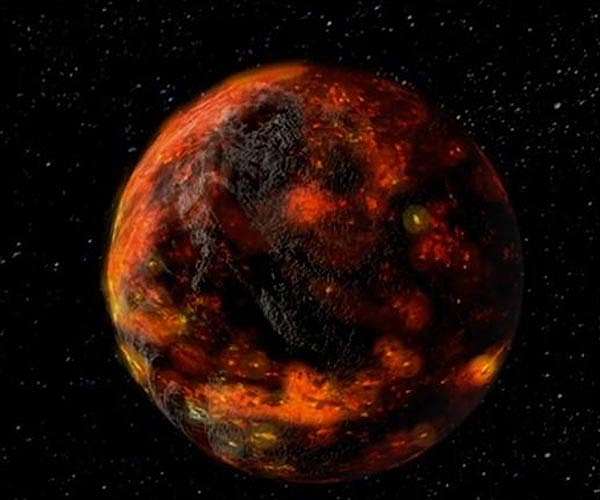
illustration only

Hidden magma oceans could shield rocky exoplanets from harmful radiation

by Lindsey Valich
Rochester NY (SPX) Jan 19, 2026

Deep beneath the surface of distant exoplanets known as super-earths, oceans of molten rock may be doing something extraordinary: powering magnetic fields strong enough to shield entire planets from dangerous cosmic radiation and other harmful high-energy particles.

Earth's magnetic field is generated by movement in its liquid iron outer core - a process known as a dynamo - but larger rocky worlds like super-earths might have solid or fully liquid cores that cannot produce magnetic fields in the same way.

In a paper published in Nature Astronomy, University of Rochester researchers, including Miki Nakajima, an associate professor in the Department of Earth and Environmental Sciences, report an alternative source: a deep layer of molten rock called a basal magma ocean (BMO). The findings could reshape how scientists think about planetary interiors and has implications for the habitability of planets beyond our solar system.

"A strong magnetic field is very important for life on a planet," Nakajima says, "but most of the terrestrial planets in the solar system, such as Venus and Mars, do not have them because their cores don't have the right physical conditions to generate a magnetic field. However, super-earths can produce dynamos in their core and/or magma, which can increase their planetary habitability."

Super-earths are larger than Earth but smaller than ice giants such as Neptune. Scientists believe they are primarily rocky like Earth, with solid surfaces rather than layers of gas such as those surrounding Jupiter or Saturn. Super-earths are the most common class of exoplanets detected in our galaxy, but they are curiously absent from our own solar system. Despite their name, "super-earth" refers only to size and mass, not to whether these planets resemble Earth in other ways.

Because super-earths appear so frequently, they offer a crucial window into how planets form and evolve. Many super-earths orbit within their stars' habitable zones, where liquid water could exist. By studying their compositions, atmospheres, and magnetic fields, scientists are uncovering clues about the origins of planetary systems and signs of conditions that might allow life to thrive elsewhere.

Scientists believe that shortly after Earth formed, it likely had a BMO. This layer of partially or fully molten rock at the base of a planet's mantle can affect its magnetic field, heat transport, and chemical evolution. Because super-earths are larger than Earth and experience much higher internal pressures, they are more likely to have long-lasting BMOs - making BMOs a key factor in understanding the interiors, magnetic fields, and habitability of super-earths.

To recreate the extreme pressures inside super-earths, Nakajima and her colleagues conducted laser shock experiments at URochester's Laboratory for Laser Energetics, combined with quantum mechanical simulations and planetary evolution models. They focused on studying molten rock under conditions similar to those expected in a BMO.

The researchers discovered that under those crushing pressures, deep-mantle molten rock becomes electrically conductive - enough to sustain a powerful magnetic field for billions of years. This suggests that on super-earths more than three to six times the size of Earth, BMO dynamos - driven by the movement of molten rock - could generate stronger, longer-lasting magnetic fields than those produced by Earth's core, potentially creating habitable conditions for life across the galaxy.

"This work was exciting and challenging, given that my background is primarily computational and this was my first experimental work," Nakajima says. "I'm very grateful for the support from my collaborators from various research fields to conduct this interdisciplinary work. I cannot wait for future magnetic field observations of exoplanets to test our hypothesis."

Related Links
University of Rochester
Lands Beyond Beyond - extra solar planets - news and science
Life Beyond Earth

Subscribe Free To Our Daily Newsletters
Tweet

RELATED CONTENT
The following news reports may link to other Space Media Network websites.
EXO WORLDS
Mixed crystal phase of superionic water mapped inside giant planets
Berlin, Germany (SPX) Jan 13, 2026
Temperatures of several thousand degrees Celsius and pressures of millions of atmospheres drive water into a superionic state in which hydrogen ions move freely through a solid lattice of oxygen atoms. In this exotic phase, which forms only under extreme conditions, water behaves like a hybrid of solid and liquid and shows very high electrical conductivity. Because this phase can efficiently carry electrical currents, researchers link superionic water to the generation of the unusual magnetic fiel ... read more

EXO WORLDS
Explore the World with These Travel Tips

The Quiet Transformation of GPS - What's Coming by 2026

NASA Back for Seconds with New Food System Design Challenge

New orbital mapping system targets Earth Moon libration traffic

EXO WORLDS
NASA moves moon rocket to launch pad ahead of Artemis 2 mission

PH-1 test flight advances Chinese reusable suborbital spacecraft plans

GE and Lockheed validate compact rotating detonation ramjet for hypersonic missiles

Firefly prepares Alpha Block II upgrade for Flight 8

EXO WORLDS
Ancient deltas reveal vast Martian ocean across northern hemisphere

Tiny Mars' big impact on Earth's climate

The electrifying science behind Martian dust

Sandblasting winds sculpt Mars landscape

EXO WORLDS
Tiangong science program delivers data surge

China tallies record launch year as lunar and asteroid plans advance

China harnesses nationwide system to drive spaceflight and satellite navigation advances

Shenzhou 21 crew complete eight hour spacewalk outside Tiangong station

EXO WORLDS
China outlines mega constellations in ITU satellite filings

ThinkOrbital raises seed funding to advance orbital defense and construction systems

Aerospacelab expands Pulsar navigation constellation work with new Xona satellite order

Multiple satellite filings demonstrate transparency, responsibility and ambition: China Daily editorial

EXO WORLDS
The decentralized future of space transactions

How IVRT Testing Ensures Consistent Product Quality

The Silent Partner - How Machine Learning Quietly Powers Modern Space Operations

Why Space Theme Slots Are Popular with Canadian Casino Players

EXO WORLDS
Frozen hydrogen cyanide crystals may have helped spark early chemistry for life

Pandora exoplanet mission checks in after launch

Mixed crystal phase of superionic water mapped inside giant planets

Berkeley Scientists set to home in on 100 signals from Seti at Home

EXO WORLDS
Jupiter's moon Europa has a seafloor that may be quiet and lifeless

Uranus and Neptune may be rock rich worlds

SwRI links Uranus radiation belt mystery to solar storm driven waves

Looking inside icy moons

Subscribe Free To Our Daily Newsletters


The content herein, unless otherwise known to be public domain, are Copyright 1995-2024 - Space Media Network. All websites are published in Australia and are solely subject to Australian law and governed by Fair Use principals for news reporting and research purposes. AFP, UPI and IANS news wire stories are copyright Agence France-Presse, United Press International and Indo-Asia News Service. ESA news reports are copyright European Space Agency. All NASA sourced material is public domain. Additional copyrights may apply in whole or part to other bona fide parties. All articles labeled "by Staff Writers" include reports supplied to Space Media Network by industry news wires, PR agencies, corporate press officers and the like. Such articles are individually curated and edited by Space Media Network staff on the basis of the report's information value to our industry and professional readership. Advertising does not imply endorsement, agreement or approval of any opinions, statements or information provided by Space Media Network on any Web page published or hosted by Space Media Network. General Data Protection Regulation (GDPR) Statement Our advertisers use various cookies and the like to deliver the best ad banner available at one time. All network advertising suppliers have GDPR policies (Legitimate Interest) that conform with EU regulations for data collection. By using our websites you consent to cookie based advertising. If you do not agree with this then you must stop using the websites from May 25, 2018. Privacy Statement. Additional information can be found here at About Us.