24/7 Space News
SOLAR SCIENCE
Ganymede aurora study links moon and Earth space weather
illustration only

Ganymede aurora study links moon and Earth space weather

by Sophie Jenkins
London (SDX) Feb 25, 2026

New observations of Jupiter's largest moon, Ganymede, reveal that its auroras share detailed structural similarities with auroras on Earth, suggesting that the physical processes that generate these lights may be universal across different types of celestial bodies.

A team from the Laboratory of Atmospheric and Planetary Physics (LPAP) at the University of Liege has used NASA's Juno spacecraft to resolve, for the first time, fine-scale features in Ganymede's auroras, which develop in the moon's thin oxygen atmosphere under the influence of its intrinsic magnetic field, the only such field known around a moon in the solar system.

Auroras have fascinated observers for centuries as diffuse, shifting curtains of red, green, purple and blue light that typically appear at high latitudes on Earth, although strong solar activity, such as the recent peak of the 11 year solar cycle, can drive them to mid latitudes where they become visible over much broader regions.

On Earth, these displays occur when the solar wind interacts with the planet's magnetic field, driving powerful electromagnetic processes that channel charged particles into the upper atmosphere, where they collide with gases such as oxygen and nitrogen and cause them to emit visible light.

Auroras are not unique to Earth and have been detected at other solar system bodies including Venus, Mars, Jupiter, Saturn and Uranus, but until now limitations in spatial resolution left key questions open about how closely auroras at different worlds resemble one another on small scales.

Juno, which has been orbiting Jupiter since 2016 and is approaching a decade of operations, provided a unique opportunity to investigate Ganymede's auroras during a high speed flyby on 7 July 2021 that brought the spacecraft close to the icy moon.

Philippe Gusbin, whose master's thesis in Space Sciences underpins the new analysis, notes that earlier observations of Ganymede's auroras, particularly from ground based facilities, could not resolve the small scale structures that are typical of planetary auroral emissions and thus offered only a coarse view of the phenomenon.

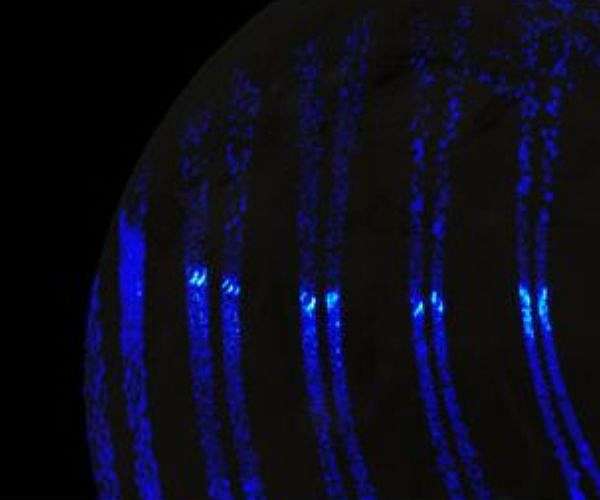
Using Juno's ultraviolet spectrograph (UVS), the LPAP team achieved spatial resolutions of a few kilometres, allowing them to reconstruct the overall shape of Ganymede's ultraviolet aurora from a set of narrow strips acquired as the spacecraft swept quickly past the moon.

When the researchers examined these high resolution strips in detail, they found that the auroral emission is not a uniform curtain but instead breaks up into a chain of discrete patches, revealing a fragmented structure across the auroral region.

Similar patchy forms, often described as "beads", have previously been documented in Earth's and Jupiter's auroras, where they are associated with sub storms and dawn storms, events that involve large scale rearrangements of a magnetosphere and the rapid release of stored energy that intensifies auroral activity.

Ganymede interacts with Jupiter's magnetospheric plasma in a way that the authors compare to Earth's interaction with the solar wind, and the detection of Ganymede auroral patches resembling terrestrial structures points to common underlying mechanisms that can arise whenever a magnetised body couples to its surrounding plasma environment and external drivers.

The new results appear in the journal Astronomy and Astrophysics in a letter titled "Juno's high spatial resolution ultraviolet observations of Ganymede's auroral patches. Constraints on the magnetospheric source region," which uses the morphology of the patches to place limits on where in Ganymede's magnetosphere the responsible processes occur.

Although Juno's close look at Ganymede lasted less than 15 minutes and the spacecraft will not repeat such a flyby, leaving open questions about how frequently the patches occur and how they evolve, future missions are expected to build on these findings with longer term monitoring.

The European Space Agency's Juice (Jupiter Icy Moons Explorer) mission, now en route to Jupiter with arrival planned for 2031, carries an ultraviolet spectrograph similar to Juno's and will dedicate extensive observation time to Ganymede's auroras, offering the prospect of tracing their variability and uncovering additional details of the moon's space environment.

Research Report:Juno's high spatial resolution ultraviolet observations of Ganymede's auroral patches. Constraints on the magnetospheric source region

Related Links
University of Liege
Solar Science News at SpaceDaily

Subscribe Free To Our Daily Newsletters
Tweet

RELATED CONTENT
The following news reports may link to other Space Media Network websites.
SOLAR SCIENCE
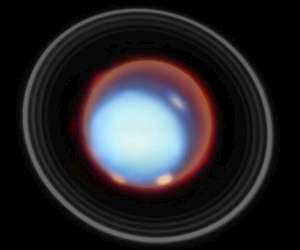
Webb maps Uranus upper atmosphere in 3D
London (SDX) Feb 23, 2026
A Northumbria University PhD student has led an international collaboration to construct the first three-dimensional view of Uranus upper atmosphere, showing how the planet's unusual magnetic field sculpts bright auroras thousands of kilometers above its clouds. Using the James Webb Space Telescope, operated by NASA with ESA and CSA, lead author Paola Tiranti and colleagues observed Uranus for nearly a full rotation and detected faint infrared emissions from molecules located as high as 5,000 kilo ... read more

SOLAR SCIENCE
Texas AM partners with Aegis to orbit TAMU SPIRIT research hub on ISS

Sophie Adenot, the second French woman to fly to space

International crew arrives at space station

Regrowing marginal farmland can curb emissions without cutting food output

SOLAR SCIENCE
Prometheus starts work on new Indiana solid rocket motor campus

NASA prepares Artemis II rocket for rollback after upper stage issue

Lithium trace in upper air linked to Falcon 9 rocket breakup

NASA delivers harsh assessment of botched Boeing Starliner test flight

SOLAR SCIENCE
Perseverance rover now self-locates precisely on Mars

Curiosity Blog, Sols 4798-4803: Back for More Science

Mars relay orbiter seen as backbone for future exploration

UAE extends Mars probe mission until 2028

SOLAR SCIENCE
Dragon spacecraft gears up for crew 12 arrival and station science work

China prepares offshore test base for reusable liquid rocket launches

Retired EVA workhorse to guide China's next-gen spacesuit and lunar gear

Tiangong science program delivers data surge

SOLAR SCIENCE
Infleqtion lists shares on NYSE as neutral atom quantum firm

AAC Clyde Space adds Sedna satellites to boost maritime data services

China tests AI satellite swarm for space-based computing

BlackSky expands Gen 3 Assured deals with new defense customer

SOLAR SCIENCE
India chases 'DeepSeek moment' with homegrown AI models

Swift observatory changes operations ahead of planned orbit reboost

Pale Blue opens Tsukuba site to scale satellite propulsion production

AST SpaceMobile deploys record low orbit cellular array on BlueBird 6

SOLAR SCIENCE
Cheops spots inside out exoplanet quartet

Study questions assumptions about hidden alien technosignals

Study revisits chances of detecting alien technosignatures

Hydrogen sulfide detected in distant gas giant exoplanets for the first time

SOLAR SCIENCE
Simple collapse may build cosmic snowman worlds

Jupiter size refined by new radio mapping

Polar weather on Jupiter and Saturn hints at the planets' interior details

Europa ice delamination may deliver nutrients to hidden ocean

Subscribe Free To Our Daily Newsletters


The content herein, unless otherwise known to be public domain, are Copyright 1995-2024 - Space Media Network. All websites are published in Australia and are solely subject to Australian law and governed by Fair Use principals for news reporting and research purposes. AFP, UPI and IANS news wire stories are copyright Agence France-Presse, United Press International and Indo-Asia News Service. ESA news reports are copyright European Space Agency. All NASA sourced material is public domain. Additional copyrights may apply in whole or part to other bona fide parties. All articles labeled "by Staff Writers" include reports supplied to Space Media Network by industry news wires, PR agencies, corporate press officers and the like. Such articles are individually curated and edited by Space Media Network staff on the basis of the report's information value to our industry and professional readership. Advertising does not imply endorsement, agreement or approval of any opinions, statements or information provided by Space Media Network on any Web page published or hosted by Space Media Network. General Data Protection Regulation (GDPR) Statement Our advertisers use various cookies and the like to deliver the best ad banner available at one time. All network advertising suppliers have GDPR policies (Legitimate Interest) that conform with EU regulations for data collection. By using our websites you consent to cookie based advertising. If you do not agree with this then you must stop using the websites from May 25, 2018. Privacy Statement. Additional information can be found here at About Us.