24/7 Space News
SOLAR SCIENCE
AI-driven solar model aims to extend space weather warnings
illustration only

AI-driven solar model aims to extend space weather warnings

by Silas Korrin
New York (SDX) Feb 23, 2026

New research by Southwest Research Institute and the National Science Foundation's National Center for Atmospheric Research has produced a new tool that could eventually extend space weather forecasts from hours to weeks. The approach aims to provide earlier warnings of solar activity that can disrupt GPS, power grids, satellites and astronaut operations.

The work targets a longstanding heliophysics challenge: anticipating where and when large, flare-producing active regions will emerge on the Sun. According to SwRI scientist Subhamoy Chatterjee, these solar active regions exhibit tangled magnetic fields and generate explosive events such as solar flares and coronal mass ejections, which can drive hazardous space weather.

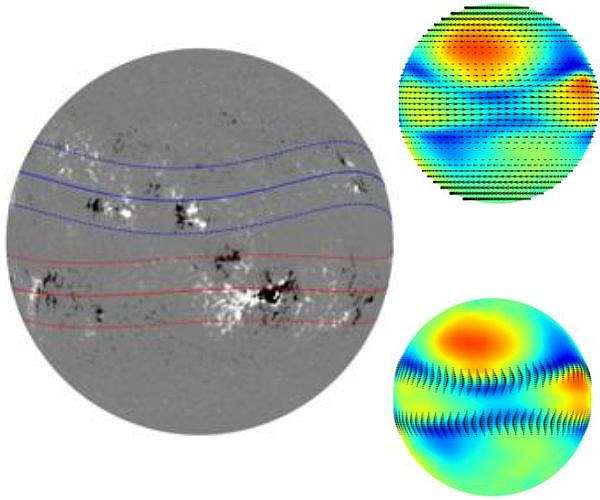
Solar active regions tend to cluster along large-scale, warped magnetic toroidal bands rather than appearing randomly across the solar surface. Using magnetic measurements from the Solar Dynamics Observatory's Helioseismic and Magnetic Imager taken on February 14, 2024, the team showed that surface magnetic patterns can be inverted to reconstruct critical subsurface magnetic states.

Most operational space weather tools currently rely on localized magnetic signatures that only become clearly predictive a few hours before an eruption. To push forecasts further ahead, the SwRI and NSF-NCAR team developed PINNBARDS, a Physics-Informed Neural Network-Based Active Region Distribution Simulator, which links visible solar active regions to the deep magnetic dynamics of the Sun's tachocline.

The tachocline is a thin transition layer between the uniformly rotating radiative interior and the more turbulent outer convection zone, and it plays a key role in solar magnetic field generation. By incorporating physical constraints into the neural network, PINNBARDS uses global surface magnetic information to infer how large-scale magnetic structures evolve in this deep region.

By bridging surface observations and deep solar magnetic processes, the researchers are advancing a physics-informed, AI-enabled framework for anticipating extreme space weather events. The global perspective built into PINNBARDS offers the potential for significantly longer forecast lead times, a capability viewed as critical for protecting communications networks, satellites and future human spaceflight.

"The reconstructed subsurface states from PINNBARDS provide initial conditions for forward simulations of solar magnetic evolution, opening the door to predicting where and when large, flare-producing active regions are likely to emerge weeks in advance," said Mausumi Dikpati, a senior scientist at NSF-NCAR who led the team. The latitude and longitude at which new active regions appear are especially important because they determine whether resulting solar particle bursts are likely to intersect Earth's orbit.

Research Report:A Physics Informed Neural Network for Deriving MHD State Vectors from Global Active Regions Observations

Related Links
Southwest Research Institute
Solar Science News at SpaceDaily

Subscribe Free To Our Daily Newsletters
Tweet

RELATED CONTENT
The following news reports may link to other Space Media Network websites.
SOLAR SCIENCE
Thunderstorm, not eclipse, drove tree signal spike in Dolomites
Paris, France (SPX) Feb 08, 2026
Around 14 hours before a partial solar eclipse crossed the Dolomites in northern Italy, a cluster of spruce trees showed a sharp, synchronized rise in electrical activity. A new opinion paper argues that this spike did not reflect any anticipatory response to the eclipse but was instead triggered by a local thunderstorm and nearby lightning. In a widely publicized study, Chiolerio and colleagues had reported that the trees appeared to "anticipate" the approaching eclipse, interpreting their bioele ... read more

SOLAR SCIENCE
Texas AM partners with Aegis to orbit TAMU SPIRIT research hub on ISS

Sophie Adenot, the second French woman to fly to space

International crew arrives at space station

Chinese visitors to Japan slump as spat rumbles on

SOLAR SCIENCE
Russian era ends at abandoned launchpad in South American jungle

NASA teams set for second Artemis II wet dress rehearsal

Vietnam licenses Musk's satellite internet firm Starlink

Latvian startup advances nuclear-fueled power for satellites and future Moon missions

SOLAR SCIENCE
Curiosity Blog, Sols 4798-4803: Back for More Science

Mars relay orbiter seen as backbone for future exploration

UAE extends Mars probe mission until 2028

Mars' 'Young' Volcanoes Were More Complex Than Scientists Once Thought

SOLAR SCIENCE
Dragon spacecraft gears up for crew 12 arrival and station science work

China prepares offshore test base for reusable liquid rocket launches

Retired EVA workhorse to guide China's next-gen spacesuit and lunar gear

Tiangong science program delivers data surge

SOLAR SCIENCE
AAC Clyde Space adds Sedna satellites to boost maritime data services

China tests AI satellite swarm for space-based computing

BlackSky expands Gen 3 Assured deals with new defense customer

Muon Space ramps up multi-mission satellite constellations

SOLAR SCIENCE
ST Engineering iDirect and G&S SatCom align network and service management on Intuition

Light based computing module aims to cut AI power demand

KSAT prepares Hyperion in orbit relay test for satellite data

Pale Blue opens Tsukuba site to scale satellite propulsion production

SOLAR SCIENCE
Hydrogen sulfide detected in distant gas giant exoplanets for the first time

Cheops spots inside out exoplanet quartet

Study revisits chances of detecting alien technosignatures

Engineered microbes use light to build new molecules

SOLAR SCIENCE
Jupiter size refined by new radio mapping

Polar weather on Jupiter and Saturn hints at the planets' interior details

Europa ice delamination may deliver nutrients to hidden ocean

Birth conditions fixed water contrast on Jupiters moons

Subscribe Free To Our Daily Newsletters


The content herein, unless otherwise known to be public domain, are Copyright 1995-2024 - Space Media Network. All websites are published in Australia and are solely subject to Australian law and governed by Fair Use principals for news reporting and research purposes. AFP, UPI and IANS news wire stories are copyright Agence France-Presse, United Press International and Indo-Asia News Service. ESA news reports are copyright European Space Agency. All NASA sourced material is public domain. Additional copyrights may apply in whole or part to other bona fide parties. All articles labeled "by Staff Writers" include reports supplied to Space Media Network by industry news wires, PR agencies, corporate press officers and the like. Such articles are individually curated and edited by Space Media Network staff on the basis of the report's information value to our industry and professional readership. Advertising does not imply endorsement, agreement or approval of any opinions, statements or information provided by Space Media Network on any Web page published or hosted by Space Media Network. General Data Protection Regulation (GDPR) Statement Our advertisers use various cookies and the like to deliver the best ad banner available at one time. All network advertising suppliers have GDPR policies (Legitimate Interest) that conform with EU regulations for data collection. By using our websites you consent to cookie based advertising. If you do not agree with this then you must stop using the websites from May 25, 2018. Privacy Statement. Additional information can be found here at About Us.