





These propulsion systems are essential to change orbits, perform end of life de-orbiting, carry out collision avoidance with space debris or other satellites, maintain or adjust altitude, and counteract aerodynamic drag to keep spacecraft on station.
Almost all systems in use today are effectively rockets that generate thrust by expelling onboard propellant at high velocity, and they are broadly grouped into chemical propulsion and electric propulsion technologies.
Chemical propulsion, familiar from launch vehicles that eject hot, high pressure gases at supersonic speeds through a nozzle, remains the only practical option for lifting payloads from Earth into space because of its ability to deliver very high thrust.
Once satellites are in orbit, operators increasingly turn to electric propulsion systems, which use electrical power from solar arrays or batteries to accelerate propellants through electric or magnetic fields.
To enable this process, the propellant must be ionised so that electrons are stripped from atoms or molecules, producing a plasma of positively charged ions and negatively charged electrons that can be manipulated by applied fields to generate thrust.
Electric propulsion can expel propellant at far higher speeds than chemical systems, reducing the amount of propellant needed for orbital manoeuvres, but the resulting thrust is extremely low, comparable to the weight of a sheet of paper resting on a hand, and is only effective in the vacuum of space.
For many high performance electric propulsion systems, xenon has been the traditional propellant because it is a non toxic noble gas that is largely chemically inert with common materials, relatively easy to ionise, and offers very favourable storage properties.
When xenon is stored under sufficient pressure it can reach a density higher than liquid water, allowing compact tank designs that save mass and volume on spacecraft.
However, xenon is rare and is produced by fractional distillation of air, a time consuming and energy intensive industrial process that yields only about 1 kilogram of xenon for every 1000 metric tons of oxygen produced.
The combination of limited production capacity, estimated at around 50 to 60 metric tons per year, and high processing costs drives xenon prices to around 5000 dollars per kilogram, creating concerns for future supply.
Forecasts suggesting up to 2000 satellites may be launched annually, with most requiring onboard propulsion, indicate that space industry demand for xenon alone could exceed global production, even before accounting for use in semiconductor manufacturing, medical applications and lighting.
Geopolitical factors have also affected the market, with Russia and Ukraine together responsible for roughly 25 to 30 percent of world xenon output and prices rising sharply after conflict broke out in the region.
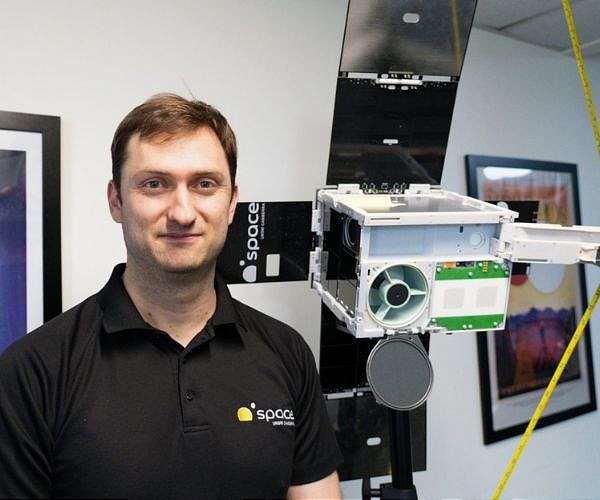
In this context, UNSW Canberra Space researcher Dr Trevor Lafleur and colleagues have completed what they describe as the most comprehensive review to date of iodine and its rapid emergence as an attractive alternative propellant for electric space propulsion systems.
Iodine is widely encountered in everyday life, from topical antiseptics and iodised table salt to pregnancy supplements, and is critical for human health, but it also exhibits a range of properties that make it promising for spacecraft propulsion.
It has a similar atomic mass to xenon and requires slightly less energy to ionise, enabling comparable or potentially superior performance in electric thrusters.
From a supply and cost perspective, iodine is about 100 times cheaper than xenon, while global production is roughly 500 to 600 times higher, suggesting that it can comfortably meet current and projected space industry needs.
At ambient conditions iodine is a solid, which provides higher storage density than gaseous xenon and eliminates the need for high pressure tanks, reducing the mass and size of propellant storage and associated hardware.
These cost and mass advantages are particularly important for small satellites and large constellations, where compact, low cost propulsion systems can significantly improve mission economics.
Despite its promise, iodine presents several engineering challenges that must be addressed before it can see widespread deployment.
Because it is stored as a solid, delivering iodine to a thruster is more complex than routing gas through a valve, and the propellant must be heated to slightly above 100 degrees Celsius so that it sublimates directly from solid to gas.
This requirement drives the need for integrated heating and flow control systems that can reliably bring iodine to the correct temperature and regulate its gaseous output to the thruster.
Iodine is also substantially more chemically reactive than xenon and can corrode common structural and plumbing materials such as iron and aluminium, so careful attention to system design and material selection is essential.
In the plasma state, iodine exhibits a much more complex chemistry than xenon, with many competing reaction pathways, and fundamental understanding of these processes remains less mature than for traditional propellants.
UNSW Canberra Space is contributing to this knowledge gap through research into iodine plasma behaviour, new propulsion concepts and system designs tailored to the propellant.
More than 100 iodine electric propulsion systems are already operating in space, but most of these units run at relatively low power levels below 100 watts, while larger platforms often need between 1 and 10 kilowatts for higher thrust applications.
Efforts are now focused on adapting iodine compatible architectures for higher power thrusters so that larger satellites can also exploit the propellant's benefits.
Another technical hurdle involves neutralisers, the devices that emit electrons to maintain charge balance in electric propulsion systems that accelerate positive ions to generate thrust.
Because iodine is extremely chemically reactive, engineering neutralisers that operate stably and with high performance in iodine environments has proven difficult and remains an active area of investigation.
UNSW Canberra Space is pursuing multiple iodine related projects that sit within its broader research priorities in space safety, security and sustainability, including work aimed at improving the fundamental understanding of iodine plasmas.
The team has partnered with the University of Michigan to carry out what is described as a world first audit of iodine propulsion systems, tracking their evolution from initial design through to on orbit performance.
This audit is intended to provide the wider space community with better insight into the capabilities and reliability of iodine based propulsion technologies.
With collaborators at Ecole Polytechnique, CNRS and Safran in France, working through their joint COMHET laboratory, the group has also developed one of the most advanced iodine plasma chemistry models currently available.
The UNSW Canberra Space researchers are using this model to interpret laboratory measurements and to support numerical simulations that can inform the design of future iodine fuelled propulsion systems.
Dr Lafleur, a physicist and engineer with more than 14 years of experience in plasma physics and space propulsion, was part of the team that designed and flew the first iodine fuelled electric propulsion system demonstrated in space.
Related Links
UNSW Canberra Space
Microsat News and Nanosat News at SpaceMart.com
| Subscribe Free To Our Daily Newsletters |
| Subscribe Free To Our Daily Newsletters |








