24/7 Space News
EXO WORLDS
Cheops spots inside out exoplanet quartet
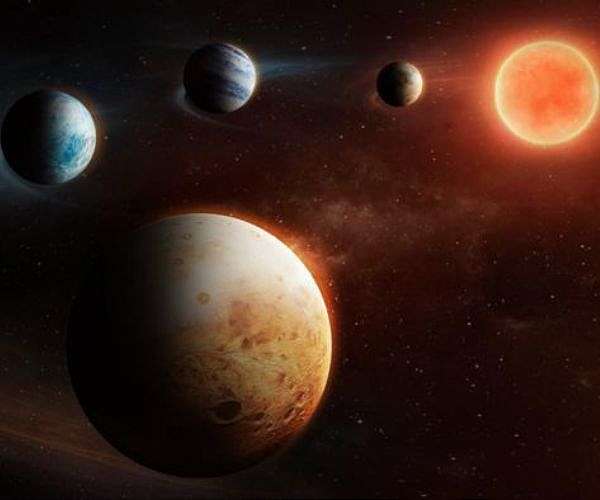
illustration only

Cheops spots inside out exoplanet quartet

by Erica Marchand
Paris, France (SPX) Feb 16, 2026

Many students learn memory tricks to remember the order of the Solar System's planets, with rocky worlds close to the Sun and gas giants farther out.

Astronomers have now found a nearby planetary system that breaks that familiar pattern.

An international team led by Thomas Wilson of the University of Warwick used ESA's Characterising Exoplanet Satellite, Cheops, along with other space and ground based observatories, to study the red dwarf star LHS 1903 and its planets.

LHS 1903 is a small, cool M dwarf star that shines less brightly than the Sun.

Earlier work had identified three planets orbiting this star.

Measurements showed that the innermost of these worlds is rocky, while the two outer ones are gaseous planets with thick atmospheres.

Cheops observations revealed something unexpected: a fourth planet orbiting even farther from LHS 1903.

Follow up analysis indicates that this outermost planet is small and rocky, even though it resides where a gas rich planet would normally be expected.

The resulting architecture is rocky, gaseous, gaseous and then rocky again, an inside out order that defies standard planet formation models.

Current theories predict that close to a young star, intense radiation strips away surrounding gas, leaving behind compact rocky planets.

Farther out in the cooler regions of a protoplanetary disc, gas can accumulate around solid cores to form gas giants or gas rich worlds.

A rocky planet at large distance from its star therefore poses a puzzle.

The team examined whether violent events could explain the observations, such as a collision with a large asteroid, comet or planetary body that might have blown away a gaseous envelope from the outer planet.

They also considered whether the planets could have swapped orbits over time, reshuffling the system.

Simulations and orbital calculations did not support these scenarios, leading the researchers to favour a different explanation.

Their preferred picture is that the planets around LHS 1903 did not all form at once, but instead emerged one after another.

In the conventional view, planets grow from a disc of gas and dust as many planetary embryos form roughly simultaneously and then evolve over millions of years into planets of various sizes and compositions.

In contrast, LHS 1903 appears to host a system where the star may have given rise to planetary siblings sequentially, a process known as inside out planet formation.

That idea was proposed about a decade ago, but until now evidence for it has been limited.

In this case, the outer rocky planet seems to be a latecomer that formed in an environment very different from that of its inner siblings.

By the time this world took shape, the system may have been largely depleted of gas that is normally considered crucial for building planets with thick atmospheres.

The discovery suggests that planet formation can proceed in a gas depleted disc, producing a small rocky planet where a gas rich world would normally be expected.

This makes the outer planet either a rare outlier or an early example of a wider class of planets that current models do not yet fully capture.

Scientists involved in the work argue that such systems push them to revisit assumptions built from the Solar System alone.

Traditional planet formation theories were largely developed from what is known about the eight planets orbiting the Sun.

As new instruments find more diverse exoplanet systems, including ones that look nothing like our own, theorists are adjusting their models to accommodate this growing variety.

Cheops project scientist Maximilian Gunther notes that many aspects of planet formation and evolution remain poorly understood, and that systems such as LHS 1903 provide crucial clues.

The mission is designed to measure exoplanet sizes and orbits with high precision, helping researchers link planetary properties to their formation histories.

The LHS 1903 system adds to a list of so called weird planetary systems that challenge expectations.

Each of these discoveries forces astronomers to question how universal the Solar System's layout really is.

In turn, they help place the Sun and its planets in context within the wider population of planetary systems in the Milky Way.

The work also raises questions about how often inside out formation might occur and whether other systems host late forming rocky planets in gas poor regions.

As surveys continue and instruments improve, more examples may come to light.

That would allow astronomers to test whether LHS 1903 is unique or part of a broader trend that demands a substantial revision of planet formation theory.

Research Report: Gas-depleted planet formation occurred in the four-planet system around the red dwarf LHS 1903

Related Links
European Space Agency
Lands Beyond Beyond - extra solar planets - news and science
Life Beyond Earth

Subscribe Free To Our Daily Newsletters
Tweet

RELATED CONTENT
The following news reports may link to other Space Media Network websites.
EXO WORLDS
JWST study links sulfur rich gas giants to core growth in distant HR 8799 system
Los Angeles CA (SPX) Feb 10, 2026
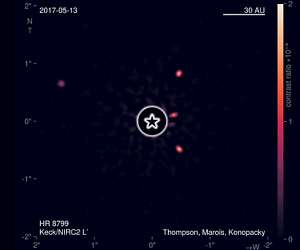
Gas giants are large planets composed mainly of hydrogen and helium with dense cores but no solid surfaces. Astronomers have long debated how the most massive of these worlds form and where the boundary lies between true planets and brown dwarfs. A new investigation of the HR 8799 planetary system using the James Webb Space Telescope provides key evidence that even very massive gas giants can grow like Jupiter rather than forming like failed stars. HR 8799 lies about 133 light years away in the co ... read more

EXO WORLDS
Launch to ISS pushed to Thursday over weather: NASA

NASA crew set for flight to ISS

Voyager wins NASA ISS mission management role through 2030

Sophie Adenot, the second French woman to fly to space

EXO WORLDS
xAI sees key staff exits, Musk promises moon factories

Vietnam licenses Musk's satellite internet firm Starlink

UK space firm Skyrora explores buying assets of struggling rival Orbex

Ariane 6 four booster launcher completes on schedule mission

EXO WORLDS
Mars' 'Young' Volcanoes Were More Complex Than Scientists Once Thought

Curiosity Blog, Sols 4788-4797: Welcome Back from Conjunction

NASA Study: Non-biologic Processes Don't Fully Explain Mars Organics

Martian toxin found to toughen microbe built bricks

EXO WORLDS
Dragon spacecraft gears up for crew 12 arrival and station science work

China prepares offshore test base for reusable liquid rocket launches

Retired EVA workhorse to guide China's next-gen spacesuit and lunar gear

Tiangong science program delivers data surge

EXO WORLDS
BlackSky expands Gen 3 Assured deals with new defense customer

Muon Space ramps up multi-mission satellite constellations

ESA member states back SWISSto12 HummingSat with fresh funding round

Aerospacelab expands Pulsar navigation constellation work with new Xona satellite order

EXO WORLDS
Abundant element alloy enables rare earth free cryogenic cooling

JUNO VR system brings detector events into immersive 3D space

Astroscale Japan to mature electric refueling for future GEO servicing

Anthropic unveils new AI model as OpenAI rivalry heats up

EXO WORLDS
Debris disc oddities point to hidden outer planets

Hydrogen sulfide detected in distant gas giant exoplanets for the first time

JWST study links sulfur rich gas giants to core growth in distant HR 8799 system

Pressure driven leakage from marine snow feeds deep ocean microbes

EXO WORLDS
Jupiter size refined by new radio mapping

Polar weather on Jupiter and Saturn hints at the planets' interior details

Europa ice delamination may deliver nutrients to hidden ocean

Birth conditions fixed water contrast on Jupiters moons

Subscribe Free To Our Daily Newsletters


The content herein, unless otherwise known to be public domain, are Copyright 1995-2024 - Space Media Network. All websites are published in Australia and are solely subject to Australian law and governed by Fair Use principals for news reporting and research purposes. AFP, UPI and IANS news wire stories are copyright Agence France-Presse, United Press International and Indo-Asia News Service. ESA news reports are copyright European Space Agency. All NASA sourced material is public domain. Additional copyrights may apply in whole or part to other bona fide parties. All articles labeled "by Staff Writers" include reports supplied to Space Media Network by industry news wires, PR agencies, corporate press officers and the like. Such articles are individually curated and edited by Space Media Network staff on the basis of the report's information value to our industry and professional readership. Advertising does not imply endorsement, agreement or approval of any opinions, statements or information provided by Space Media Network on any Web page published or hosted by Space Media Network. General Data Protection Regulation (GDPR) Statement Our advertisers use various cookies and the like to deliver the best ad banner available at one time. All network advertising suppliers have GDPR policies (Legitimate Interest) that conform with EU regulations for data collection. By using our websites you consent to cookie based advertising. If you do not agree with this then you must stop using the websites from May 25, 2018. Privacy Statement. Additional information can be found here at About Us.