24/7 Space News
MICROSAT BLITZ
Mexican Gxiba-1 CubeSat Starts Mission After Kibo Deployment
illustration only

Mexican Gxiba-1 CubeSat Starts Mission After Kibo Deployment

by Riko Seibo
Tokyo, Japan (SPX) Feb 16, 2026

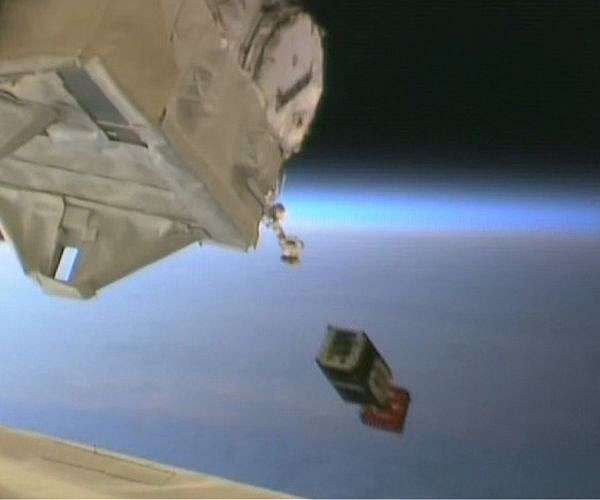
On February 3, 2026, the Mexican CubeSat Gxiba-1 was deployed from the Japanese Experiment Module Kibo on the International Space Station, beginning its on orbit mission. The small satellite was released into space using the Kibo module's robotic arm as Earth passed in the background.

Gxiba-1 was built by a team from the Popular Autonomous University of the State of Puebla in Mexico after the university won the sixth round of the KiboCUBE program. KiboCUBE is a joint initiative of the Japan Aerospace Exploration Agency and the United Nations Office for Outer Space Affairs that offers CubeSat deployment opportunities to emerging and developing space nations. The program is designed to help universities and institutions gain hands on experience in space projects and satellite operations.

The Mexican project moved through several steps on the way to deployment. UPAEP was selected as the sixth round KiboCUBE winner in February 2022. The completed CubeSat was delivered to JAXA's Tsukuba Space Center in August 2025 for inspection and integration. In October 2025, Gxiba-1 was launched to the International Space Station from the Tanegashima Space Center, and on February 3, 2026 it was released into orbit from Kibo.

Since deployment, the UPAEP team has been operating Gxiba-1 from the ground, tracking the satellite and beginning its planned observation work. The mission focuses on optical observations of volcanic activity and the spread of volcanic ash, with the aim of contributing to risk assessment and disaster related research. Experience gained from planning, building, and operating the spacecraft is expected to support future space activities in Mexico.

To mark the deployment, H.E. Ms. Melba Pria, Ambassador of Mexico to Japan, embassy officials, and members of the satellite development team visited the Tsukuba Space Center. The deployment sequence from Kibo was streamed live, and partners in Mexico organized a public viewing so that local audiences could watch the event in real time. The outreach activities highlighted both the educational role of the mission and the importance of international partnerships in space.

JAXA Director General of the Human Spaceflight Technology Directorate Mayumi Matsuura congratulated the UPAEP team on the successful deployment from Kibo. She thanked UNOOSA and UPAEP for their efforts, and noted that Gxiba-1 will now conduct optical observations of volcanoes and volcanic ash. Matsuura said she hopes the experience from the mission will support the further development of Mexican space activities and looked forward to taking on new challenges in space together with Mexico.

UNOOSA Director Aarti Holla-Maini praised the achievement and described Gxiba-1 as a result of close cooperation between UNOOSA, JAXA and UPAEP. She said the partnership shows the power of global collaboration and that the two organizations are working together to expand access to space for all. According to Holla-Maini, such missions directly support capacity building where it is most needed and most valued.

UPAEP Rector Emilio Banos expressed his gratitude to JAXA and UNOOSA for making it possible for emerging countries to develop their space capabilities through KiboCUBE. He said that challenges like the Gxiba-1 mission help students deepen their technical and scientific knowledge and prepare for future work in the space industry or academia. Banos added that for Mexico the satellite represents a strong incentive to invest in its own aerospace industry and to train human resources that can respond to national needs.

Ambassador Pria said that the successful deployment of Gxiba-1 shows the talent and creativity of Mexican students, researchers and faculty members. She underlined the value of international cooperation for sustainable space exploration and thanked JAXA, UNOOSA and the KiboCUBE program for supporting young people and strengthening ties with Japan. She said the mission is an example of how educational institutions, governments and international organizations can work together to share the benefits of space activities.

Gxiba-1 will continue its mission under the control of the UPAEP operations team in Mexico as it circles the Earth. The knowledge gained throughout the selection, design, integration, launch and operational phases is expected to feed into new projects and support the growth of Mexico's space sector. The mission also confirms the role of the Kibo module on the ISS as a platform for international cooperation and a path for new spacefaring nations to gain practical experience in satellite development and operation.

Related Links
Japan Aerospace Exploration Agency
Microsat News and Nanosat News at SpaceMart.com

Subscribe Free To Our Daily Newsletters
Tweet

RELATED CONTENT
The following news reports may link to other Space Media Network websites.
MICROSAT BLITZ
Firefly prepares Alpha Flight 7 stairway to seven mission
Los Angeles CA (SPX) Feb 10, 2026
Firefly Aerospace is preparing its next Alpha rocket mission, Flight 7 "Stairway to Seven", as a dedicated return-to-flight test from Space Launch Complex 2 at Vandenberg Space Force Base in California. The Alpha FLTA007 rocket will launch no earlier than February 18 on a mission focused on achieving nominal performance of both the first and second stages rather than deploying an operational payload. Flight 7 is the final Alpha mission in the rocket's current configuration and will pave the ... read more

MICROSAT BLITZ
Launch to ISS pushed to Thursday over weather: NASA

NASA crew set for flight to ISS

Voyager wins NASA ISS mission management role through 2030

Sophie Adenot, the second French woman to fly to space

MICROSAT BLITZ
xAI sees key staff exits, Musk promises moon factories

Vietnam licenses Musk's satellite internet firm Starlink

UK space firm Skyrora explores buying assets of struggling rival Orbex

Ariane 6 four booster launcher completes on schedule mission

MICROSAT BLITZ
Mars' 'Young' Volcanoes Were More Complex Than Scientists Once Thought

Curiosity Blog, Sols 4788-4797: Welcome Back from Conjunction

NASA Study: Non-biologic Processes Don't Fully Explain Mars Organics

Martian toxin found to toughen microbe built bricks

MICROSAT BLITZ
Dragon spacecraft gears up for crew 12 arrival and station science work

China prepares offshore test base for reusable liquid rocket launches

Retired EVA workhorse to guide China's next-gen spacesuit and lunar gear

Tiangong science program delivers data surge

MICROSAT BLITZ
BlackSky expands Gen 3 Assured deals with new defense customer

Muon Space ramps up multi-mission satellite constellations

ESA member states back SWISSto12 HummingSat with fresh funding round

Aerospacelab expands Pulsar navigation constellation work with new Xona satellite order

MICROSAT BLITZ
Abundant element alloy enables rare earth free cryogenic cooling

JUNO VR system brings detector events into immersive 3D space

Astroscale Japan to mature electric refueling for future GEO servicing

Anthropic unveils new AI model as OpenAI rivalry heats up

MICROSAT BLITZ
Debris disc oddities point to hidden outer planets

Hydrogen sulfide detected in distant gas giant exoplanets for the first time

JWST study links sulfur rich gas giants to core growth in distant HR 8799 system

Pressure driven leakage from marine snow feeds deep ocean microbes

MICROSAT BLITZ
Jupiter size refined by new radio mapping

Polar weather on Jupiter and Saturn hints at the planets' interior details

Europa ice delamination may deliver nutrients to hidden ocean

Birth conditions fixed water contrast on Jupiters moons

Subscribe Free To Our Daily Newsletters


The content herein, unless otherwise known to be public domain, are Copyright 1995-2024 - Space Media Network. All websites are published in Australia and are solely subject to Australian law and governed by Fair Use principals for news reporting and research purposes. AFP, UPI and IANS news wire stories are copyright Agence France-Presse, United Press International and Indo-Asia News Service. ESA news reports are copyright European Space Agency. All NASA sourced material is public domain. Additional copyrights may apply in whole or part to other bona fide parties. All articles labeled "by Staff Writers" include reports supplied to Space Media Network by industry news wires, PR agencies, corporate press officers and the like. Such articles are individually curated and edited by Space Media Network staff on the basis of the report's information value to our industry and professional readership. Advertising does not imply endorsement, agreement or approval of any opinions, statements or information provided by Space Media Network on any Web page published or hosted by Space Media Network. General Data Protection Regulation (GDPR) Statement Our advertisers use various cookies and the like to deliver the best ad banner available at one time. All network advertising suppliers have GDPR policies (Legitimate Interest) that conform with EU regulations for data collection. By using our websites you consent to cookie based advertising. If you do not agree with this then you must stop using the websites from May 25, 2018. Privacy Statement. Additional information can be found here at About Us.