24/7 Space News
EXO WORLDS
Study questions assumptions about hidden alien technosignals
illustration only

Study questions assumptions about hidden alien technosignals

by Robert Schreiber
Berlin, Germany (SPX) Feb 18, 2026

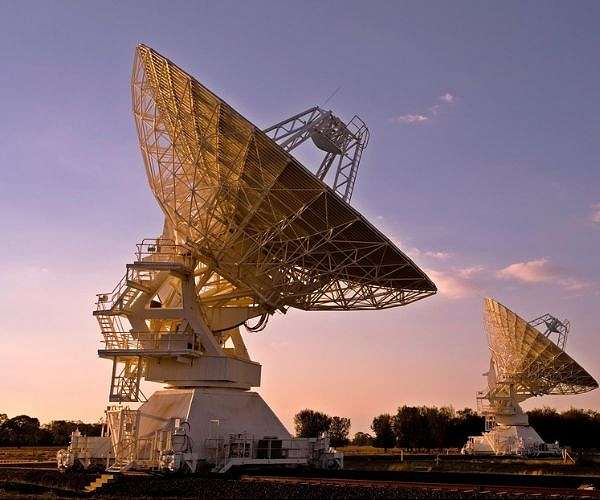
For more than sixty years, astronomers have conducted systematic searches for technosignatures, looking for artificial radio emissions, laser flashes, or excess heat that could reveal advanced civilizations in the Milky Way.

Despite decades of monitoring across radio, optical, and infrared bands, no technosignature has been confirmed, a result often attributed to the fact that only a small fraction of the Galaxy has been explored so far.

A common idea is that extraterrestrial signals may already have passed through Earth without being recognized, implying that similar signals might still be crossing our planet today and could be detected as instruments become more sensitive.

A new theoretical study by EPFL physicist Claudio Grimaldi from the Laboratory of Statistical Biophysics examines this assumption by asking what undetected past contacts would imply for current and future searches for technosignatures.

In the work, technosignatures are modeled as emissions from technological species or their artifacts located somewhere in the Milky Way, with signals spreading at the speed of light and lasting from very short durations, like days, to very long durations of thousands of years.

Earth is considered to be in contact whenever one of these signals sweeps across its position in space, but actual detection requires that the source lies within a maximum distance at which its signal remains strong enough for present or near-future telescopes to pick it out from background noise.

That distance effectively summarizes both the intrinsic strength of the technosignature and the sensitivity of the receiving instruments, meaning that a signal could easily cross Earth and still remain too faint, too brief, or at the wrong wavelength to be noticed.

Using a Bayesian statistical framework, Grimaldi connects three key quantities: the number of times alien technosignatures have contacted Earth in the past, the typical lifetime of those technosignatures, and the range of distances that current or upcoming SETI observations can realistically probe.

The analysis includes both broadly emitted signals, such as waste heat or omnidirectional transmissions that spread over large regions, and highly focused signals, such as intentional beacons or laser flashes tightly directed across interstellar space.

By exploring this parameter space, the study tests how many undetected past contacts would be required to make a present-day detection within a few hundred to a few thousand light years highly probable.

The results challenge some optimistic expectations, showing that achieving a high probability of detection within such relatively nearby volumes would often require that an implausibly large number of technosignatures have already crossed Earth unnoticed since 1960.

In many scenarios explored, the number of required past contacts exceeds even the number of potentially habitable planets estimated to exist within the same region of the Galaxy, making these specific combinations of assumptions unlikely rather than strictly impossible.

The picture changes when searches extend to much larger distances and to long-lived technosignatures that can persist as they traverse the Milky Way.

If technosignatures last thousands of years and are distributed on galactic scales, the probability of detection becomes higher at distances of several thousand light years or more, but the model still predicts that only a few detectable signals would exist in the entire Galaxy at any given time.

In this framework, the idea that many signals have quietly passed us by does not automatically imply that detection is imminent; instead, it points toward scenarios in which extraterrestrial technologies are rare, far away, or emitting over long timescales rather than being numerous and nearby.

The work therefore reinforces the view that technosignature science is a long term, statistically driven endeavor, where progress depends on expanding searches to cover wider regions and deeper volumes of the Milky Way rather than expecting obvious signals to appear quickly in our cosmic neighborhood.

This perspective supports ongoing and planned efforts to conduct broad, sensitive surveys across different wavelengths, aiming to improve constraints on how often technosignatures might arise and how they might be distributed through the Galaxy.

Research Report:Undetected Past Contacts with Technological Species: Implications for Technosignature Science

Related Links
Ecole polytechnique federale de Lausanne
Lands Beyond Beyond - extra solar planets - news and science
Life Beyond Earth

Subscribe Free To Our Daily Newsletters
Tweet

RELATED CONTENT
The following news reports may link to other Space Media Network websites.
EXO WORLDS
Study revisits chances of detecting alien technosignatures
Sydney, Australia (SPX) Feb 19, 2026
For more than sixty years, astronomers have searched the sky for signs of advanced extraterrestrial technology, scanning the Milky Way for artificial radio transmissions, optical flashes and excess infrared heat. Despite these efforts, no technosignature has been confirmed so far, a silence often attributed to the fact that only a tiny fraction of the cosmic search space has been explored. A new theoretical study from EPFL physicist Claudio Grimaldi examines a different possibility: that ali ... read more

EXO WORLDS
Texas AM partners with Aegis to orbit TAMU SPIRIT research hub on ISS

Sophie Adenot, the second French woman to fly to space

International crew arrives at space station

Chinese visitors to Japan slump as spat rumbles on

EXO WORLDS
Russian era ends at abandoned launchpad in South American jungle

NASA teams set for second Artemis II wet dress rehearsal

Vietnam licenses Musk's satellite internet firm Starlink

Latvian startup advances nuclear-fueled power for satellites and future Moon missions

EXO WORLDS
Curiosity Blog, Sols 4798-4803: Back for More Science

Mars relay orbiter seen as backbone for future exploration

UAE extends Mars probe mission until 2028

Mars' 'Young' Volcanoes Were More Complex Than Scientists Once Thought

EXO WORLDS
Dragon spacecraft gears up for crew 12 arrival and station science work

China prepares offshore test base for reusable liquid rocket launches

Retired EVA workhorse to guide China's next-gen spacesuit and lunar gear

Tiangong science program delivers data surge

EXO WORLDS
Hidden Legal Infrastructure Behind Commercial Space Industry

AAC Clyde Space adds Sedna satellites to boost maritime data services

China tests AI satellite swarm for space-based computing

BlackSky expands Gen 3 Assured deals with new defense customer

EXO WORLDS
ST Engineering iDirect and G&S SatCom align network and service management on Intuition

Light based computing module aims to cut AI power demand

KSAT prepares Hyperion in orbit relay test for satellite data

Pale Blue opens Tsukuba site to scale satellite propulsion production

EXO WORLDS
Hydrogen sulfide detected in distant gas giant exoplanets for the first time

Cheops spots inside out exoplanet quartet

Study revisits chances of detecting alien technosignatures

Engineered microbes use light to build new molecules

EXO WORLDS
Jupiter size refined by new radio mapping

Polar weather on Jupiter and Saturn hints at the planets' interior details

Europa ice delamination may deliver nutrients to hidden ocean

Birth conditions fixed water contrast on Jupiters moons

Subscribe Free To Our Daily Newsletters


The content herein, unless otherwise known to be public domain, are Copyright 1995-2024 - Space Media Network. All websites are published in Australia and are solely subject to Australian law and governed by Fair Use principals for news reporting and research purposes. AFP, UPI and IANS news wire stories are copyright Agence France-Presse, United Press International and Indo-Asia News Service. ESA news reports are copyright European Space Agency. All NASA sourced material is public domain. Additional copyrights may apply in whole or part to other bona fide parties. All articles labeled "by Staff Writers" include reports supplied to Space Media Network by industry news wires, PR agencies, corporate press officers and the like. Such articles are individually curated and edited by Space Media Network staff on the basis of the report's information value to our industry and professional readership. Advertising does not imply endorsement, agreement or approval of any opinions, statements or information provided by Space Media Network on any Web page published or hosted by Space Media Network. General Data Protection Regulation (GDPR) Statement Our advertisers use various cookies and the like to deliver the best ad banner available at one time. All network advertising suppliers have GDPR policies (Legitimate Interest) that conform with EU regulations for data collection. By using our websites you consent to cookie based advertising. If you do not agree with this then you must stop using the websites from May 25, 2018. Privacy Statement. Additional information can be found here at About Us.