





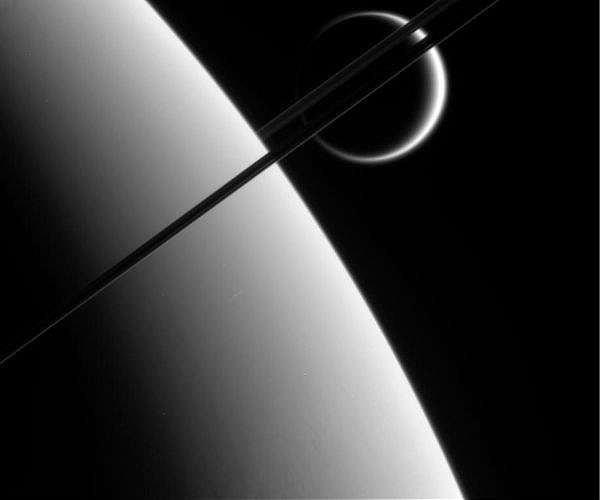
The study, led by SETI Institute scientist Matija Cuk, aims to reconcile several puzzles that emerged from the Cassini mission, including the youth of Saturns rings, Titans unusual orbital behavior, and the tilted orbit of the distant moon Iapetus. Near the end of its mission, Cassini precisely measured Saturns internal mass distribution, which controls how the planets spin axis slowly wobbles, or precesses. Those data showed that Saturns mass is slightly more concentrated toward its center than expected, breaking a previously suspected resonance in which Saturns precession matched that of Neptune.
To explain the new picture of Saturns interior and spin, earlier studies proposed that the planet once hosted an additional large moon. In that model, the extra moon was destabilized by a close encounter with Titan, was ultimately ejected, and its disruption supplied material for the rings. The new work revisits that idea using detailed computer simulations and finds that the most likely outcome is not ejection but a collision between the extra moon and Titan itself.
Hyperion, a small, irregular, sponge like moon whose orbit is locked in resonance with Titan, turned out to be a key clue. In many simulations, when the hypothetical extra moon became dynamically unstable, Hyperion was ejected or destroyed, and only rarely survived. The researchers concluded that the existing Titan Hyperion orbital lock is relatively young, dating back only a few hundred million years, roughly the same time that the extra moon is inferred to have disappeared.
The team proposes that Hyperion itself may be a survivor of this chaotic period, but as a second generation object. If the extra moon merged with Titan, the impact would have produced a spray of debris near Titans orbit. That rubble could later re accrete into a small, low density body like Hyperion, occupying the same region of space but with a new history tied to the merger event.
In this framework, todays Titan formed when a large Proto Titan, perhaps similar to Jupiters battered and airless moon Callisto, collided with a smaller Proto Hyperion. The energy of the impact would have resurfaced Titan, helping to erase older impact scars and contributing to the moons relatively smooth appearance at large scales. Titans currently eccentric orbit, which is slowly circularizing under tidal forces, signals a recent disturbance that fits naturally with such a merger.
The simulations also help explain why Iapetus, a distant Saturnian moon with a distinctive two toned surface, follows an unusually tilted orbit. Before it disappeared, Proto Hyperion appears to have gravitationally pumped up Iapetus orbital inclination, leaving a dynamical signature that persists today. This mechanism offers a coherent way to link the fates of multiple moons in the outer Saturn system to a single sequence of events.
If Titan did form in a moon moon merger, the question of how Saturns rings arose shifts inward. Members of the SETI Institute team had previously suggested that the rings are the debris of collisions among medium sized moons closer to Saturn. Later numerical studies from the University of Edinburgh and NASA Ames supported this picture, showing that most of the shattered material would clump back into moons while a fraction would be scattered inward to create a broad ring system.
For years, the leading trigger for that inner moon collision was thought to be the gravitational influence of the Sun. The new work instead links it directly to the Titan merger. As Titans orbit expanded and became more eccentric after the collision, it would have swept through orbital resonances with inner moons whose periods were simple fractions of Titans. In those resonances, repeated gravitational nudges can greatly amplify orbital eccentricities, pushing smaller moons onto intersecting paths and setting up catastrophic impacts.
Such a chain reaction would naturally occur after the Titan merger and could happen on timescales consistent with current estimates of the rings age, roughly 100 million years. While the exact timing of this second wave of destruction remains uncertain, tying it to Titans evolution offers a way to explain why the rings appear geologically young in a planetary system that is more than four billion years old.
The upcoming Dragonfly mission from NASA may provide an important test of this collision driven history for Titan and the Saturn system. Scheduled to reach Titan in 2034, the nuclear powered octocopter will explore multiple locations on the moons surface, sampling material and imaging the geology at close range. If Titan was built in a giant impact roughly half a billion years ago, Dragonfly may uncover chemical or structural evidence of that event in the crust and surface deposits.
Beyond solving specific mysteries at Saturn, the new model highlights how violent interactions among moons can reshape planetary systems long after their initial formation. Moons once thought to be quiet, frozen worlds may instead carry records of dramatic reconfigurations that continue to influence their orbits, surfaces, and potential habitability today. By tying Titans properties, Hyperions oddities, Iapetus tilt, and the youth of the rings into a single narrative, the research offers a unified view of a system still evolving under the legacy of ancient impacts.
Research Report: Origin of Hyperion and Saturn's Rings in A Two-Stage Saturnian System Instability
Related Links
SETI Institute
Explore The Ring World of Saturn and her moons
Jupiter and its Moons
The million outer planets of a star called Sol
News Flash at Mercury
| Subscribe Free To Our Daily Newsletters |
| Subscribe Free To Our Daily Newsletters |








