24/7 Space News
SATURN DAILY
Enceladus waves shape Saturn space weather
illustration only

Enceladus waves shape Saturn space weather

by Erica Marchand
Paris, France (SPX) Feb 10, 2026

Enceladus, a small icy moon of Saturn, generates electromagnetic ripples that stretch more than half a million kilometers through the giant planet's space environment. A new analysis of data from NASA's Cassini mission shows that this modest world acts as a large scale generator of Alfven waves that carry energy and momentum along Saturn's magnetic field lines.

An international team led by researchers at the Laboratoire de Physique de Plasmas in France examined 13 years of Cassini observations to map how Enceladus interacts with Saturn's magnetosphere. Plumes of water vapor and dust vent from fractures near the moon's south pole and become ionized, forming a plasma that is swept up by Saturn's rotating magnetic field and carved into a torus along the moon's orbit.

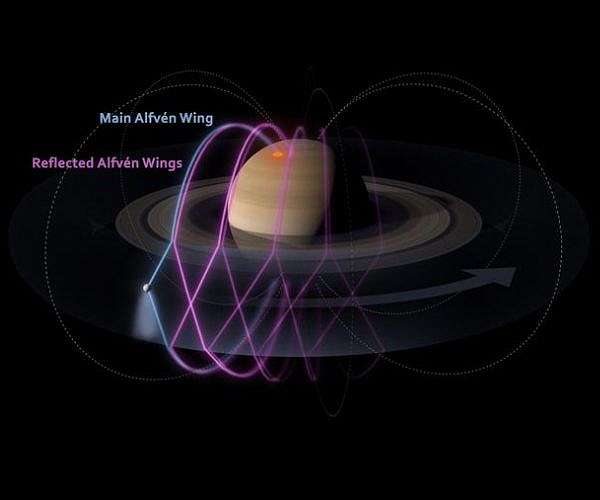
As this electrically conducting plasma torus moves through the magnetic field, it creates a primary Alfven wing structure that guides electromagnetic energy along field lines between Enceladus and Saturn's polar regions. The study finds that these wave structures are reflected back and forth between Saturn's ionosphere and the plasma torus, producing a complex lattice of crisscrossing reflected wings. The team reports that Enceladus's influence can be traced over distances exceeding 504,000 kilometers, more than 2,000 times the radius of the moon.

"Enceladus, Saturn's small icy moon, is famous for its water geysers, but its actual impact and interaction with the giant planet has remained partly unknown. This result from Cassini transforms our vision of the moon's role in the Saturnian system," said lead author Lina Hadid. By using a multi instrument approach combining four different Cassini instruments, the researchers were able to link magnetic, plasma, and wave signatures to the extended Alfven wing system.

The study reveals that the primary Alfven wing is not a simple structure but is threaded by fine scale filaments produced by turbulence in the plasma. These filaments help the waves reflect off the Enceladus plasma torus and reach high latitudes in Saturn's ionosphere, where they are associated with auroral features connected to the moon. Cassini measurements captured these signatures not only during close flybys but also along more distant trajectories that still intersected the magnetic field lines driven by Enceladus.

On 36 separate occasions, the team identified clear evidence of Alfven wave connections between Enceladus and Saturn, including at distances much larger than initially expected. Co author Thomas Chust said the findings confirm that the moon functions as a planetary scale Alfven wave generator capable of influencing the magnetospheric environment on the scale of Saturn itself. The work suggests that similar processes could operate at other moons and exoplanets with conducting atmospheres immersed in strong magnetic fields.

The authors note that the Enceladus system provides a natural laboratory for studying how small bodies can regulate the flow of energy and momentum in giant planetary magnetospheres. Understanding these interactions is important for interpreting auroral emissions, radiation belt dynamics, and plasma circulation around gas and ice giants. The results also offer a framework for future observations of the icy moons of Jupiter and other magnetized systems.

The team emphasizes that upcoming missions to Enceladus will benefit from carrying instruments designed to probe electromagnetic interactions in detail. "These results highlight the importance for future missions to Enceladus, such as the planned ESA orbiter and lander in the 2040s, to carry instrumentation that can study these electromagnetic interactions in even more detail," Hadid said. The work involved collaborators from multiple French laboratories and international partners across Europe and the United States and used the CDPP/AMDA data tool supported through the Europlanet 2024 Research Infrastructure project.

Research Report:Evidence of an extended Alfven wing system at Enceladus: Cassini's multi instrument observations.

Related Links
Europlanet
Explore The Ring World of Saturn and her moons
Jupiter and its Moons
The million outer planets of a star called Sol
News Flash at Mercury

Subscribe Free To Our Daily Newsletters
Tweet

RELATED CONTENT
The following news reports may link to other Space Media Network websites.
SATURN DAILY
Saturn's icy moon may host a stable ocean fit for life, study finds
Oxford, UK (SPX) Nov 08, 2025
New findings from NASA's Cassini mission show that Enceladus, one of Saturn's moons and a top contender for extra-terrestrial life, is losing heat from both poles - indicating that it has the long-term stability required for life to develop. The findings have been published 7 November in Science Advances. A new study led by researchers from Oxford University, Southwest Research Institute and the Planetary Science Institute in Tucson, Arizona has provided the first evidence of significant heat flow ... read more

SATURN DAILY
The coming end of ISS, symbol of an era of global cooperation

NASA confirms first flight to ISS since medical evacuation

Crew 12 set for Dragon launch to Station in February

Bezos's Blue Origin to 'pause' space tourism to focus on Moon efforts

SATURN DAILY
Isar Aerospace expands engine and stage testing at Esrange

NASA Moon mission launch srubbed to March after test

NASA books fifth Axiom private astronaut flight to space station

Musk merges xAI into SpaceX in bid to build space data centers

SATURN DAILY
Martian toxin found to toughen microbe built bricks

Curiosity Blog, Sols 4788-4797: Welcome Back from Conjunction

NASA Study: Non-biologic Processes Don't Fully Explain Mars Organics

Perseverance rover completes landmark AI guided trek across Jezero rim

SATURN DAILY
Dragon spacecraft gears up for crew 12 arrival and station science work

China prepares offshore test base for reusable liquid rocket launches

Retired EVA workhorse to guide China's next-gen spacesuit and lunar gear

Tiangong science program delivers data surge

SATURN DAILY
BlackSky expands Gen 3 Assured deals with new defense customer

ESA member states back SWISSto12 HummingSat with fresh funding round

Muon Space ramps up multi-mission satellite constellations

Aerospacelab expands Pulsar navigation constellation work with new Xona satellite order

SATURN DAILY
Launching the idea of data centers in space

Gilat books multimillion order for Sidewinder inflight ESA terminals

NTU Singapore boosts agile space access with trio of new projects

Musk merges xAI into SpaceX in bid to build space data centers

SATURN DAILY
Survey of 80 near Earth asteroids sharpens view of their origins and risks

Lab made cosmic dust experiment reveals paths to life chemistry

Einstein effect clears planets from tight double star systems

Engineered microbes use light to build new molecules

SATURN DAILY
Jupiter size refined by new radio mapping

Polar weather on Jupiter and Saturn hints at the planets' interior details

Europa ice delamination may deliver nutrients to hidden ocean

Birth conditions fixed water contrast on Jupiters moons

Subscribe Free To Our Daily Newsletters


The content herein, unless otherwise known to be public domain, are Copyright 1995-2024 - Space Media Network. All websites are published in Australia and are solely subject to Australian law and governed by Fair Use principals for news reporting and research purposes. AFP, UPI and IANS news wire stories are copyright Agence France-Presse, United Press International and Indo-Asia News Service. ESA news reports are copyright European Space Agency. All NASA sourced material is public domain. Additional copyrights may apply in whole or part to other bona fide parties. All articles labeled "by Staff Writers" include reports supplied to Space Media Network by industry news wires, PR agencies, corporate press officers and the like. Such articles are individually curated and edited by Space Media Network staff on the basis of the report's information value to our industry and professional readership. Advertising does not imply endorsement, agreement or approval of any opinions, statements or information provided by Space Media Network on any Web page published or hosted by Space Media Network. General Data Protection Regulation (GDPR) Statement Our advertisers use various cookies and the like to deliver the best ad banner available at one time. All network advertising suppliers have GDPR policies (Legitimate Interest) that conform with EU regulations for data collection. By using our websites you consent to cookie based advertising. If you do not agree with this then you must stop using the websites from May 25, 2018. Privacy Statement. Additional information can be found here at About Us.