24/7 Space News
STELLAR CHEMISTRY
Stellar rotation drives deep mixing in ageing red giant stars
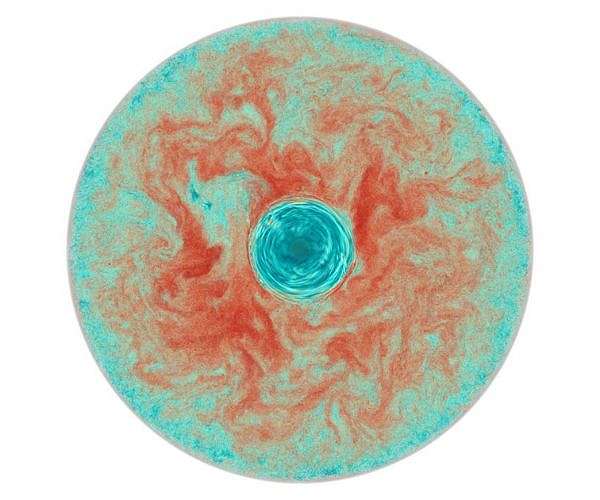
illustration only

Stellar rotation drives deep mixing in ageing red giant stars

by Silas Korrin
New York (SDX) Feb 23, 2026

Advances in supercomputing have enabled astronomers to resolve a long-standing problem in stellar evolution: how changes in the chemical composition at the centers of red giant stars connect to the altered chemistry seen at their surfaces as they age.

Researchers at the University of Victoria's Astronomy Research Centre and the University of Minnesota report that stellar rotation provides the missing link, by dramatically enhancing the mixing of material across a barrier layer that separates the nuclear-burning interior from the outer convective envelope.

As Sun-like stars exhaust hydrogen in their cores, they expand into red giants that can grow to about 100 times their original size. Since the 1970s, astronomers have observed changes in the surface composition of these stars during this expansion phase, including a drop in the ratio of carbon 12 to carbon 13 that cannot be explained without efficient transport of material from deep inside the star up to the surface.

Standard models include a stable layer between the core and the convective envelope that acts as a barrier to mixing, leaving open the question of how newly produced elements cross this region. Scientists knew that internal waves generated by the churning motions in the convective envelope could pass through the barrier, but earlier simulations indicated that these waves carried very little material and could not account for the observed chemical signatures.

Using new high resolution three dimensional hydrodynamical simulations, lead researcher and University of Victoria postdoctoral fellow Simon Blouin and his colleagues quantified the impact of stellar rotation on these internal waves. They found that rotation amplifies the ability of the waves to mix material across the otherwise stable layer to a degree that matches the compositional changes measured at the surfaces of typical red giant stars.

According to the team, the mixing rates in the rotating red giant they studied can exceed those in comparable non rotating stars by more than a factor of 100, and the efficiency of this process increases for faster rotating stars. Because red giants represent a future evolutionary phase of stars like the Sun, the work also offers a window on how the chemical structure of our own star will change as it ages.

To obtain these results, the researchers carried out large scale hydrodynamical calculations that follow how stellar material flows and interacts in three dimensions. The size and detail of the simulations required some of the most advanced supercomputers currently available to the academic community.

The team used computing resources at the Texas Advanced Computing Centre at the University of Texas at Austin, along with the new Trillium supercomputing cluster at SciNet at the University of Toronto. Trillium, which launched in August 2025 as part of the Digital Research Alliance of Canada, is one of the most powerful Canadian systems for large parallel simulations, and its expanded computing capacity was essential for completing the work.

Project lead Falk Herwig, a professor of physics and astronomy and director of the Astronomy Research Centre, notes that the simulations make it possible to isolate subtle physical effects inside stars and connect them directly to astronomical observations. He describes the calculations as the most computationally intensive simulations of stellar convection and internal gravity waves performed to date.

The numerical methods developed for this project have applications beyond stellar interiors. Similar approaches can help researchers study complex flows in other natural systems, including ocean circulation, atmospheric dynamics and even blood flow, enabling cross disciplinary advances in how scientists model and understand turbulence and wave driven transport.

Blouin plans to extend the investigation of rotation driven mixing to a broader range of stars. Future work will examine how different internal rotation profiles modify the efficiency of mixing and whether rotationally enhanced wave transport also operates in other types of stars and at other evolutionary stages.

Research Report:Wave-driven mixing enhanced by rotation in red giant branch stars

Related Links
University of Victoria
Stellar Chemistry, The Universe And All Within It

Subscribe Free To Our Daily Newsletters
Tweet

RELATED CONTENT
The following news reports may link to other Space Media Network websites.
STELLAR CHEMISTRY
Strange 'inside-out' planetary system baffles astronomers
Paris, France (AFP) Feb 12, 2026
Surprised astronomers said Thursday they have discovered a star with planets in a bizarre order that defies scientific expectations - and suggests these faraway worlds formed in a manner never seen before. In our Solar System, the four planets closest to the Sun are small and rocky, while the four farther out are gas giants. Scientists had thought this planetary order - rocky first, then gaseous - was consistent across the universe. However, a star called LHS 1903 discovered in the Milky ... read more

STELLAR CHEMISTRY
Texas AM partners with Aegis to orbit TAMU SPIRIT research hub on ISS

Sophie Adenot, the second French woman to fly to space

International crew arrives at space station

Chinese visitors to Japan slump as spat rumbles on

STELLAR CHEMISTRY
Russian era ends at abandoned launchpad in South American jungle

NASA teams set for second Artemis II wet dress rehearsal

Vietnam licenses Musk's satellite internet firm Starlink

Latvian startup advances nuclear-fueled power for satellites and future Moon missions

STELLAR CHEMISTRY
Curiosity Blog, Sols 4798-4803: Back for More Science

Mars relay orbiter seen as backbone for future exploration

UAE extends Mars probe mission until 2028

Mars' 'Young' Volcanoes Were More Complex Than Scientists Once Thought

STELLAR CHEMISTRY
Dragon spacecraft gears up for crew 12 arrival and station science work

China prepares offshore test base for reusable liquid rocket launches

Retired EVA workhorse to guide China's next-gen spacesuit and lunar gear

Tiangong science program delivers data surge

STELLAR CHEMISTRY
AAC Clyde Space adds Sedna satellites to boost maritime data services

China tests AI satellite swarm for space-based computing

BlackSky expands Gen 3 Assured deals with new defense customer

Muon Space ramps up multi-mission satellite constellations

STELLAR CHEMISTRY
ST Engineering iDirect and G&S SatCom align network and service management on Intuition

Light based computing module aims to cut AI power demand

KSAT prepares Hyperion in orbit relay test for satellite data

Pale Blue opens Tsukuba site to scale satellite propulsion production

STELLAR CHEMISTRY
Hydrogen sulfide detected in distant gas giant exoplanets for the first time

Cheops spots inside out exoplanet quartet

Study revisits chances of detecting alien technosignatures

Engineered microbes use light to build new molecules

STELLAR CHEMISTRY
Jupiter size refined by new radio mapping

Polar weather on Jupiter and Saturn hints at the planets' interior details

Europa ice delamination may deliver nutrients to hidden ocean

Birth conditions fixed water contrast on Jupiters moons

Subscribe Free To Our Daily Newsletters


The content herein, unless otherwise known to be public domain, are Copyright 1995-2024 - Space Media Network. All websites are published in Australia and are solely subject to Australian law and governed by Fair Use principals for news reporting and research purposes. AFP, UPI and IANS news wire stories are copyright Agence France-Presse, United Press International and Indo-Asia News Service. ESA news reports are copyright European Space Agency. All NASA sourced material is public domain. Additional copyrights may apply in whole or part to other bona fide parties. All articles labeled "by Staff Writers" include reports supplied to Space Media Network by industry news wires, PR agencies, corporate press officers and the like. Such articles are individually curated and edited by Space Media Network staff on the basis of the report's information value to our industry and professional readership. Advertising does not imply endorsement, agreement or approval of any opinions, statements or information provided by Space Media Network on any Web page published or hosted by Space Media Network. General Data Protection Regulation (GDPR) Statement Our advertisers use various cookies and the like to deliver the best ad banner available at one time. All network advertising suppliers have GDPR policies (Legitimate Interest) that conform with EU regulations for data collection. By using our websites you consent to cookie based advertising. If you do not agree with this then you must stop using the websites from May 25, 2018. Privacy Statement. Additional information can be found here at About Us.