24/7 Space News
PHYSICS NEWS
Slow mantle flow built Antarctica gravity low over tens of millions of years
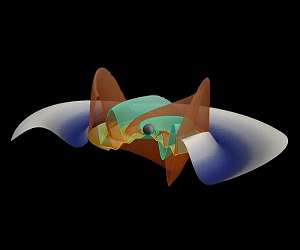
illustration only

Slow mantle flow built Antarctica gravity low over tens of millions of years

by Clarence Oxford
Los Angeles CA (SPX) Feb 18, 2026
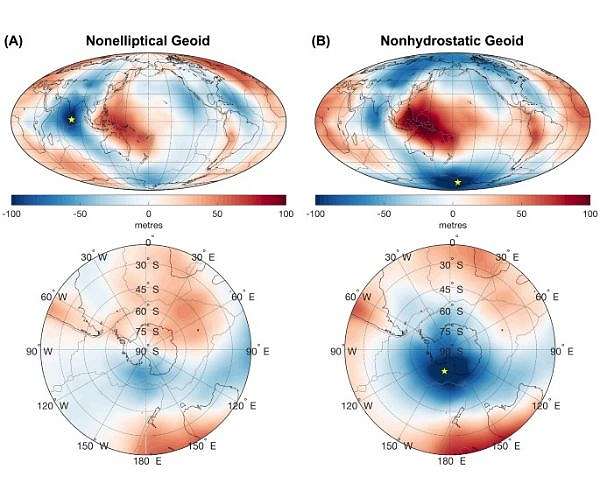
Gravity feels stable in everyday life, but its strength varies across the surface of the planet, and it is weakest beneath Antarctica after accounting for Earth rotation. These subtle variations arise from differences in rock density deep inside the planet, and around Antarctica they create a pronounced gravity low that also affects regional sea level by allowing the nearby ocean surface to sit slightly lower than it otherwise would.

A new study by researchers at the University of Florida and the Paris Institute of Earth Physics reconstructs how this Antarctic gravity low developed over tens of millions of years. The team focused on very slow rock movements in Earth mantle and how those flows reshaped the geoid, the gravity-defined surface to which global sea level roughly conforms.

Co author Alessandro Forte, a professor of geophysics at the University of Florida, said a better understanding of the link between Earth interior, gravity and sea level could improve insight into the growth and stability of large ice sheets. He noted that changes in the Antarctic gravity low appear to overlap in time with major shifts in the continent climate, including the onset of widespread glaciation.

To investigate the origin of the anomaly, Forte and colleague Petar Glisovic used data from a global seismological project that combines earthquake recordings with physics based modeling to reconstruct three dimensional structure inside Earth. They liken the approach to performing a CT scan of the planet, with seismic waves from earthquakes providing the signals that illuminate the interior instead of X rays.

Using this seismic information, the researchers built a model of mantle density variations and then applied physics based calculations to predict the resulting pattern of gravity at Earth surface. The computed gravity map closely matches high precision satellite measurements, which the authors interpret as evidence that their model captures the main features of the interior structure responsible for the observed geoid anomalies.

The team then used sophisticated numerical methods to run the mantle flow backward in time, effectively rewinding interior dynamics over the past 70 million years to the late age of dinosaurs. By tracking how density structures and associated gravity signals evolve in these simulations, they produced a series of snapshots that show the Antarctic gravity low emerging and changing through the Cenozoic.

The reconstructions indicate that the gravity low was initially weaker but began to strengthen between about 50 million and 30 million years ago. This interval coincides with major changes in Antarctica climate system, including the transition from a largely ice free continent to one dominated by extensive ice sheets.

Because gravity helps shape regional sea level, a strengthening low around Antarctica could influence how and where ice sheets grow by subtly altering coastal ocean heights and the buoyancy forces acting on ice margins. Changes in the distribution of mass within the mantle can also affect the elevation of the continent itself, adding another pathway by which deep Earth processes may interact with surface climate.

Forte plans to extend this work by explicitly coupling models of gravity, sea level and vertical land motion to test whether the evolving gravity low played a causal role in the initiation or growth of Antarctic ice. He frames the broader goal as answering how climate at the surface connects to slow but powerful processes far below, where mantle rocks flow on timescales of millions of years.

Research Report:Cenozoic evolution of earth's strongest geoid low illuminates mantle dynamics beneath Antarctica

Related Links
University of Florida
The Physics of Time and Space

Subscribe Free To Our Daily Newsletters
Tweet

RELATED CONTENT
PHYSICS NEWS
Gravitational wave triad puts relativity under intense scrutiny
Berlin, Germany (SPX) Feb 02, 2026
An international team working within the LIGO Virgo KAGRA collaboration has used the exceptionally clear gravitational wave signal GW250114 to carry out some of the most precise tests yet of Einstein general theory of relativity. The work, which appears in Physical Review Letters, relies heavily on contributions from researchers at the Max Planck Institute for Gravitational Physics (Albert Einstein Institute, AEI) in Potsdam. GW250114 was detected about a year ago and stands out as the strongest g ... read more

PHYSICS NEWS
Texas AM partners with Aegis to orbit TAMU SPIRIT research hub on ISS

Sophie Adenot, the second French woman to fly to space

International crew arrives at space station

Chinese visitors to Japan slump as spat rumbles on

PHYSICS NEWS
Russian era ends at abandoned launchpad in South American jungle

NASA teams set for second Artemis II wet dress rehearsal

Vietnam licenses Musk's satellite internet firm Starlink

Latvian startup advances nuclear-fueled power for satellites and future Moon missions

PHYSICS NEWS
Curiosity Blog, Sols 4798-4803: Back for More Science

Mars relay orbiter seen as backbone for future exploration

UAE extends Mars probe mission until 2028

Mars' 'Young' Volcanoes Were More Complex Than Scientists Once Thought

PHYSICS NEWS
Dragon spacecraft gears up for crew 12 arrival and station science work

China prepares offshore test base for reusable liquid rocket launches

Retired EVA workhorse to guide China's next-gen spacesuit and lunar gear

Tiangong science program delivers data surge

PHYSICS NEWS
AAC Clyde Space adds Sedna satellites to boost maritime data services

China tests AI satellite swarm for space-based computing

BlackSky expands Gen 3 Assured deals with new defense customer

Muon Space ramps up multi-mission satellite constellations

PHYSICS NEWS
ST Engineering iDirect and G&S SatCom align network and service management on Intuition

Light based computing module aims to cut AI power demand

KSAT prepares Hyperion in orbit relay test for satellite data

Pale Blue opens Tsukuba site to scale satellite propulsion production

PHYSICS NEWS
Hydrogen sulfide detected in distant gas giant exoplanets for the first time

Cheops spots inside out exoplanet quartet

Study revisits chances of detecting alien technosignatures

Engineered microbes use light to build new molecules

PHYSICS NEWS
Jupiter size refined by new radio mapping

Polar weather on Jupiter and Saturn hints at the planets' interior details

Europa ice delamination may deliver nutrients to hidden ocean

Birth conditions fixed water contrast on Jupiters moons


The content herein, unless otherwise known to be public domain, are Copyright 1995-2026 - SpaceDaily.com. All websites are published in Australia and are solely subject to Australian law and governed by Fair Use principals for news reporting and research purposes. AFP, UPI and IANS news wire stories are copyright Agence France-Presse, United Press International and Indo-Asia News Service. ESA news reports are copyright European Space Agency. All NASA sourced material is public domain. Additional copyrights may apply in whole or part to other bona fide parties. All articles labeled "by Staff Writers" include reports supplied to Space Media Network by industry news wires, PR agencies, corporate press officers and the like. Such articles are individually curated and edited by Space Media Network staff on the basis of the report's information value to our industry and professional readership. Advertising does not imply endorsement, agreement or approval of any opinions, statements or information provided by Space Media Network on any Web page published or hosted by Space Media Network. General Data Protection Regulation (GDPR) Statement Our advertisers use various cookies and the like to deliver the best ad banner available at one time. All network advertising suppliers have GDPR policies (Legitimate Interest) that conform with EU regulations for data collection. By using our websites you consent to cookie based advertising. If you do not agree with this then you must stop using the websites from May 25, 2018. Privacy Statement. Additional information can be found here at About Us.
Subscribe Free To Our Daily Newsletters