





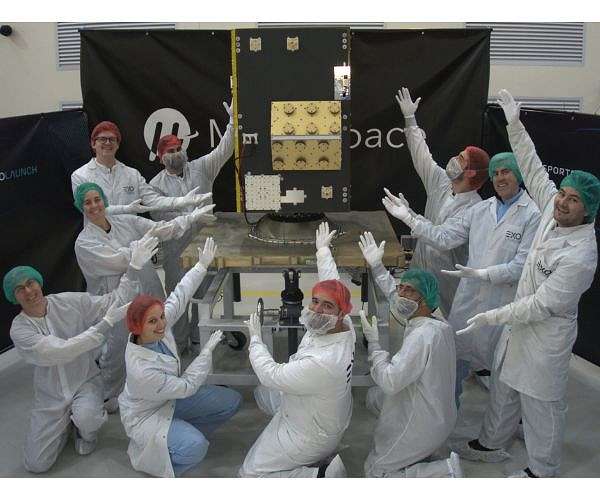
The Mountain View based company reports that its growing mission portfolio, expanding launch manifest and increasing demand for end-to-end, mission-optimized systems are driving this transition. In 2025 Muon Space secured major government contracts supporting missile warning and tracking and dual-use environmental monitoring while launching new commercial satellites and advancing multiple operational constellations. During the same period the company more than doubled its employee headcount and delivered over 100 percent year-over-year growth for the second year running.
Company leaders frame this shift as a response to changing customer expectations around speed and outcomes. "Customers are no longer asking for satellites - they're asking for operational outcomes," said Jonny Dyer, CEO of Muon Space. "They want high-performance missions delivered in months, not years, with tight integration across spacecraft, sensors, and operations. That's what the Mission Foundry delivers."
Muon Space positions its Mission Foundry as an industrial approach to constellation development that integrates spacecraft platforms, payloads, mission operations and data processing from initial simulation through to on-orbit operations. The company says this model enables customers to design, launch and bring constellations into service faster and more affordably than traditional programs while maintaining higher performance and reliability.
The Mission Foundry builds on the firm's Halo technology stack, its M-class and XL-class spacecraft platforms, in-house propulsion capabilities and experience in advanced sensor design. These building blocks support missions across defense, civil and commercial domains including maritime intelligence, wildfire detection, logistics and agriculture, with architectures tailored to individual customer requirements rather than a single standard design.
Muon Space reports that its launch cadence is accelerating as it enters a period of sustained deployment backed by a growing government and commercial order book. In 2025 the company completed its third and fourth mission launches, and management expects a higher operational tempo in 2026 and beyond. Upcoming programs span hyperspectral mapping, radio frequency sensing, thermal infrared sensing, weather and atmospheric intelligence and other applications where rapid deployment and high performance are central.
Over the next 20 months Muon Space has 20 satellites manifested for launch, highlighting its shift toward continuous operations across multiple constellations. Many of these contracts were awarded in the second half of 2025, which the company cites as evidence of accelerating market traction. Near term missions include deployments for SNC, supporting its Vindler 2.0 constellation for RF collection and analytics, with the first three satellites scheduled to launch in the first quarter of 2026.
The company is also expanding its role in wildfire detection and monitoring through the FireSat program for Earth Fire Alliance. Three additional FireSats are scheduled to launch in mid 2026, expanding the constellation to reduce revisit times and improve early wildfire detection and situational awareness. FireSat Protoflight, launched in 2025, is approaching its first year of on-orbit operations, and the initial satellite in the wildfire monitoring constellation delivered its first detection imagery in 2025, validating performance and mission readiness.
Muon Space points to a series of customer and business milestones achieved over the past year. The company closed a 146 million dollar Series B financing round and supported the launch of Hydrosat's VanZyl-2 satellite in 2025. It also added senior leadership from the US Space Development Agency, Raytheon and Loft Orbital to support its next phase of execution and scale.
The firm has expanded its partnerships and recognition in adjacent markets. A new partnership with Hubble Network is intended to expand Bluetooth-based tracking services by combining Muon Space's satellites with Hubble's connectivity layer. FireSat development contributed to Muon Space receiving SpaceNews' 2025 Icon Award for Sustainability and Environmental Impact, and TIME Magazine named FireSat among its Best Inventions of 2025.
On the government side Muon Space continues to build its portfolio of national security and defense contracts. In 2025 the company was awarded a 44.6 million dollar US Space Force SBIR Phase III Other Transaction Agreement to demonstrate a dual-use environmental monitoring constellation. It also secured Stage II on a National Reconnaissance Office contract supporting the advancement of commercial electro optical capabilities.
Additional awards include a 1.9 million dollar SBIR Direct-to-Phase II contract from SpaceWERX in support of the Space Development Agency's missile warning and tracking mission. Muon Space has also been selected for the Missile Defense Agency's SHIELD indefinite delivery, indefinite quantity program, contributing to the development of next generation missile defense architecture with commercial space-based sensing and responsive deployment.
Key technology milestones underpin the mission pipeline and launch manifest. Muon Space expanded its production facilities by a factor of ten, increasing capacity to support up to 500 satellites per year. It also acquired propulsion startup Starlight Engines, bringing an in-house zinc-based propulsion system that is designed for improved cost, storage stability and rapid integration to accelerate manufacturing and integration flows.
The company launched its new XL spacecraft platform to support larger payloads, expanded mission flexibility and higher performance sensing. Muon Space has also signed an agreement with SpaceX to adopt Starlink mini laser terminals on its satellites, enabling persistent optical connectivity in orbit. Integration of these optical links is scheduled to begin in the third quarter of 2026 and is expected to enhance real time data delivery and crosslink capabilities across the firm's constellations.
With a growing launch manifest, expanded production capacity and a deepening pipeline of government and commercial missions, Muon Space says it is moving into a phase of sustained execution. The company aims to use its Mission Foundry model and Halo technology stack to convert innovative mission concepts into operational systems in orbit at increasing scale over the next several years.
Related Links
Muon Space
The latest information about the Commercial Satellite Industry
| Subscribe Free To Our Daily Newsletters |
| Subscribe Free To Our Daily Newsletters |







