





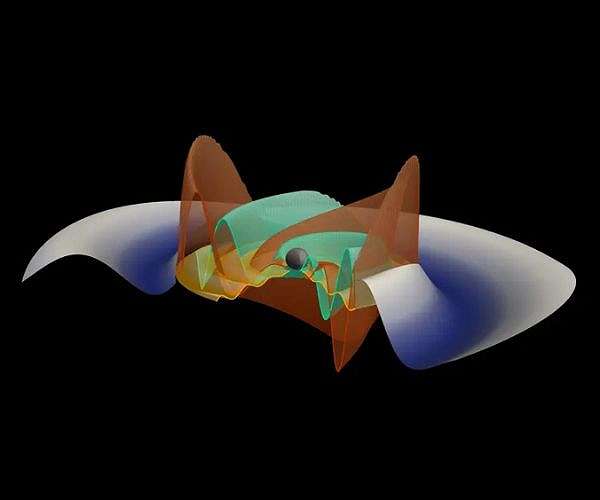
GW250114 was detected about a year ago and stands out as the strongest gravitational wave signal recorded so far from the coalescence of two stellar mass black holes. The source system contained black holes with masses between roughly 30 and 40 times the mass of the Sun, located about 1.3 billion light years from Earth. Because the signal rises well above the background noise, theorists can compare it in great detail with predictions from general relativity across all stages of the merger.
The new analysis builds on earlier work that used GW250114 to probe the nature of black holes and Hawking area law. Alessandra Buonanno, director of the Astrophysical and Cosmological Relativity department at AEI, chaired the writing team and, together with AEI colleagues Lorenzo Pompili, Elisa Maggio, and Elise Saenger, carried out several key elements of the study. They used accurate waveform models and advanced data analysis methods to search for any deviation from Einstein theory in the highly dynamical, strong gravity regime of a black hole collision.
A central part of the project focuses on black hole spectroscopy, a technique that studies the so called ringdown phase that follows the merger. After two black holes coalesce, the remnant object settles into a stable rotating configuration by emitting gravitational waves with a set of characteristic tones. Each tone behaves like the sound of a struck bell and is specified by its frequency and its damping time, that is, the rate at which it fades away as the black hole rings down.
According to the no hair theorem of general relativity, an isolated black hole is fully described by just two macroscopic quantities, its mass and its spin. Those two parameters fix the entire spectrum of ringdown tones and their damping rates. Measuring more than one tone therefore provides a stringent, theory based consistency check, since all observed frequencies and decay times must be compatible with a single mass spin pair for the remnant black hole.
Using a ringdown only analysis, the team was able to identify the fundamental tone of GW250114 and its first, more rapidly damped overtone. By fitting these components, they verified that the measured frequencies and damping times agree with general relativistic predictions for a rotating black hole. This test relies solely on the late time portion of the data, when the binary has merged and the remnant is ringing down, making it a clean probe of the final object properties.
Researchers at AEI then went a step further by applying a new analysis tool that models the full coalescence signal without imposing any prior assumptions on which tones appear in the ringdown. Originally proposed in 2018 and recently upgraded by Maggio and Pompili, this method takes into account the inspiral, merger, and ringdown as a single coherent event. By exploiting information from the entire waveform, the tool can detect subtler spectral features than ringdown only approaches.
With this full signal method, the team constrained a third, higher pitched ringdown tone at roughly twice the frequency of the fundamental mode. Although this third component is more challenging to isolate, the analysis yields the first constraints on such a tone in an observed gravitational wave event. The properties of this additional tone are again compatible with theoretical expectations for a Kerr black hole, reinforcing the validity of general relativity in this extreme astrophysical environment.
The two complementary strategies, one restricted to the ringdown and one incorporating the complete waveform, together provide a robust test of the Kerr solution published by Roy Kerr in 1963. In both cases, GW250114 behaves in line with the predictions for a rotating black hole governed by Einstein equations, leaving little room for large deviations or exotic alternatives at the probed scales. The consistency between the independent analyses strengthens confidence in the underlying theoretical framework.
Beyond the late time behavior, the collaboration also examined an earlier phase of the coalescence when the two black holes were still orbiting each other at lower velocities and wider separations. For this regime, Elise Saenger employed a flexible, theory independent model previously developed at AEI to parameterize possible departures from general relativity in the gravitational wave phase evolution. This framework does not commit to any single alternative theory but instead measures how much the data can differ from the standard prediction.
Remarkably, the clarity of GW250114 allows this single event to set some of the tightest bounds yet on potential deviations from general relativity during the inspiral. When the team compares its constraints using the AEI model with those derived from the combined data set of dozens of signals in the LIGO Virgo KAGRA Gravitational Wave Transient Catalogue GWTC 4.0, they find that several parameters are limited two to three times more strongly by GW250114 alone. The result underscores how a particularly loud and clean signal can outweigh the statistical power of a larger but noisier sample.
Taken together, the spectroscopy tests and the inspiral analysis indicate that GW250114 is fully consistent with a binary black hole merger in general relativity. No significant anomalies emerge in the tone structure, frequency evolution, or damping times that would point to new physics, additional fields, or departures from the no hair picture. While the study cannot rule out all conceivable extensions of Einstein theory, it significantly narrows the allowed space for such modifications in the mass and distance range of the observed system.
Buonanno emphasizes that the work highlights the synergy between high fidelity waveform models and sophisticated data analysis tools. Accurate theoretical calculations of black hole mergers, often derived from numerical relativity simulations, are essential to interpret the observed signals and to design sensitive tests. At the same time, flexible statistical methods make it possible to search for unexpected features without biasing the outcome toward the standard model.
The team stresses that GW250114 represents only the beginning of a new era in high precision gravitational wave tests of gravity. The recently completed fourth observing run of the LIGO Virgo KAGRA network has already produced a growing catalogue of detections, and future runs are expected to uncover more events with GW250114 level clarity or better. As detector sensitivities improve and observing time increases, the number of strong binary black hole signals will rise.
Each such event will provide additional opportunities to conduct black hole spectroscopy, probe the no hair theorem, and scrutinize general relativity under extreme conditions. With multiple clear detections, researchers will be able to test for subtle trends across the population, such as small systematic mismatches between predicted and observed tone frequencies or inspiral phases. Any consistent pattern of discrepancies could offer the first clues toward physics beyond Einstein framework.
For now, however, GW250114 stands as a showcase example of how gravitational wave astronomy can put fundamental physics to the test. By carefully dissecting the loudest signal of its kind, the LIGO Virgo KAGRA collaboration and AEI scientists have shown that Einstein century old description of gravity continues to pass demanding new checks in the strong field, highly dynamical regime of black hole mergers. The results set a high bar for any alternative theory that seeks to replace or extend general relativity in the cosmos.
Research Report:Black Hole Spectroscopy and Tests of General Relativity with GW250114
Related Links
Max Planck Institute for Gravitational Physics (Albert Einstein Institute)
The Physics of Time and Space
| Subscribe Free To Our Daily Newsletters |
| Subscribe Free To Our Daily Newsletters |








