





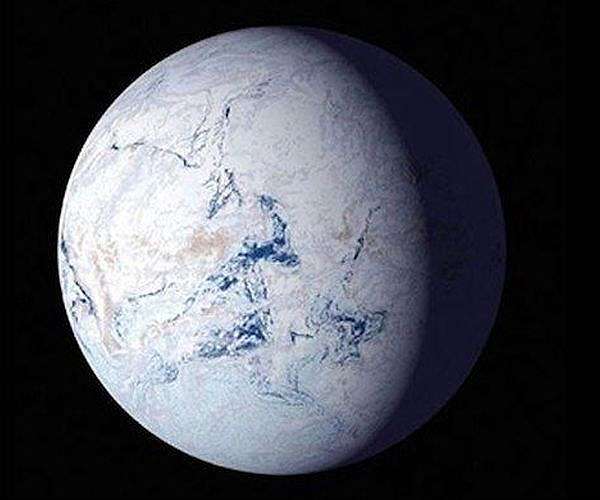
Researchers have long debated why some Snowball Earth events lasted far longer than others and what controlled their termination. A new study led by planetary scientist Trent Thomas at the University of Washington, published in the journal Geology, focuses on two Cryogenian-age Snowball Earth events that occurred between about 720 and 635 million years ago. Geological data indicate that one of these glaciations persisted for roughly 56 million years, while the other lasted about 4 million years. The authors argue that this striking 14-fold difference in duration offers a key test of how the carbon cycle operated under extreme conditions.
Snowball Earth conditions begin when growing ice sheets advance from the poles toward the equator. As more of the planet becomes covered in bright, reflective ice, an amplifying feedback reflects additional sunlight back into space. This process cools the planet further and helps lock in a globally frozen state. Over millions of years, however, volcanoes continue to emit carbon dioxide into the atmosphere, and the progressive buildup of this greenhouse gas can eventually tip the system out of deep freeze. Once this threshold is crossed, the glaciation can end abruptly, giving way to some of the warmest climates in Earth history.
Thomas and colleagues reasoned that some aspect of the carbon system must have differed between the two Cryogenian Snowball intervals to produce such contrasting lengths of time. They considered two main possibilities: a change in the rate at which volcanoes supplied CO2 to the atmosphere, or a change in how quickly CO2 was removed by weathering processes. Available evidence does not point to a large shift in volcanic outgassing between the two events, so the team focused on weathering as the more likely control. On continents, weathering of exposed rock usually dominates long-term CO2 removal, but during a Snowball Earth, thick ice largely shuts down this mechanism.
To investigate the problem, the team built a computer model of the coupled Earth and carbon system to test whether they could reproduce a 14-fold difference in Snowball duration under plausible conditions. They assumed a constant volcanic CO2 input and varied other parameters to see what combination could generate both a relatively short, 4-million-year Snowball and a much longer, 56-million-year Snowball. The simulations showed that changing the efficiency of seafloor weathering, rather than volcanism or continental weathering, was the only way to reconcile the two durations in a self-consistent framework.
In the modern climate system, alteration of oceanic crust on the seafloor accounts for only a modest share of CO2 removal. However, 700 million years ago, seafloor weathering appears to have played a much larger role in regulating atmospheric CO2 during global glaciations. According to the model results, the prolonged Snowball interval would require faster seafloor weathering that drew down volcanic CO2 more efficiently, keeping the planet frozen for tens of millions of years. In contrast, slower seafloor weathering during the shorter event would have allowed CO2 to accumulate more quickly and triggered deglaciation sooner.
Thomas notes that earlier modeling efforts struggled to construct a single, long-lived Snowball event that matched geological constraints. The new work suggests that explicitly accounting for seafloor weathering resolves this difficulty. By adjusting the rate at which oceanic crust reacts with seawater to remove CO2, the model can produce both the shorter and longer Cryogenian Snowball episodes within the same conceptual framework. This result implies that seafloor processes, often overlooked compared to surface weathering, can dominate the carbon cycle under extreme icy conditions.
The study also explores why seafloor weathering might have operated at different rates during the two Snowball Earth events. Thomas proposes that changes in the porosity of oceanic crust could be a key factor, because higher porosity allows more seawater to circulate through the rocks and react with minerals, enhancing CO2 uptake. One possible control on porosity is the sulfate content of seawater. In high-temperature hydrothermal systems, dissolved sulfate can react with calcium to form minerals that clog pore spaces and reduce permeability, which would in turn weaken seafloor weathering.
If sulfate concentrations or related chemical conditions differed between the two Cryogenian intervals, they could have altered crustal porosity and shifted the balance of seafloor weathering. In the scenario described by the authors, low clogging and high porosity during the long Snowball would support strong seafloor weathering and prolonged glaciation. During the shorter Snowball, more extensive pore clogging could have limited seawater circulation, reduced weathering efficiency, and allowed CO2 to accumulate faster in the atmosphere.
Thomas emphasizes that this mechanism is still a hypothesis, and further data and modeling will be needed to test how seafloor chemistry, crustal properties, and hydrothermal circulation evolved through time. Nonetheless, the work highlights a gap in current understanding of how Snowball Earth conditions influence, and are influenced by, oceanic crust processes. By pointing to seafloor weathering as a central player in the longevity of global glaciations, the study opens new lines of inquiry into the deep-time carbon cycle and its sensitivity to undersea geology.
Research Report:Seafloor weathering can explain the disparate durations of Snowball glaciations
Related Links
University of Washington
Beyond the Ice Age
| Subscribe Free To Our Daily Newsletters |
| Subscribe Free To Our Daily Newsletters |








