





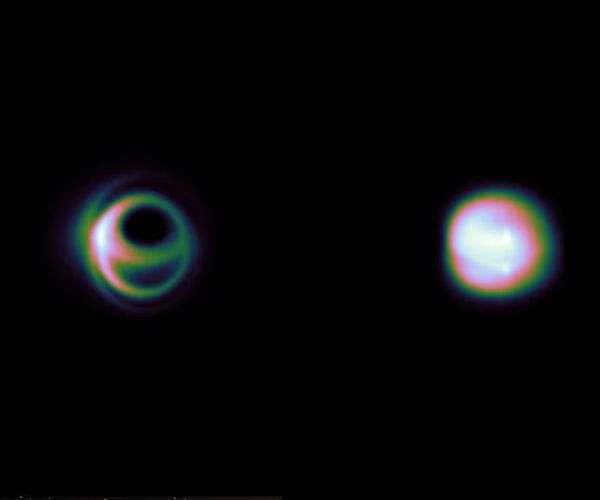
Physicist Carlos Herdeiro of the University of Aveiro in Portugal leads NewFunFiCO, an EU-funded project examining whether certain gravitational wave detections could originate from theoretical compact objects rather than conventional black holes. The collaboration links researchers in Spain, Portugal, Italy, Germany, Mexico, Brazil and China to test ideas at the boundary of astrophysics and fundamental physics. Their work targets phenomena that have not yet been directly observed but are consistent with modern theories of gravity and particle physics.
The team relies on data from the LIGO-Virgo-KAGRA network, a trio of ultra-sensitive observatories in the United States, Italy and Japan designed to measure minute distortions in space-time. According to Einsteins theory, space and time form a unified fabric whose geometry changes when massive bodies move or interact. Gravitational wave detectors track these changes as tiny variations in length, revealing the mergers of compact objects hundreds of millions or billions of light years away.
Since the first detection of gravitational waves in 2015, more than 150 pairs of merging black holes have been catalogued by these facilities. The most recent observation run, known as O4, operated from May 2023 to November 2025 and produced about 250 candidate events that are still under detailed study. Within this growing catalogue, NewFunFiCO scientists expect that some signals may deviate subtly from standard black hole predictions.
Among the most intriguing candidates are boson stars, hypothetical ultra-compact bodies composed of dark matter particles rather than ordinary matter. Seen from a distance, a boson star could resemble a black hole of similar mass and size but would lack an event horizon, the boundary from which nothing can escape a true black hole. Instead of a sharp surface, such an object would appear fuzzy at the edges and packed internally with dark matter.
These exotic stars may be formed from ultralight dark matter, potentially including axions, a proposed class of invisible subatomic particles trillions of times lighter than an electron. A single boson star could span a volume comparable to a planet while containing a mass similar to that of the Sun. For researchers like NewFunFiCO co-lead Nico Sanchis-Gual of the University of Valencia, the idea of such an object is both extreme and compelling.
If boson stars exist, they should occasionally collide and merge just like stellar-mass black holes, generating gravitational waves detectable from Earth. NewFunFiCO is developing and applying theoretical models to identify what those signals would look like in real data from LIGO, Virgo and KAGRA. According to Herdeiro, the gravitational wave pattern produced by a boson star merger might match the GW190521 event slightly better than a standard black hole collision, making it a prime case study.
Boson stars are not the only target of the project. The team is also investigating mixed stars in which a neutron star, the dense remnant left after a massive star explodes, contains a dark matter core. Another class of objects under consideration is gravastars, theoretical configurations that imitate black holes externally but differ radically at their centres and again lack a true event horizon. Each of these possibilities would imprint distinct signatures on gravitational waveforms.
The overarching aim is to use the current surge in gravitational wave detections to search systematically for signs of new physics. By comparing precise wave patterns against large libraries of theoretical models, the researchers hope to distinguish conventional black holes from exotic alternatives. Any confirmed deviation would point toward previously unseen structures in the universe and provide fresh clues about the nature of dark matter and gravity.
Dark matter remains one of the major unsolved problems in physics, thought to outweigh normal matter by a large factor yet interacting only weakly with light. If even one boson star, mixed star or gravastar is identified unambiguously in the gravitational wave data, it would give physicists a rare and direct handle on dark matter properties. Herdeiro notes that the effort could reshape our understanding of how dark matter clumps, collapses and influences cosmic evolution.
NewFunFiCO runs from 2023 through the end of 2026, supported by the European Unions Marie Sklodowska-Curie Actions programme. The project ties European institutions to partners in Latin America and China, encouraging both scientific exchange and broader cultural connections. Herdeiro stresses that this international dimension is an essential part of the initiative as researchers tackle questions that cross borders and disciplines.
Beyond its scientific goals, the work highlights how large-scale experiments can benefit wider society. Gravitational wave observatories required advances in laser interferometry, vibration isolation and ultra-precise optics to measure minute changes in distance. The resulting technologies have already influenced precision manufacturing, medical imaging and navigation systems, demonstrating the broader impact of frontier physics research.
For the public, the appeal of topics such as black holes, the early universe and invisible dark matter helps draw attention to fundamental science. As Sanchis-Gual notes, the leading hypothesis still assumes dark matter is composed of particles that have yet to be directly detected. The possibility that some of this hidden mass sits in compact clumps masquerading as black-hole-like stars adds a new twist to the search for answers.
Related Links
NewFunFiCO project website
Stellar Chemistry, The Universe And All Within It
| Subscribe Free To Our Daily Newsletters |
| Subscribe Free To Our Daily Newsletters |








