





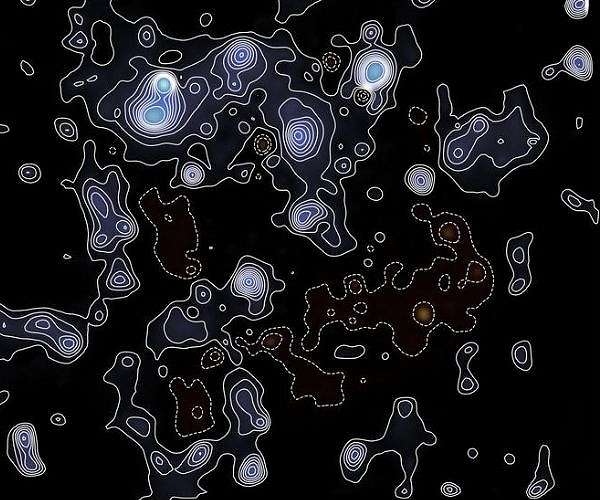
The new map, created with observations from NASA's James Webb Space Telescope and published in Nature Astronomy, traces dark matter in a region of sky in the constellation Sextans covering an area about 2.5 times larger than the full Moon.
The study, jointly led by Durham University in the UK, NASA's Jet Propulsion Laboratory and the Ecole Polytechnique Federal de Lausanne in Switzerland, uses Webb data to confirm earlier dark matter measurements and to add finer structure and new clumps not seen before.
Astronomers think that when the Universe began, both dark matter and normal matter were sparsely distributed, but dark matter clumped together first under its own gravity and then pulled in ordinary matter, setting up the large-scale structure in which galaxies could form.
In this picture, dark matter acts as an invisible scaffolding that determines where galaxies, stars and eventually planets emerge, creating the conditions necessary for the chemical elements and environments that make life possible.
Research co-lead author Dr Gavin Leroy, of Durham University's Institute for Computational Cosmology, said: "By revealing dark matter with unprecedented precision, our map shows how an invisible component of the Universe has structured visible matter to the point of enabling the emergence of galaxies, stars, and ultimately life itself.
"This map reveals the invisible but essential role of dark matter, the true architect of the Universe, which gradually organises the structures we observe through our telescopes."
Dark matter does not emit, reflect, absorb or block light and passes through normal matter largely unnoticed, but its presence reveals itself through gravity, which curves space and deflects light from background galaxies.
The team inferred the dark matter distribution in the Webb field by measuring how the mass in the region warps space and subtly distorts the apparent shapes of nearly 800,000 distant galaxies, as if their light had passed through a warped window.
The Webb data provide around 10 times more galaxies than equivalent maps made by ground-based observatories and roughly twice as many as previous maps made with the Hubble Space Telescope, enabling a sharper and more detailed reconstruction of the dark matter.
The overlap between the dark matter map and the distribution of normal matter, such as galaxies and gas, is so strong that the researchers conclude it cannot be a coincidence, and must arise from dark matter's gravity pulling ordinary matter toward it throughout cosmic history.
Research co-author Professor Richard Massey, also of Durham University's Institute for Computational Cosmology, said: "Wherever you find normal matter in the Universe today, you also find dark matter.
"Billions of dark matter particles pass through your body every second. There's no harm, they don't notice us and just keep going.
"But the whole swirling cloud of dark matter around the Milky Way has enough gravity to hold our entire galaxy together. Without dark matter, the Milky Way would spin itself apart."
Compared to earlier work, the new map reveals previously unseen clumps of dark matter and shows familiar structures with much higher resolution, offering a clearer view of how mass is arranged in the cosmic web.
Research co-lead author Dr Diana Scognamiglio, of NASA's Jet Propulsion Laboratory, said: "This is the largest dark matter map we've made with Webb, and it's twice as sharp as any dark matter map made by other observatories.
"Previously, we were looking at a blurry picture of dark matter. Now we're seeing the invisible scaffolding of the Universe in stunning detail, thanks to Webb's incredible resolution."
To refine distance estimates for the galaxies used in the analysis, the team drew on James Webb's Mid-Infrared Instrument, MIRI, which is particularly effective at identifying galaxies hidden behind cosmic dust that can obscure visible light.
Durham University's Centre for Extragalactic Astronomy contributed to the development of MIRI, which was designed and managed through launch by NASA's Jet Propulsion Laboratory.
Looking ahead, the researchers plan to extend their mapping of dark matter across the entire sky using the European Space Agency's Euclid mission and NASA's upcoming Nancy Grace Roman Space Telescope, allowing them to study how dark matter's properties may have evolved over time.
The dark matter map produced in this Webb study will serve as a reference field for future surveys, providing a benchmark against which subsequent measurements of the cosmic mass distribution can be calibrated and compared.
The work received support from NASA, the UK Research Councils' Science and Technology Facilities Council, the Swiss State Secretariat for Education, Research and Innovation, the RCUK/STFC Central Laser Facility at the STFC Rutherford Appleton Laboratory and the Centre National d'Etudes Spatiales.
Research Report:An ultra-high-resolution map of (dark) matter
Related Links
Durham University
Stellar Chemistry, The Universe And All Within It
| Subscribe Free To Our Daily Newsletters |
| Subscribe Free To Our Daily Newsletters |








