24/7 Space News
TECH SPACE
ReOrbit and Google Cloud develop orbital space cloud network
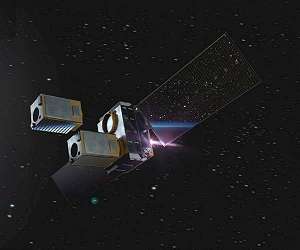
illustration only

ReOrbit and Google Cloud develop orbital space cloud network

by Clarence Oxford
Los Angeles CA (SPX) Feb 10, 2026

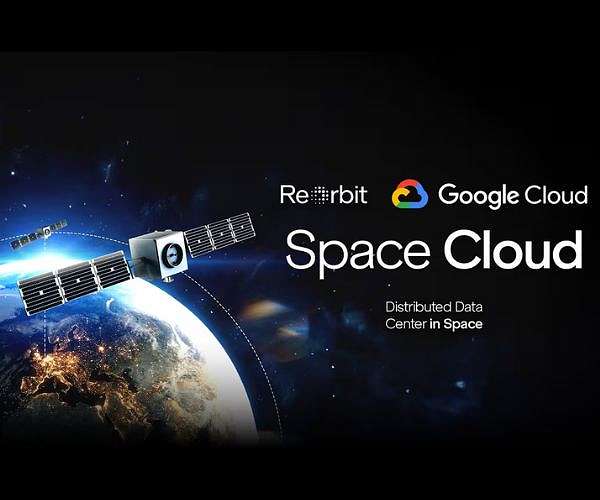
ReOrbit has launched Space Cloud, a multi year initiative to build a distributed network of software enabled satellites that can move and process data securely in orbit, in collaboration with Google Cloud. The company describes the project as a space based data center network that will combine on board computing, advanced networking and cloud style orchestration to support government, military and commercial users.

The concept centers on a mesh of multi purpose satellites equipped with localized AI compute and interconnected through optical inter satellite links for high speed data transmission. By designing an in orbit infrastructure that can host applications and process data at the edge, ReOrbit aims to reduce reliance on ground stations and deliver faster, more resilient services for time critical missions.

Google Cloud is working with ReOrbit in a hands on design partnership, contributing technical expertise in cloud orchestration and large scale infrastructure management. The companies are developing a proprietary network orchestration software layer and a cloud based management system modeled on the principles used in Google Cloud terrestrial data centers, adapted for the constraints and dynamics of space.

According to ReOrbit, a key objective is to support European and NATO data sovereignty by ensuring that sensitive intelligence and other strategic information can be processed and routed in orbit under sovereign control. Space Cloud is positioned as a response to growing geopolitical complexity and the need for secure, controllable infrastructure that does not depend on foreign ground networks or congested terrestrial routes.

The architecture is divided into two main segments that target different user communities. The Sovereign Space Cloud is an air gapped, isolated environment owned and operated by ReOrbit, designed to handle national security and other highly sensitive data with strict separation from public networks. The Commercial Space Cloud forms a backbone for an emerging orbital data economy, providing a marketplace for Earth observation products and commercial edge computing services.

To support this approach, the satellites will host several specialized subsystems. Quantum Key Distribution capability is planned to generate and distribute cryptographic keys that can help protect critical data flows against interception, including in a future quantum computing environment. Optical laser terminals will provide high bandwidth inter satellite links that can bypass ground based bottlenecks and enable rapid data movement across the orbital mesh.

On board edge processors will bring high performance computing closer to data sources, allowing real time AI processing and analytics directly in orbit rather than waiting for downlink. In addition, the spacecraft are expected to support IoT and direct to device connectivity using 3GPP compliant standards, enabling communication with standard mobile devices and other distributed assets without custom terminals.

"Space Cloud reflects a long standing vision of ReOrbit, now made possible by the convergence of technological maturity and market pull. In partnership with our ecosystem, we are set to scale quickly and transform the orbital economy with intelligent, AI enabled satellite infrastructure for the decade ahead," said Sethu Saveda Suvanam, CEO and founder of ReOrbit. He positioned the project as a way to rethink how space systems handle data, moving from single purpose platforms to interconnected, software driven networks.

Markus Hongisto, Google Cloud country manager for Finland, said the project offers a way to explore new patterns for orbital data processing using cloud technologies. "We are pleased to collaborate with ReOrbit on the 'Space Cloud' project, which explores an interesting approach to orbital data processing," he said. "This initiative allows us to share our technical expertise in cloud orchestration and AI to support ReOrbit as they build new ways to manage data securely," Hongisto added.

ReOrbit, which designs and builds software defined satellites in Finland for high speed data transmission and distributed AI processing, sees Space Cloud as the foundation for future services across military and civil domains. The company highlights possible applications including secure communications for defense users, critical communications for public infrastructure, and commercial services for industries that depend on rapid Earth observation insights and in orbit data analytics.

By combining sovereign control, quantum era security features and edge processing with commercial cloud practices, the Space Cloud initiative illustrates how satellite operators and cloud providers are beginning to converge. If successful, the ReOrbit and Google Cloud collaboration could demonstrate how orbital infrastructure can evolve into flexible, software driven platforms that mirror the modularity and scalability of data centers, but operate in the harsh environment of space.

Related Links
ReOrbit
Space Technology News - Applications and Research

Subscribe Free To Our Daily Newsletters
Tweet

RELATED CONTENT
The following news reports may link to other Space Media Network websites.
TECH SPACE
NTU Singapore boosts agile space access with trio of new projects
Tokyo, Japan (SPX) Feb 03, 2026
Nanyang Technological University, Singapore is launching three new space projects under Singapore's Space Technology Development Programme, a national initiative to accelerate the commercialisation of space technologies. The projects are among the first supported under the Space Access Programme, which targets annual launches in 2026, 2027 and 2028 to give local researchers and companies faster, more cost effective access to space for in orbit testing and validation. One of the new projects will s ... read more

TECH SPACE
The coming end of ISS, symbol of an era of global cooperation

NASA confirms first flight to ISS since medical evacuation

Crew 12 set for Dragon launch to Station in February

Bezos's Blue Origin to 'pause' space tourism to focus on Moon efforts

TECH SPACE
Isar Aerospace expands engine and stage testing at Esrange

NASA Moon mission launch srubbed to March after test

NASA books fifth Axiom private astronaut flight to space station

Musk merges xAI into SpaceX in bid to build space data centers

TECH SPACE
Martian toxin found to toughen microbe built bricks

Curiosity Blog, Sols 4788-4797: Welcome Back from Conjunction

NASA Study: Non-biologic Processes Don't Fully Explain Mars Organics

Perseverance rover completes landmark AI guided trek across Jezero rim

TECH SPACE
Dragon spacecraft gears up for crew 12 arrival and station science work

China prepares offshore test base for reusable liquid rocket launches

Retired EVA workhorse to guide China's next-gen spacesuit and lunar gear

Tiangong science program delivers data surge

TECH SPACE
BlackSky expands Gen 3 Assured deals with new defense customer

ESA member states back SWISSto12 HummingSat with fresh funding round

Muon Space ramps up multi-mission satellite constellations

Aerospacelab expands Pulsar navigation constellation work with new Xona satellite order

TECH SPACE
Launching the idea of data centers in space

Gilat books multimillion order for Sidewinder inflight ESA terminals

NTU Singapore boosts agile space access with trio of new projects

Musk merges xAI into SpaceX in bid to build space data centers

TECH SPACE
Survey of 80 near Earth asteroids sharpens view of their origins and risks

Lab made cosmic dust experiment reveals paths to life chemistry

Einstein effect clears planets from tight double star systems

Engineered microbes use light to build new molecules

TECH SPACE
Jupiter size refined by new radio mapping

Polar weather on Jupiter and Saturn hints at the planets' interior details

Europa ice delamination may deliver nutrients to hidden ocean

Birth conditions fixed water contrast on Jupiters moons

Subscribe Free To Our Daily Newsletters


The content herein, unless otherwise known to be public domain, are Copyright 1995-2024 - Space Media Network. All websites are published in Australia and are solely subject to Australian law and governed by Fair Use principals for news reporting and research purposes. AFP, UPI and IANS news wire stories are copyright Agence France-Presse, United Press International and Indo-Asia News Service. ESA news reports are copyright European Space Agency. All NASA sourced material is public domain. Additional copyrights may apply in whole or part to other bona fide parties. All articles labeled "by Staff Writers" include reports supplied to Space Media Network by industry news wires, PR agencies, corporate press officers and the like. Such articles are individually curated and edited by Space Media Network staff on the basis of the report's information value to our industry and professional readership. Advertising does not imply endorsement, agreement or approval of any opinions, statements or information provided by Space Media Network on any Web page published or hosted by Space Media Network. General Data Protection Regulation (GDPR) Statement Our advertisers use various cookies and the like to deliver the best ad banner available at one time. All network advertising suppliers have GDPR policies (Legitimate Interest) that conform with EU regulations for data collection. By using our websites you consent to cookie based advertising. If you do not agree with this then you must stop using the websites from May 25, 2018. Privacy Statement. Additional information can be found here at About Us.