24/7 Space News
TIME AND SPACE
Quantum team reads information from robust Majorana qubits using quantum capacitance
illustration only

Quantum team reads information from robust Majorana qubits using quantum capacitance

by Robert Schreiber
Berlin, Germany (SPX) Feb 16, 2026
Researchers have demonstrated a method to read information stored in Majorana-based qubits using a technique known as quantum capacitance, marking what they describe as a crucial advance for topological quantum computing. The work involves an international collaboration in which the Spanish National Research Council (CSIC), through the Madrid Institute of Materials Science (ICMM-CSIC), provided the theoretical foundation for a sophisticated experiment carried out primarily at Delft University of Technology.

Topological qubits based on Majorana zero modes are designed to protect quantum information by storing it non locally rather than at a single point in a device. In this scheme, information is encoded across a pair of special quantum states called Majorana zero modes, which act like a safe box for quantum data because local disturbances are unlikely to corrupt the global state. This non local encoding is expected to make Majorana qubits intrinsically robust against local noise and decoherence, since an error would have to affect the entire system to destroy the stored information.

However, the same property that provides protection has also posed a major challenge for experiments, because it is not obvious how to read out a property that does not reside at any specific location. Traditional local charge measurements tend to be blind to the non local information associated with the parity of the Majorana pair, limiting earlier attempts to verify and use these qubits. The new study addresses this problem by introducing a global probe that can sense the overall quantum state of the system rather than just local observables.

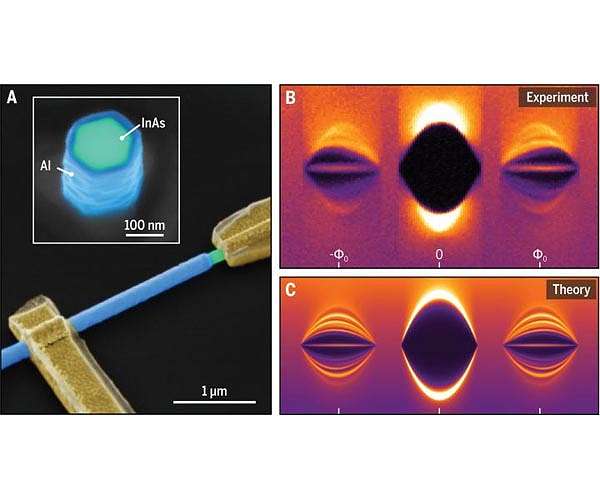
The experimental team constructed a modular nanostructure referred to as a minimal Kitaev chain, assembled in a bottom up fashion from controllable building blocks. In practice, they created a chain consisting of two semiconductor quantum dots coupled via a superconducting segment, allowing them to engineer conditions under which Majorana modes emerge in a controlled way. This modular approach contrasts with previous experiments that relied on less controlled combinations of materials and interfaces.

Once the minimal Kitaev chain was established, the researchers used quantum capacitance as a global probe to access the qubit information encoded in the non local Majorana modes. With this technique, they were able, for the first time, to distinguish in real time and in a single measurement whether the non local quantum state formed by the two Majorana modes had even or odd parity. In qubit language, this corresponds to determining whether the fermionic mode formed by the two Majoranas is effectively full or empty, which defines the logical states of the qubit.

The measurements showed that while local charge probes did not reveal the parity information, the quantum capacitance probe responded clearly to changes in the global state. This finding provides an elegant confirmation of the topological protection principle: local observables remain largely insensitive to the encoded information, while a carefully designed global observable can access it without strongly disturbing the qubit. The result offers a practical readout pathway that is compatible with the underlying robustness of Majorana-based qubits.

In addition to demonstrating parity readout, the experiment revealed what the researchers describe as random parity jumps in the system. By monitoring these stochastic events, they were able to extract a parity coherence time exceeding one millisecond, which is a highly promising value for future topological qubit operations based on Majorana modes. Such coherence times suggest that, with further engineering, Majorana qubits could support gate operations and error correction protocols that exploit their intrinsic noise protection.

The study highlights the synergy between advanced experimental techniques and detailed theoretical modeling. The Delft group developed and implemented the modular device architecture and quantum capacitance measurement scheme, while the ICMM-CSIC team provided the theoretical framework needed to interpret the complex signals and confirm that they arise from Majorana physics in a minimal Kitaev chain. According to the authors, this combination of controlled device design, global probing, and robust theory represents a significant step toward functional topological qubits that can be initialized, manipulated, and read out in scalable quantum processors.

Research Report: Single-shot parity readout of a minimal Kitaev chain

Related Links
Spanish National Research Council
Understanding Time and Space

Subscribe Free To Our Daily Newsletters
Tweet

RELATED CONTENT
TIME AND SPACE
Experiments settle debate over how Molybdenum 93 isomer releases stored energy
Tokyo, Japan (SPX) Feb 17, 2026
A team at the Institute of Modern Physics of the Chinese Academy of Sciences and collaborators has identified the dominant mechanism that releases energy stored in the nuclear isomer Molybdenum 93m. Their experiments show that inelastic nuclear scattering, not nuclear excitation by electron capture, governs how this isomer is depleted under the tested conditions. Nuclear isomers are long lived excited states of atomic nuclei that can store large amounts of energy. They are considered candidates fo ... read more

TIME AND SPACE
Texas AM partners with Aegis to orbit TAMU SPIRIT research hub on ISS

Sophie Adenot, the second French woman to fly to space

International crew arrives at space station

Chinese visitors to Japan slump as spat rumbles on

TIME AND SPACE
Russian era ends at abandoned launchpad in South American jungle

NASA teams set for second Artemis II wet dress rehearsal

Vietnam licenses Musk's satellite internet firm Starlink

Latvian startup advances nuclear-fueled power for satellites and future Moon missions

TIME AND SPACE
Curiosity Blog, Sols 4798-4803: Back for More Science

Mars relay orbiter seen as backbone for future exploration

UAE extends Mars probe mission until 2028

Mars' 'Young' Volcanoes Were More Complex Than Scientists Once Thought

TIME AND SPACE
Dragon spacecraft gears up for crew 12 arrival and station science work

China prepares offshore test base for reusable liquid rocket launches

Retired EVA workhorse to guide China's next-gen spacesuit and lunar gear

Tiangong science program delivers data surge

TIME AND SPACE
AAC Clyde Space adds Sedna satellites to boost maritime data services

China tests AI satellite swarm for space-based computing

BlackSky expands Gen 3 Assured deals with new defense customer

Muon Space ramps up multi-mission satellite constellations

TIME AND SPACE
ST Engineering iDirect and G&S SatCom align network and service management on Intuition

Light based computing module aims to cut AI power demand

KSAT prepares Hyperion in orbit relay test for satellite data

Pale Blue opens Tsukuba site to scale satellite propulsion production

TIME AND SPACE
Hydrogen sulfide detected in distant gas giant exoplanets for the first time

Cheops spots inside out exoplanet quartet

Study revisits chances of detecting alien technosignatures

Engineered microbes use light to build new molecules

TIME AND SPACE
Jupiter size refined by new radio mapping

Polar weather on Jupiter and Saturn hints at the planets' interior details

Europa ice delamination may deliver nutrients to hidden ocean

Birth conditions fixed water contrast on Jupiters moons


The content herein, unless otherwise known to be public domain, are Copyright 1995-2026 - SpaceDaily.com. All websites are published in Australia and are solely subject to Australian law and governed by Fair Use principals for news reporting and research purposes. AFP, UPI and IANS news wire stories are copyright Agence France-Presse, United Press International and Indo-Asia News Service. ESA news reports are copyright European Space Agency. All NASA sourced material is public domain. Additional copyrights may apply in whole or part to other bona fide parties. All articles labeled "by Staff Writers" include reports supplied to Space Media Network by industry news wires, PR agencies, corporate press officers and the like. Such articles are individually curated and edited by Space Media Network staff on the basis of the report's information value to our industry and professional readership. Advertising does not imply endorsement, agreement or approval of any opinions, statements or information provided by Space Media Network on any Web page published or hosted by Space Media Network. General Data Protection Regulation (GDPR) Statement Our advertisers use various cookies and the like to deliver the best ad banner available at one time. All network advertising suppliers have GDPR policies (Legitimate Interest) that conform with EU regulations for data collection. By using our websites you consent to cookie based advertising. If you do not agree with this then you must stop using the websites from May 25, 2018. Privacy Statement. Additional information can be found here at About Us.
Subscribe Free To Our Daily Newsletters