24/7 Space News
TIME AND SPACE
Experiments settle debate over how Molybdenum 93 isomer releases stored energy
illustration only

Experiments settle debate over how Molybdenum 93 isomer releases stored energy

by Riko Seibo
Tokyo, Japan (SPX) Feb 17, 2026
A team at the Institute of Modern Physics of the Chinese Academy of Sciences and collaborators has identified the dominant mechanism that releases energy stored in the nuclear isomer Molybdenum 93m. Their experiments show that inelastic nuclear scattering, not nuclear excitation by electron capture, governs how this isomer is depleted under the tested conditions.

Nuclear isomers are long lived excited states of atomic nuclei that can store large amounts of energy. They are considered candidates for applications such as nuclear batteries, gamma ray lasers and highly precise nuclear clocks, but controlled and rapid release of their stored energy remains a major challenge.

The isomer Mo 93m has attracted particular interest as a potential high energy density storage medium. Earlier work proposed that nuclear excitation by electron capture could efficiently trigger its energy release, but later theoretical and experimental studies raised doubts about whether that process really dominates in realistic environments.

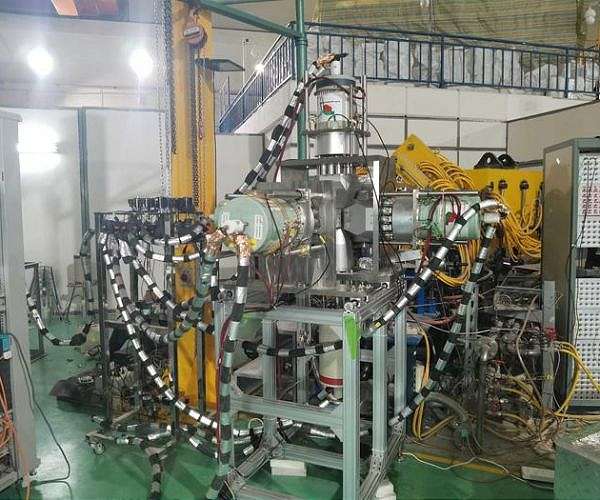
To resolve the issue, the researchers produced a purified high energy beam of Mo 93m ions using the radioactive ion beam line at the Heavy Ion Research Facility in Lanzhou. They also developed a low background, high sensitivity technique to track how the population of the isomer changed during interactions with different target materials.

After purification, the Mo 93m ions were implanted into detectors covered with either lead foil or carbon foil. By detecting characteristic gamma rays emitted as the ions slowed down and interacted with the target, the team measured the probability that the isomer would be depleted in each case.

The depletion probability was about 2 in 100000 for ions implanted in lead and about 5 in 1000000 for ions implanted in carbon. These values matched theoretical expectations for inelastic nuclear scattering but were far larger than predicted for nuclear excitation by electron capture under the same conditions.

"This indicates that the observed isomer depletion in Mo 93m is dominated by inelastic nuclear scattering, rather than the previously proposed NEEC mechanism," said first author Dr. DING Bing of the Institute of Modern Physics. The result provides experimental clarity in a debate that has persisted for years.

The work delivers benchmark data for understanding how nuclear isomers behave in environments such as plasmas, astrophysical sites and inertial confinement fusion targets. It also constrains scenarios in which isomer based energy storage or release might be harnessed in future technologies.

According to corresponding author Prof. ZHOU Xiaohong, nuclear excitation by electron capture still remains a promising pathway in principle for triggering the release of energy from isomers. However, future attempts to detect and use NEEC may require specially optimized conditions, including plasma environments or collisions between intense electron beams and ion beams.

Research Report:Isomer Depletion of 93mMo Triggered by Inelastic Nuclear Scattering Rather than Nuclear Excitation by Electron Capture

Related Links
Institute of Modern Physics of the Chinese Academy of Sciences
Understanding Time and Space

Subscribe Free To Our Daily Newsletters
Tweet

RELATED CONTENT
TIME AND SPACE
One dimensional anyons offer tunable quantum statistics
Tokyo, Japan (SPX) Feb 05, 2026
Physicists have traditionally divided all elementary particles in three dimensional space into just two categories, bosons and fermions, depending on how systems of identical particles behave when the particles exchange places. In standard quantum theory, experimental observations in three dimensions point to a strict binary: when two identical particles swap positions, the combined quantum state either remains unchanged, corresponding to bosons, or it acquires a minus sign, corresponding to fermions, w ... read more

TIME AND SPACE
Chinese visitors to Japan slump as spat rumbles on

International crew takes off for space station

Launch to ISS pushed to Thursday over weather: NASA

Voyager wins NASA ISS mission management role through 2030

TIME AND SPACE
Macron calls Musk 'an oversubsidised guy', prompting retort

SpaceX shifts focus from Mars to Moon, Musk says

Isar Aerospace expands engine and stage testing at Esrange

NASA books fifth Axiom private astronaut flight to space station

TIME AND SPACE
Mars' 'Young' Volcanoes Were More Complex Than Scientists Once Thought

Curiosity Blog, Sols 4788-4797: Welcome Back from Conjunction

NASA Study: Non-biologic Processes Don't Fully Explain Mars Organics

Martian toxin found to toughen microbe built bricks

TIME AND SPACE
Dragon spacecraft gears up for crew 12 arrival and station science work

China prepares offshore test base for reusable liquid rocket launches

Retired EVA workhorse to guide China's next-gen spacesuit and lunar gear

Tiangong science program delivers data surge

TIME AND SPACE
BlackSky expands Gen 3 Assured deals with new defense customer

Muon Space ramps up multi-mission satellite constellations

ESA member states back SWISSto12 HummingSat with fresh funding round

Aerospacelab expands Pulsar navigation constellation work with new Xona satellite order

TIME AND SPACE
JUNO VR system brings detector events into immersive 3D space

Hologram method boosts 3D image sharpness fivefold

AI prosthetic arm speed shapes sense of body ownership in VR

Extreme heat flips strength rules for pure metals

TIME AND SPACE
Debris disc oddities point to hidden outer planets

JWST study links sulfur rich gas giants to core growth in distant HR 8799 system

Pressure driven leakage from marine snow feeds deep ocean microbes

Survey of 80 near Earth asteroids sharpens view of their origins and risks

TIME AND SPACE
Jupiter size refined by new radio mapping

Polar weather on Jupiter and Saturn hints at the planets' interior details

Europa ice delamination may deliver nutrients to hidden ocean

Birth conditions fixed water contrast on Jupiters moons


The content herein, unless otherwise known to be public domain, are Copyright 1995-2026 - SpaceDaily.com. All websites are published in Australia and are solely subject to Australian law and governed by Fair Use principals for news reporting and research purposes. AFP, UPI and IANS news wire stories are copyright Agence France-Presse, United Press International and Indo-Asia News Service. ESA news reports are copyright European Space Agency. All NASA sourced material is public domain. Additional copyrights may apply in whole or part to other bona fide parties. All articles labeled "by Staff Writers" include reports supplied to Space Media Network by industry news wires, PR agencies, corporate press officers and the like. Such articles are individually curated and edited by Space Media Network staff on the basis of the report's information value to our industry and professional readership. Advertising does not imply endorsement, agreement or approval of any opinions, statements or information provided by Space Media Network on any Web page published or hosted by Space Media Network. General Data Protection Regulation (GDPR) Statement Our advertisers use various cookies and the like to deliver the best ad banner available at one time. All network advertising suppliers have GDPR policies (Legitimate Interest) that conform with EU regulations for data collection. By using our websites you consent to cookie based advertising. If you do not agree with this then you must stop using the websites from May 25, 2018. Privacy Statement. Additional information can be found here at About Us.
Subscribe Free To Our Daily Newsletters