24/7 Space News
TIME AND SPACE
Primordial magnetism offers fresh angle on the Hubble constant puzzle
illustration only

Primordial magnetism offers fresh angle on the Hubble constant puzzle

by Clarence Oxford
Los Angeles CA (SPX) Mar 02, 2026
A Simon Fraser University cosmologist reports that new theoretical work on primordial magnetic fields could move researchers closer to resolving the longstanding Hubble tension, the mismatch in measurements of how fast the universe is expanding today.

The Hubble tension arises because two precise approaches to determining the Hubble constant give significantly different results, despite drawing on high quality data. One method infers the expansion rate from the cosmic microwave background, while the other uses observations of relatively nearby objects such as supernovae and galaxies.

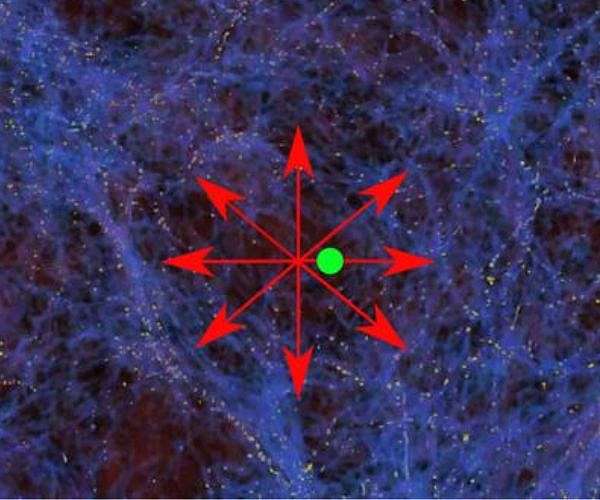
The SFU led team proposes that tiny magnetic fields generated in the very early universe may have altered the physics of recombination, the epoch when electrons and protons combined to form neutral atoms and the cosmic microwave background was released. If primordial magnetic fields sped up recombination, they would subtly change the pattern of temperature anisotropies in the microwave background sky.

Such changes feed directly into how cosmologists infer the Hubble constant from cosmic microwave background data, potentially shifting the value and easing the tension with late time measurements. The idea suggests that a physical ingredient long present in the cosmos could reconcile the discrepant expansion rates without invoking a completely new cosmological model.

"This is an exciting moment for us and the wider cosmology community because our idea could address two major unsolved puzzles about our universe - the Hubble tension and the origin of cosmic magnetic fields," says Levon Pogosian, professor and department chair at SFU Physics and co author of the study. "Solving these puzzles would be like opening a new window into the early universe. It would help cosmologists to better explain the origin of the universe and everything within it."

Pogosian notes that cosmologists worldwide have been driven to introduce new components into the standard cosmological model to deal with the Hubble tension. In contrast, he argues that primordial magnetic fields could serve as a more natural ingredient that both influences recombination and seeds the magnetic fields observed across galaxies and clusters today.

"It's a major headache for cosmologists across the world. It has sprung an industry of scientists inventing new ingredients in the cosmological model to try to address the Hubble tension," he says. "But what we are saying is that the ingredient, the magnetic fields, could have been there all this time. And, if confirmed, it would also explain the origin of magnetic fields observed throughout the cosmos."

Over the last three years, Pogosian and collaborators Karsten Jedamzik from the University of Montpelier, Tom Abel from Stanford University, and Yacine Ali Haimoud from New York University have used SFU's Cedar supercomputer to run detailed simulations of the recombination era. These large computations track how primordial magnetic fields would modify the interaction between matter and radiation in the early universe.

The team then confronted the simulated signatures with observations from the Hubble Space Telescope, the Planck satellite and other facilities. By comparing model predictions with data, they tested whether the proposed primordial magnetic fields scenario remains compatible with current cosmological measurements.

"Remarkably, our findings show that the idea survives the most detailed and realistic tests available today," says Pogosian. He adds that the work not only preserves agreement with existing observations but also points to specific patterns that future measurements could look for.

According to Pogosian, the analysis defines clear observational targets for upcoming surveys of the cosmic microwave background and large scale structure. Over the next several years, new data should be able to confirm or rule out whether tiny magnetic fields from the dawn of time helped shape the universe visible today and whether they can finally settle the Hubble tension.

SFU's Cedar supercomputer, and its successor Fir, were central to the project. The machines made it possible to decompose the demanding recombination calculations into many smaller jobs and execute them in parallel.

"We would not have been able to carry out our research without the supercomputer. It was crucial for our tests and calculations," Pogosian says. "The supercomputer allowed us to break down our tests into smaller jobs and run them in parallel, which saved us a huge amount of time."

An accessible overview essay, "A Cosmic Clue Hidden in Magnetism: How Primordial Magnetic Fields May Help Resolve the Hubble Tension," offers additional context on how the proposed mechanism connects early universe magnetism to present day cosmological measurements.

Research Report:Hints of primordial magnetic fields at recombination and implications for the Hubble tension

Related Links
Simon Fraser University
Understanding Time and Space

Subscribe Free To Our Daily Newsletters
RELATED CONTENT
TIME AND SPACE
Star like early galaxies challenge views of cosmic evolution
Los Angeles CA (SPX) Mar 04, 2026
Scientists at the University of Missouri have identified a small group of unusual objects in the early universe that look like stars in images yet behave like compact galaxies when analyzed in detail. Using NASAs James Webb Space Telescope JWST, Haojing Yan and colleagues at Mizzous College of Arts and Science found that these sources appear as single points of light while carrying the spectral signatures of dense star forming regions. These objects show point like features that would normally pla ... read more

TIME AND SPACE
NASA announces overhaul of Artemis lunar program amid technical delays

Texas AM partners with Aegis to orbit TAMU SPIRIT research hub on ISS

Regrowing marginal farmland can curb emissions without cutting food output

Chinese visitors to Japan slump as spat rumbles on

TIME AND SPACE
Prometheus starts work on new Indiana solid rocket motor campus

NASA prepares Artemis II rocket for rollback after upper stage issue

Superconducting thruster cuts power and mass for space propulsion

Lithium trace in upper air linked to Falcon 9 rocket breakup

TIME AND SPACE
Perseverance rover now self-locates precisely on Mars

Curiosity Blog, Sols 4798-4803: Back for More Science

Mars relay orbiter seen as backbone for future exploration

UAE extends Mars probe mission until 2028

TIME AND SPACE
Dragon spacecraft gears up for crew 12 arrival and station science work

China prepares offshore test base for reusable liquid rocket launches

Retired EVA workhorse to guide China's next-gen spacesuit and lunar gear

Tiangong science program delivers data surge

TIME AND SPACE
Infleqtion lists shares on NYSE as neutral atom quantum firm

AAC Clyde Space adds Sedna satellites to boost maritime data services

China tests AI satellite swarm for space-based computing

BlackSky expands Gen 3 Assured deals with new defense customer

TIME AND SPACE
Dynamic terrain model boosts airborne gamma ray survey accuracy

KSAT prepares Hyperion in orbit relay test for satellite data

India chases 'DeepSeek moment' with homegrown AI models

ST Engineering iDirect and G&S SatCom align network and service management on Intuition

TIME AND SPACE
Debris disc oddities point to hidden outer planets

Hydrogen sulfide detected in distant gas giant exoplanets for the first time

JWST study links sulfur rich gas giants to core growth in distant HR 8799 system

Survey of 80 near Earth asteroids sharpens view of their origins and risks

TIME AND SPACE
Simple collapse may build cosmic snowman worlds

Jupiter size refined by new radio mapping

Polar weather on Jupiter and Saturn hints at the planets' interior details

Europa ice delamination may deliver nutrients to hidden ocean


The content herein, unless otherwise known to be public domain, are Copyright 1995-2026 - SpaceDaily.com. All websites are published in Australia and are solely subject to Australian law and governed by Fair Use principals for news reporting and research purposes. AFP, UPI and IANS news wire stories are copyright Agence France-Presse, United Press International and Indo-Asia News Service. ESA news reports are copyright European Space Agency. All NASA sourced material is public domain. Additional copyrights may apply in whole or part to other bona fide parties. All articles labeled "by Staff Writers" include reports supplied to Space Media Network by industry news wires, PR agencies, corporate press officers and the like. Such articles are individually curated and edited by Space Media Network staff on the basis of the report's information value to our industry and professional readership. Advertising does not imply endorsement, agreement or approval of any opinions, statements or information provided by Space Media Network on any Web page published or hosted by Space Media Network. General Data Protection Regulation (GDPR) Statement Our advertisers use various cookies and the like to deliver the best ad banner available at one time. All network advertising suppliers have GDPR policies (Legitimate Interest) that conform with EU regulations for data collection. By using our websites you consent to cookie based advertising. If you do not agree with this then you must stop using the websites from May 25, 2018. Privacy Statement. Additional information can be found here at About Us.
Subscribe Free To Our Daily Newsletters