





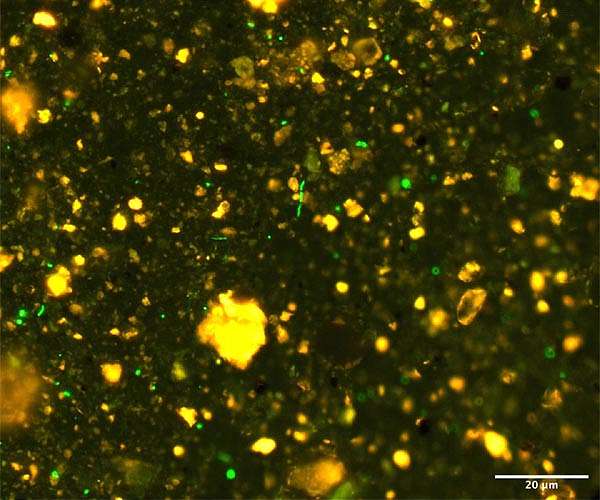
The study, led by biologists at the Department of Biology and research centers Nordcee and the Danish Center for Hadal Research, focuses on so called marine snow. These tiny clumps of dead algae, microbes and other organic material form in surface waters, aggregate, and sink through the ocean as a steady shower of particles.
As marine snow travels downwards into depths of 2 to 6 kilometers, it encounters intense hydrostatic pressure. The team reports that this pressure causes the particles to leak dissolved organic carbon and nitrogen into the surrounding seawater, effectively turning the deep ocean into a zone where microbes can tap into freshly liberated nutrients.
"The pressure acts almost like a giant juicer," said first author and Associate Professor Peter Stief. "It squeezes dissolved organic compounds out of the particles, and microbes can use them immediately."
To probe this mechanism, the scientists generated marine snow in the laboratory using diatoms, microalgae that naturally clump together in the ocean. They placed the diatom aggregates in specially built rotating pressure tanks designed to mimic the high pressure conditions of the deep sea while keeping the particles in suspension instead of letting them settle.
Under these conditions, the researchers observed that up to half of a particle's carbon content can leak out during its descent. They also found that 58 to 63 percent of the particles' initial nitrogen can escape as dissolved compounds, making substantial amounts of organic matter available to free living microbes in the deep water column.
Chemical analyses revealed that the leaked material consists mainly of proteins and carbohydrates. These compounds are readily consumed by microbes, providing an efficient source of energy and nutrients far below the sunlit surface where most primary production occurs.
Microbial communities in the experiments responded quickly to this new supply. Within two days, bacterial abundance increased by a factor of 30, and respiration rates rose sharply. These changes indicate that deep sea microbes capitalize rapidly on the freshly released organic matter and that the leakage fuels active metabolism at great depth.
The team observed similar leakage behavior across multiple diatom species tested in the pressure tanks. That consistency suggests the underlying mechanism is widespread in the ocean and not restricted to a single type of marine snow particle.
The findings carry important implications for the global carbon cycle. If sinking particles lose such large fractions of their carbon before reaching the seabed, less organic carbon ultimately becomes buried in deep sea sediments than previously assumed. Instead, more carbon remains dissolved in the deep water column, where it can persist for hundreds to thousands of years.
In contrast, carbon that reaches and is buried in sediments can stay locked away for millions of years and accumulate into vast stores over geological timescales. Much of the oil and gas currently extracted around the world formed from organic matter that was buried and transformed in this way.
"This process affects how much carbon the ocean can store and for how long," said Stief. "It is relevant for understanding climate processes and for improving future models."
The researchers emphasize that recognizing this pressure driven leakage changes how scientists estimate the efficiency of the ocean's biological carbon pump, the set of processes that move carbon from the surface to the depths. Accounting for the newly identified loss pathway may refine projections of long term carbon storage in the deep ocean.
The work also points to several next steps. The team plans to search directly in the ocean for molecular fingerprints that match the leaked compounds identified in the laboratory experiments. By comparing surface and deep water chemistry, they hope to link specific dissolved molecules to particle degradation under pressure.
To pursue this goal, the researchers are preparing for an expedition to the Arctic aboard the German research vessel Polarstern. Sampling along the voyage track will allow them to test whether the laboratory observations hold in natural deep water environments and to evaluate how widespread the phenomenon is across different ocean regions.
Research Report:The ocean's biological carbon pump under pressure
Related Links
University of Southern Denmark
Lands Beyond Beyond - extra solar planets - news and science
Life Beyond Earth
| Subscribe Free To Our Daily Newsletters |
| Subscribe Free To Our Daily Newsletters |







