24/7 Space News
SPACE MEDICINE
Open source microscope enables low cost live cell imaging in zero gravity
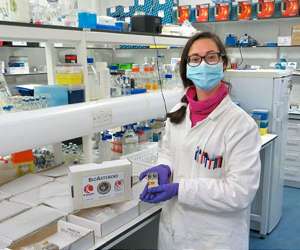
illustration only

Open source microscope enables low cost live cell imaging in zero gravity

by Silas Korrin
New York (SDX) Feb 23, 2026
As space agencies advance plans for human missions to the Moon and Mars, researchers are working to understand how the absence of gravity affects living cells over time. A team led by Newcastle University in the United Kingdom has now developed a rugged, low cost microscope platform that can monitor living cells in real time during zero gravity, and they are making the system openly available to other laboratories.

The work, which was previously published in the journal npj Microgravity, will be highlighted at the 70th Biophysical Society Annual Meeting in San Francisco from February 21 to 25, 2026. The effort focuses on enabling more laboratories to carry out microgravity biology experiments that require live cell imaging without relying on a small number of highly specialized, expensive instruments.

"We know that astronauts' cellular signaling processes like insulin signaling are affected by being in zero gravity," said Adam Wollman, an Assistant Professor at Newcastle University. "But no one had tried to look at this in a simple, stripped down system. We wanted to watch a cell sensing and responding to a signal in zero gravity to see exactly what happens."

Microscopes currently used for space research, including systems aboard the International Space Station, are typically custom built, costly instruments that only a limited number of investigators can access. Wollman and colleagues set out to create a more accessible alternative by starting from an open source microscope design developed at Stanford and then modifying it for robustness, lower cost, and easier use in harsh flight environments.

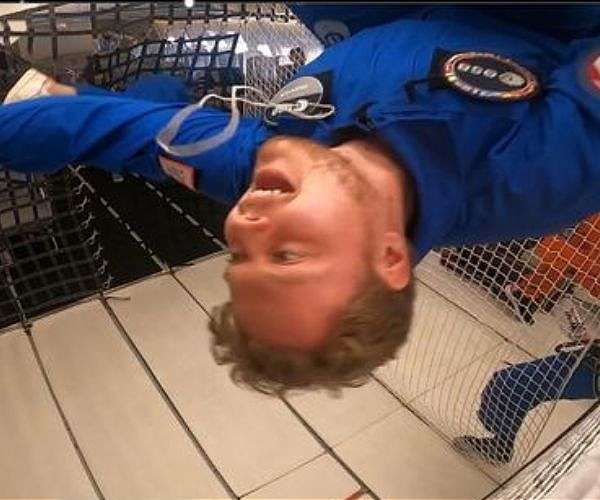
The resulting instrument, named FlightScope, was selected to fly on a European Space Agency parabolic flight campaign, often referred to as the vomit comet. These specially converted aircraft fly repeated steep parabolic trajectories that generate short periods of weightlessness, usually around 20 seconds at a time, interspersed with periods of high acceleration. While this makes parabolic flights an attractive platform for microgravity research, the rapidly changing forces and vibrations pose challenges for sensitive laboratory equipment.

To survive these conditions, the team reinforced the microscope with rigid mechanical mountings and vibration damping components, and they integrated a custom fluid handling system that can quickly switch samples and reagents between successive flight maneuvers. Using yeast cells as a model system, they imaged the uptake of fluorescently labeled glucose during the microgravity phases and reported that glucose uptake appeared slower in weightlessness than under normal gravity.

Wollman and collaborators emphasize that FlightScope is not limited to aircraft based research. The group has already deployed the microscope to the Boulby underground laboratory in an old British salt mine that serves as an analogue environment for the Moon and Mars. In that setting, the microscope supported studies of salt tolerant microorganisms known as archaea, with the goal of better understanding how life might persist in briny, subsurface environments on other worlds.

The team is now developing a new version of FlightScope designed to fly on a sounding rocket. These small rockets reach altitudes of around 80 kilometers before returning to Earth, providing roughly two minutes of microgravity in a single flight. The researchers view this as a stepping stone toward eventually operating similar imaging systems in long duration zero gravity environments.

A clearer picture of how cells behave in space is important for protecting astronaut health and for understanding how microbes that support life support systems will function off Earth. Microorganisms could eventually be used to help produce food, medicines, and other essential materials during long missions or in off world habitats. By lowering the cost and complexity of microgravity compatible microscopy and sharing their design as an open source platform, the FlightScope developers aim to broaden participation in space biology and accelerate the discoveries needed for sustainable human activity beyond Earth.

Related Links
Biophysical Society
Space Medicine Technology and Systems

Subscribe Free To Our Daily Newsletters
RELATED CONTENT
SPACE MEDICINE
Microbes harvest metals from meteorites aboard space station
Ithaca, NY (SPX) Feb 20, 2026
If humankind is to explore deep space, one small passenger should not be left behind: microbes. In fact, it would be impossible to leave them behind, since they live on and in our bodies, surfaces and food. Learning how they react to space conditions is critical, but they could also be invaluable fellows in our endeavor to explore space. Microorganisms such as bacteria and fungi can harvest crucial minerals from rocks and could provide a sustainable alternative to transporting much-needed resource ... read more

SPACE MEDICINE
NASA announces overhaul of Artemis lunar program amid technical delays

Texas AM partners with Aegis to orbit TAMU SPIRIT research hub on ISS

Regrowing marginal farmland can curb emissions without cutting food output

Chinese visitors to Japan slump as spat rumbles on

SPACE MEDICINE
Prometheus starts work on new Indiana solid rocket motor campus

NASA prepares Artemis II rocket for rollback after upper stage issue

Superconducting thruster cuts power and mass for space propulsion

Lithium trace in upper air linked to Falcon 9 rocket breakup

SPACE MEDICINE
Perseverance rover now self-locates precisely on Mars

Curiosity Blog, Sols 4798-4803: Back for More Science

Mars relay orbiter seen as backbone for future exploration

UAE extends Mars probe mission until 2028

SPACE MEDICINE
Dragon spacecraft gears up for crew 12 arrival and station science work

China prepares offshore test base for reusable liquid rocket launches

Retired EVA workhorse to guide China's next-gen spacesuit and lunar gear

Tiangong science program delivers data surge

SPACE MEDICINE
Infleqtion lists shares on NYSE as neutral atom quantum firm

AAC Clyde Space adds Sedna satellites to boost maritime data services

China tests AI satellite swarm for space-based computing

BlackSky expands Gen 3 Assured deals with new defense customer

SPACE MEDICINE
Dynamic terrain model boosts airborne gamma ray survey accuracy

KSAT prepares Hyperion in orbit relay test for satellite data

India chases 'DeepSeek moment' with homegrown AI models

ST Engineering iDirect and G&S SatCom align network and service management on Intuition

SPACE MEDICINE
Debris disc oddities point to hidden outer planets

Hydrogen sulfide detected in distant gas giant exoplanets for the first time

JWST study links sulfur rich gas giants to core growth in distant HR 8799 system

Survey of 80 near Earth asteroids sharpens view of their origins and risks

SPACE MEDICINE
Simple collapse may build cosmic snowman worlds

Jupiter size refined by new radio mapping

Polar weather on Jupiter and Saturn hints at the planets' interior details

Europa ice delamination may deliver nutrients to hidden ocean


The content herein, unless otherwise known to be public domain, are Copyright 1995-2026 - SpaceDaily.com. All websites are published in Australia and are solely subject to Australian law and governed by Fair Use principals for news reporting and research purposes. AFP, UPI and IANS news wire stories are copyright Agence France-Presse, United Press International and Indo-Asia News Service. ESA news reports are copyright European Space Agency. All NASA sourced material is public domain. Additional copyrights may apply in whole or part to other bona fide parties. All articles labeled "by Staff Writers" include reports supplied to Space Media Network by industry news wires, PR agencies, corporate press officers and the like. Such articles are individually curated and edited by Space Media Network staff on the basis of the report's information value to our industry and professional readership. Advertising does not imply endorsement, agreement or approval of any opinions, statements or information provided by Space Media Network on any Web page published or hosted by Space Media Network. General Data Protection Regulation (GDPR) Statement Our advertisers use various cookies and the like to deliver the best ad banner available at one time. All network advertising suppliers have GDPR policies (Legitimate Interest) that conform with EU regulations for data collection. By using our websites you consent to cookie based advertising. If you do not agree with this then you must stop using the websites from May 25, 2018. Privacy Statement. Additional information can be found here at About Us.
Subscribe Free To Our Daily Newsletters