24/7 Space News
MOON DAILY
Northrop Grumman Boosters Set For First Crewed Lunar Voyage Of Artemis Era
illustration only

Northrop Grumman Boosters Set For First Crewed Lunar Voyage Of Artemis Era

by Clarence Oxford
Los Angeles CA (SPX) Jan 29, 2026
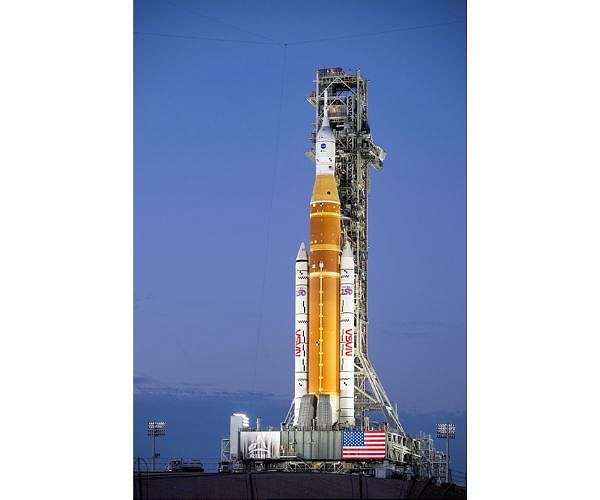
Two Northrop Grumman five segment solid rocket boosters are taking their place on the launch pad as NASA prepares for the first crewed flight of the Space Launch System rocket under the Artemis II mission from Pad 39B at Kennedy Space Center in Florida, targeted for early February 2026.

The twin solid rocket boosters stand 177 feet tall and each produces 3.6 million pounds of thrust at liftoff, making them the largest and most powerful solid rocket boosters ever flown on a human spaceflight mission. Evolved from the four segment boosters flown during the space shuttle era, the upgraded design provided more than 75 percent of the SLS rocket thrust during the Artemis I test flight and will again operate as a matched pair for the first crewed mission of the system.

Northrop Grumman has also supplied key elements of the Launch Abort System for the Orion spacecraft that will ride atop SLS. The company manufactures both the attitude control motor and the abort motor, which together are designed to pull Orion and its crew away from the rocket in the event of an emergency during launch or ascent. For Artemis II, this abort capability will be fully active to provide an additional safety layer for the four astronaut crew.

Company officials describe the booster contribution as central to the overall launch performance of SLS. Jim Kalberer, vice president of propulsion systems at Northrop Grumman, said the team has applied its manufacturing experience and solid rocket motor expertise to deliver 7.2 million pounds of the rocket's total 8.8 million pounds of thrust at liftoff. He said the power and performance of the solid rocket boosters are critical to enabling a new phase of American deep space exploration and to building a sustainable human presence beyond low Earth orbit in preparation for future missions to Mars.

Artemis II will be the first mission to send humans into deep space in more than half a century. The four astronauts will spend about 10 days on a mission around the Moon, using the flight to confirm the integrated performance of the SLS rocket, Orion spacecraft, and associated systems and hardware under operational conditions. Data and experience collected during the mission are expected to form a foundation for subsequent lunar landing flights and longer duration crewed expeditions into deep space.

Beyond the immediate launch campaign, Northrop Grumman is positioning its space hardware across multiple elements of the Artemis architecture. The company is building the Habitat and Logistics Outpost, or HALO, module for the planned Gateway station that will orbit the Moon as a deep space habitation and logistics node. HALO is intended to support astronaut crews living and working on extended missions to the lunar vicinity and to serve as a stepping stone for eventual Mars missions.

To support future deep space exploration beyond Artemis II, Northrop Grumman is also developing a next generation solid rocket booster. This system is described as the largest and most powerful segmented solid rocket booster the company has ever manufactured and is aimed at providing additional lift capability for future heavy lift missions into deep space. Together with the current SLS booster fleet and abort system motors, these developments underline the company's continuing role in U.S. human spaceflight and deep space transportation planning for years ahead.

Related Links
Northrop Grumman
Mars News and Information at MarsDaily.com
Lunar Dreams and more

Subscribe Free To Our Daily Newsletters
RELATED CONTENT
MOON DAILY
NASA Langley begins plume surface interaction tests to support future lunar landings
Los Angeles CA (SPX) Dec 22, 2025
NASA's Langley Research Center has begun a new series of plume surface interaction tests aimed at improving understanding of how rocket exhaust interacts with planetary surfaces during landing and ascent operations, a critical factor for future missions to the Moon and beyond. When spacecraft descend toward the lunar surface, high velocity exhaust plumes from descent engines can erode soil, loft dust and debris, and alter surface properties. These effects pose risks to landers, nearby infrastructu ... read more

MOON DAILY
NASA announces overhaul of Artemis lunar program amid technical delays

Texas AM partners with Aegis to orbit TAMU SPIRIT research hub on ISS

Regrowing marginal farmland can curb emissions without cutting food output

Chinese visitors to Japan slump as spat rumbles on

MOON DAILY
Prometheus starts work on new Indiana solid rocket motor campus

NASA prepares Artemis II rocket for rollback after upper stage issue

Superconducting thruster cuts power and mass for space propulsion

Lithium trace in upper air linked to Falcon 9 rocket breakup

MOON DAILY
Perseverance rover now self-locates precisely on Mars

Curiosity Blog, Sols 4798-4803: Back for More Science

Mars relay orbiter seen as backbone for future exploration

UAE extends Mars probe mission until 2028

MOON DAILY
Dragon spacecraft gears up for crew 12 arrival and station science work

China prepares offshore test base for reusable liquid rocket launches

Retired EVA workhorse to guide China's next-gen spacesuit and lunar gear

Tiangong science program delivers data surge

MOON DAILY
Infleqtion lists shares on NYSE as neutral atom quantum firm

AAC Clyde Space adds Sedna satellites to boost maritime data services

China tests AI satellite swarm for space-based computing

BlackSky expands Gen 3 Assured deals with new defense customer

MOON DAILY
Dynamic terrain model boosts airborne gamma ray survey accuracy

KSAT prepares Hyperion in orbit relay test for satellite data

India chases 'DeepSeek moment' with homegrown AI models

ST Engineering iDirect and G&S SatCom align network and service management on Intuition

MOON DAILY
Debris disc oddities point to hidden outer planets

Hydrogen sulfide detected in distant gas giant exoplanets for the first time

JWST study links sulfur rich gas giants to core growth in distant HR 8799 system

Survey of 80 near Earth asteroids sharpens view of their origins and risks

MOON DAILY
Simple collapse may build cosmic snowman worlds

Jupiter size refined by new radio mapping

Polar weather on Jupiter and Saturn hints at the planets' interior details

Europa ice delamination may deliver nutrients to hidden ocean


The content herein, unless otherwise known to be public domain, are Copyright 1995-2026 - SpaceDaily.com. All websites are published in Australia and are solely subject to Australian law and governed by Fair Use principals for news reporting and research purposes. AFP, UPI and IANS news wire stories are copyright Agence France-Presse, United Press International and Indo-Asia News Service. ESA news reports are copyright European Space Agency. All NASA sourced material is public domain. Additional copyrights may apply in whole or part to other bona fide parties. All articles labeled "by Staff Writers" include reports supplied to Space Media Network by industry news wires, PR agencies, corporate press officers and the like. Such articles are individually curated and edited by Space Media Network staff on the basis of the report's information value to our industry and professional readership. Advertising does not imply endorsement, agreement or approval of any opinions, statements or information provided by Space Media Network on any Web page published or hosted by Space Media Network. General Data Protection Regulation (GDPR) Statement Our advertisers use various cookies and the like to deliver the best ad banner available at one time. All network advertising suppliers have GDPR policies (Legitimate Interest) that conform with EU regulations for data collection. By using our websites you consent to cookie based advertising. If you do not agree with this then you must stop using the websites from May 25, 2018. Privacy Statement. Additional information can be found here at About Us.
Subscribe Free To Our Daily Newsletters