





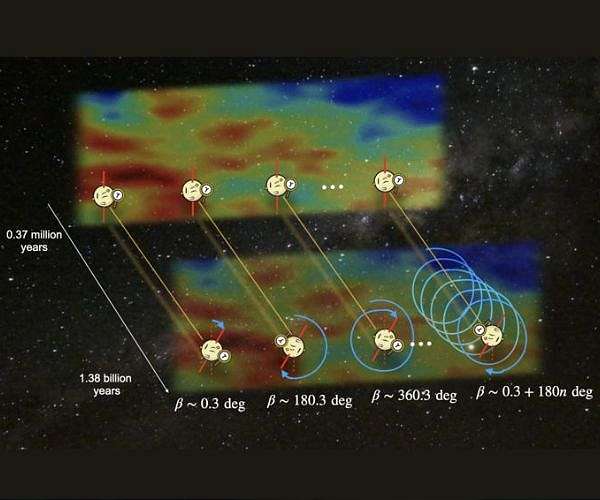
Cosmic birefringence refers to a small rotation in the polarization direction of the cosmic microwave background, the relic radiation from the Big Bang that preserves information about the early universe. Recent observations have hinted that the polarization of this ancient light is rotated, and this rotation is thought to be associated with hypothetical elementary particles known as axions that couple to light. To probe this effect, researchers analyze a signal called the CMB EB correlation, which encodes information about the rotation angle of the polarization plane.
Previous analyses of the CMB EB correlation suggested that the birefringence angle is about 0.3 degrees, but the new study indicates the true rotation may be larger than this widely quoted value. The project was led by University of Tokyo Graduate School of Science PhD candidate Fumihiro Naokawa, working with Kavli Institute for the Physics and Mathematics of the Universe Project Associate Professor Toshiya Namikawa. They carried out a detailed investigation of how phase ambiguity affects the inferred rotation angle and showed that conventional estimates can underestimate the true magnitude.
Naokawa likens the problem to telling the date by looking only at the hands of a clock without knowing how many full rotations have already occurred. In that situation, the current position of the hands does not reveal how many complete turns took place in the past, a situation scientists describe as 360 degree phase ambiguity. For cosmic birefringence, which rotates polarization as light propagates, observations only capture the present state of the CMB, so angles such as 0.3 degrees, 180.3 degrees, or 360.3 degrees appear indistinguishable in the data.
The team showed that this degeneracy leads to a 180 degree phase ambiguity in the birefringence angle as inferred from the EB correlation signal. To address this, they developed a method that exploits subtle features in the shape of the EB correlation spectrum, which can encode information about how many effective rotations the polarization direction has experienced. By examining the detailed structure of the EB signal rather than just its overall amplitude, the method can break the phase ambiguity and recover a more faithful estimate of the rotation angle.
The new uncertainty reduction technique is designed with upcoming high precision CMB experiments in mind, including facilities such as the Simons Observatory and the LiteBIRD mission. These projects aim to map polarization in the cosmic microwave background with unprecedented sensitivity, and the improved treatment of phase uncertainty will be critical for testing theories that predict cosmic birefringence. The method provides a systematic framework for incorporating phase effects into data analysis so that future surveys can more robustly connect their measurements to fundamental physics.
In addition to refining the interpretation of the EB correlation, the researchers found that properly accounting for phase uncertainty reveals a previously overlooked impact of cosmic birefringence on another polarization signal, the EE correlation. The EE correlation is a standard probe of the universe's optical depth, a parameter that encodes how the first luminous sources reionized the cosmos. The study suggests that birefringence induced modifications to the EE signal may require scientists to revisit published optical depth estimates that did not include this effect.
A companion paper by Naokawa, also appearing January 27 in Physical Review Letters, tackles a different source of error in cosmic birefringence measurements the distortions introduced by the telescopes themselves. Instrumental systematics can mimic or obscure the small polarization rotations researchers seek to detect, complicating the interpretation of CMB data. The second study proposes strategies to overcome these telescope induced errors and isolate the genuine cosmic signal.
In that separate work, Naokawa demonstrates that specific classes of celestial objects can provide an independent check on cosmic birefringence beyond the CMB. The analysis highlights radio galaxies powered by supermassive black holes as promising targets, because their polarized emission traverses large cosmological distances and can accumulate birefringent rotation. By comparing the observed polarization properties of such sources with theoretical expectations, astronomers can test for the presence of cosmic birefringence and cross validate CMB based measurements.
Together, the two Physical Review Letters papers outline a roadmap for turning hints of cosmic birefringence into a robust observational probe of new physics. By simultaneously addressing phase ambiguity in the CMB polarization signal and instrumental errors in telescopes, the research lays groundwork for future experiments to capture the effect with higher confidence. If confirmed, cosmic birefringence could open a new observational window onto axion like particles and other extensions of known physics that might explain the universe's large scale symmetry properties and the behavior of dark energy.
Research Report:Phase ambiguity of cosmic birefringence
Related Links
Kavli Institute for the Physics and Mathematics of the Universe
Understanding Time and Space
| Subscribe Free To Our Daily Newsletters |
| Subscribe Free To Our Daily Newsletters |








