24/7 Space News
ROCKET SCIENCE
New Wenchang lunar pad completes first Long March 10 test
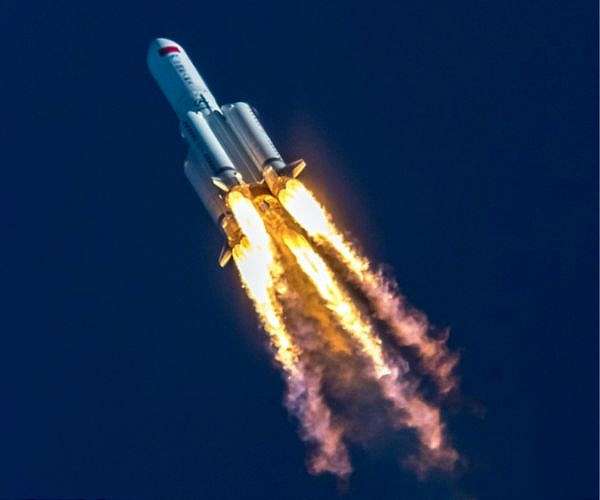
illustration only

New Wenchang lunar pad completes first Long March 10 test

by Riko Seibo
Tokyo, Japan (SPX) Feb 18, 2026

At the future departure gate for Chinas crewed lunar journeys at the Wenchang Spacecraft Launch Site in the southern island province of Hainan, personnel in blue uniforms have been carrying out post launch operations around a newly built tower dedicated to human missions to the Moon. The tower and its associated systems are being checked after the facility handled its first launch.

The new launch pad was constructed specifically for Chinas crewed lunar missions and supported its debut mission on Feb. 11. That test combined a low altitude demonstration and verification flight of the Long March 10 carrier rocket with a maximum dynamic pressure abort flight test of the new generation crewed spacecraft Mengzhou.

According to Di Baojun of the Wenchang Spacecraft Launch Site, engineers have newly built both the technical area and the launch area for the crewed lunar missions. The recent mission also served as a comprehensive trial of the entire new facility, verifying the flame trenchs ability to handle rocket exhaust, the resistance of concrete structures to ablation, the performance of a high flow water spray system, and the teams post test processing procedures.

Wenchang lies at 19 degrees north latitude and is currently Chinas lowest latitude spaceport. The location provides a wide range of launch azimuths, higher payload efficiency for launch vehicles, fewer constraints on transporting large rocket components, and safe downrange debris drop zones, making it suitable for high lift carrier rockets needed for lunar missions.

Construction of the crewed lunar mission project at Wenchang began in April 2024. In less than two years, a white launch tower about 120 meters tall, roughly the height of a 40 story building, has risen on site, making it the tallest launch tower in China at present.

The Long March 10 carrier rocket designed for crewed lunar missions reaches a maximum height of 92.5 meters, while the Mengzhou spacecraft is also relatively large. Di explained that the towers height has been matched to the dimensions of these vehicles so that platforms and umbilicals can support assembly, checkout, and launch processing.

Unlike the pad used for Chinas current Shenzhou crewed spacecraft, the new tower for lunar missions does not incorporate a rotating service structure. Di said that because of differences in rocket characteristics, some test and servicing procedures can be completed using the launch platform and umbilical arms alone, removing the need for an enclosed rotating gantry.

The fully open tower design also improves resistance to typhoons and other severe coastal weather, an important factor on tropical Hainan Island. By reducing wind loads on solid surfaces and simplifying the structure, the design better suits the extreme environmental conditions at the site.

Directly beneath the launch pad, a deep flame trench forms another critical element of the new complex. Its role is to channel away the high temperature, high velocity exhaust gases generated when the powerful Long March 10 ignites.

The trench is nearly 30 meters deep and can efficiently divert exhaust corresponding to a thrust of more than 2,600 tonnes. Di said the associated water spray system can release almost 1,000 tonnes of cooling water in 15 seconds to protect structures, reduce acoustic loads, and manage thermal stresses during liftoff.

Di added that construction of the tower, test facilities, and supporting infrastructure has now entered the equipment installation and finishing stages. All construction work on the crewed lunar mission complex at Wenchang is expected to be completed in the second half of this year.

Related Links
China Manned Space Agency
Rocket Science News at Space-Travel.Com

Subscribe Free To Our Daily Newsletters
Tweet

RELATED CONTENT
The following news reports may link to other Space Media Network websites.
ROCKET SCIENCE
Russian era ends at abandoned launchpad in South American jungle
Kourou (AFP) Feb 18, 2026
"Stop. Danger of death. Work in progress." This sign, written in Russian, is still hanging inside an office at the site where Russia once launched its Soyuz rockets from Europe's spaceport in Kourou, French Guiana. However the jungle has been slowly reclaiming the launchpad on South America's northeastern coast ever since Russia hastily left in the aftermath of invading Ukraine in February 2022. Under the tropical sun, vegetation has been encroaching on the vast concrete and metal structures ... read more

ROCKET SCIENCE
Texas AM partners with Aegis to orbit TAMU SPIRIT research hub on ISS

Sophie Adenot, the second French woman to fly to space

International crew arrives at space station

Chinese visitors to Japan slump as spat rumbles on

ROCKET SCIENCE
Russian era ends at abandoned launchpad in South American jungle

NASA teams set for second Artemis II wet dress rehearsal

Vietnam licenses Musk's satellite internet firm Starlink

Latvian startup advances nuclear-fueled power for satellites and future Moon missions

ROCKET SCIENCE
Curiosity Blog, Sols 4798-4803: Back for More Science

Mars relay orbiter seen as backbone for future exploration

UAE extends Mars probe mission until 2028

Mars' 'Young' Volcanoes Were More Complex Than Scientists Once Thought

ROCKET SCIENCE
Dragon spacecraft gears up for crew 12 arrival and station science work

China prepares offshore test base for reusable liquid rocket launches

Retired EVA workhorse to guide China's next-gen spacesuit and lunar gear

Tiangong science program delivers data surge

ROCKET SCIENCE
Hidden Legal Infrastructure Behind Commercial Space Industry

AAC Clyde Space adds Sedna satellites to boost maritime data services

China tests AI satellite swarm for space-based computing

BlackSky expands Gen 3 Assured deals with new defense customer

ROCKET SCIENCE
ST Engineering iDirect and G&S SatCom align network and service management on Intuition

Light based computing module aims to cut AI power demand

KSAT prepares Hyperion in orbit relay test for satellite data

Pale Blue opens Tsukuba site to scale satellite propulsion production

ROCKET SCIENCE
Hydrogen sulfide detected in distant gas giant exoplanets for the first time

Cheops spots inside out exoplanet quartet

Study revisits chances of detecting alien technosignatures

Engineered microbes use light to build new molecules

ROCKET SCIENCE
Jupiter size refined by new radio mapping

Polar weather on Jupiter and Saturn hints at the planets' interior details

Europa ice delamination may deliver nutrients to hidden ocean

Birth conditions fixed water contrast on Jupiters moons

Subscribe Free To Our Daily Newsletters


The content herein, unless otherwise known to be public domain, are Copyright 1995-2024 - Space Media Network. All websites are published in Australia and are solely subject to Australian law and governed by Fair Use principals for news reporting and research purposes. AFP, UPI and IANS news wire stories are copyright Agence France-Presse, United Press International and Indo-Asia News Service. ESA news reports are copyright European Space Agency. All NASA sourced material is public domain. Additional copyrights may apply in whole or part to other bona fide parties. All articles labeled "by Staff Writers" include reports supplied to Space Media Network by industry news wires, PR agencies, corporate press officers and the like. Such articles are individually curated and edited by Space Media Network staff on the basis of the report's information value to our industry and professional readership. Advertising does not imply endorsement, agreement or approval of any opinions, statements or information provided by Space Media Network on any Web page published or hosted by Space Media Network. General Data Protection Regulation (GDPR) Statement Our advertisers use various cookies and the like to deliver the best ad banner available at one time. All network advertising suppliers have GDPR policies (Legitimate Interest) that conform with EU regulations for data collection. By using our websites you consent to cookie based advertising. If you do not agree with this then you must stop using the websites from May 25, 2018. Privacy Statement. Additional information can be found here at About Us.