24/7 Space News
MOON DAILY
Lunar impacts limit late delivery of Earth ocean water
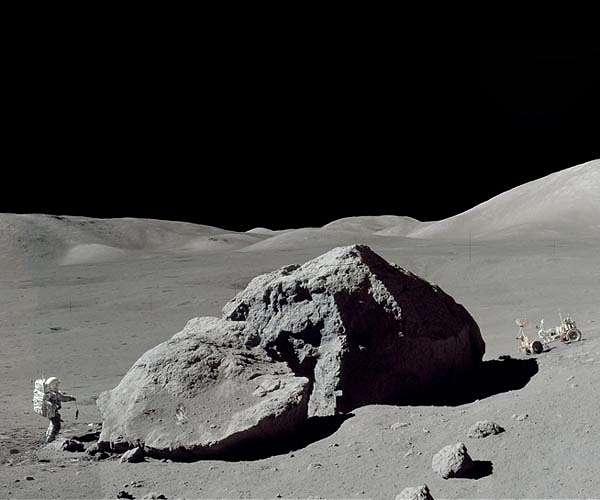
illustration only

Lunar impacts limit late delivery of Earth ocean water

by Clarence Oxford
Washington DC (SPX) Mar 05, 2026
A long-standing idea in planetary science proposes that water rich meteorites arriving late in Earth history delivered a major share of the planet's water inventory. A new study led by researchers at Universities Space Research Association and the University of New Mexico uses the Moon's surface record to impose strict limits on that scenario, concluding that impacts over the last 4 billion years could only have supplied a small fraction of Earth's water.

The team focused on lunar regolith, the loose layer of impact generated debris that blankets the Moon and preserves a continuously accessible archive of bombardment over billions of years. Unlike Earth, which has erased most of its early impact record through tectonics and constant crustal recycling, the Moon retains a time integrated record that can be probed directly with returned samples.

Earlier efforts to read this archive relied heavily on siderophile, or metal loving, elements that are abundant in meteorites but scarce in the Moon's silicate crust. Those tracers have proven difficult to interpret because impacts can repeatedly melt, vaporize, and rework material, while post impact geological processes can separate metal from silicate and obscure the original impactor signature.

The new work instead uses high precision triple oxygen isotope measurements on a large suite of Apollo lunar regolith samples. Oxygen is the dominant element by mass in most rocks, and its triple isotope "fingerprint" lets researchers separate two signals that are normally entangled in regolith: the addition of meteorite material and the isotopic effects of impact driven vaporization.

From small but resolvable offsets in the oxygen isotope composition of lunar soils, the team infers that at least about 1 percent by mass of the regolith reservoir consists of impactor derived material. The data are best explained by the addition of carbon rich meteorites that were partially vaporized on impact, leaving behind a characteristic oxygen isotope signature in the mixed regolith.

The researchers translated these impactor fractions into bounds on water delivery to both the Moon and Earth, expressed in units of Earth ocean equivalents for context. For the Moon, the implied water delivered since roughly 4 billion years ago is tiny when scaled to an Earth ocean, yet it may still be important locally because lunar water is concentrated in small, cold trapped reservoirs that are highly relevant to future human exploration.

Because water is a critical resource for life support, radiation shielding, and propellant production, even a slow trickle of impact delivered water can matter for sustaining a long term human presence on the Moon. The study therefore suggests that carbon rich impactors have contributed meaningfully to the Moon's accessible water budget, even if their global contribution is negligible by Earth standards.

The team then applied a commonly used scaling in which Earth receives substantially more impactor material than the Moon, reflecting its larger size and stronger gravity. Even if Earth experienced roughly 20 times the impactor flux recorded by the Moon and even under extreme assumptions about a deeply processed "megaregolith" end member, the cumulative water delivery from these impactors amounts to at most a few percent of a single Earth ocean.

Independent geochemical and geophysical estimates indicate that Earth hosts several ocean mass equivalents of water in total, both at the surface and in its interior. The new lunar based constraints therefore make it difficult to reconcile late delivery of water rich meteorites as the dominant source of Earth's oceans, pointing instead to earlier or alternative sources of Earth's water.

"The lunar regolith is one of the rare places we can still interpret a time integrated record of what was hitting Earth's neighborhood for billions of years," said lead author Tony Gargano of USRA's Lunar and Planetary Institute and the University of New Mexico. "The oxygen isotope fingerprint lets us pull an impactor signal out of a mixture that's been melted, vaporized, and reworked countless times."

"Our results don't say meteorites delivered no water," added co author Justin Simon of NASA's Astromaterials Research and Exploration Science Division. "They say the Moon's long term record makes it very hard for late meteorite delivery to be the dominant source of Earth's oceans."

Gargano emphasized that the study extends a scientific legacy that began with the Apollo program. "I'm part of the next generation of Apollo scientists people who didn't fly the missions, but who were trained on the samples and the questions Apollo made possible," he said. "The value of the Moon is that it gives us ground truth real material we can measure in the lab and use to anchor what we infer from meteorites and telescopes."

"Apollo samples are the reference point for comparing the Moon to the broader solar system," Gargano said. "When we put lunar soils and meteorites on the same oxygen isotope scale, we're testing ideas about what kinds of bodies were supplying water to the inner solar system, why Earth became habitable, and how the ingredients for life were assembled here in the first place."

Related Links
Universities Space Research Association
Mars News and Information at MarsDaily.com
Lunar Dreams and more

Subscribe Free To Our Daily Newsletters
RELATED CONTENT
MOON DAILY
NASA Langley begins plume surface interaction tests to support future lunar landings
Los Angeles CA (SPX) Dec 22, 2025
NASA's Langley Research Center has begun a new series of plume surface interaction tests aimed at improving understanding of how rocket exhaust interacts with planetary surfaces during landing and ascent operations, a critical factor for future missions to the Moon and beyond. When spacecraft descend toward the lunar surface, high velocity exhaust plumes from descent engines can erode soil, loft dust and debris, and alter surface properties. These effects pose risks to landers, nearby infrastructu ... read more

MOON DAILY
NASA announces overhaul of Artemis lunar program amid technical delays

Texas AM partners with Aegis to orbit TAMU SPIRIT research hub on ISS

Regrowing marginal farmland can curb emissions without cutting food output

Chinese visitors to Japan slump as spat rumbles on

MOON DAILY
Prometheus starts work on new Indiana solid rocket motor campus

NASA prepares Artemis II rocket for rollback after upper stage issue

Superconducting thruster cuts power and mass for space propulsion

Lithium trace in upper air linked to Falcon 9 rocket breakup

MOON DAILY
Perseverance rover now self-locates precisely on Mars

Curiosity Blog, Sols 4798-4803: Back for More Science

Mars relay orbiter seen as backbone for future exploration

UAE extends Mars probe mission until 2028

MOON DAILY
Dragon spacecraft gears up for crew 12 arrival and station science work

China prepares offshore test base for reusable liquid rocket launches

Retired EVA workhorse to guide China's next-gen spacesuit and lunar gear

Tiangong science program delivers data surge

MOON DAILY
Infleqtion lists shares on NYSE as neutral atom quantum firm

AAC Clyde Space adds Sedna satellites to boost maritime data services

China tests AI satellite swarm for space-based computing

BlackSky expands Gen 3 Assured deals with new defense customer

MOON DAILY
Dynamic terrain model boosts airborne gamma ray survey accuracy

KSAT prepares Hyperion in orbit relay test for satellite data

India chases 'DeepSeek moment' with homegrown AI models

ST Engineering iDirect and G&S SatCom align network and service management on Intuition

MOON DAILY
Debris disc oddities point to hidden outer planets

Hydrogen sulfide detected in distant gas giant exoplanets for the first time

JWST study links sulfur rich gas giants to core growth in distant HR 8799 system

Survey of 80 near Earth asteroids sharpens view of their origins and risks

MOON DAILY
Simple collapse may build cosmic snowman worlds

Jupiter size refined by new radio mapping

Polar weather on Jupiter and Saturn hints at the planets' interior details

Europa ice delamination may deliver nutrients to hidden ocean


The content herein, unless otherwise known to be public domain, are Copyright 1995-2026 - SpaceDaily.com. All websites are published in Australia and are solely subject to Australian law and governed by Fair Use principals for news reporting and research purposes. AFP, UPI and IANS news wire stories are copyright Agence France-Presse, United Press International and Indo-Asia News Service. ESA news reports are copyright European Space Agency. All NASA sourced material is public domain. Additional copyrights may apply in whole or part to other bona fide parties. All articles labeled "by Staff Writers" include reports supplied to Space Media Network by industry news wires, PR agencies, corporate press officers and the like. Such articles are individually curated and edited by Space Media Network staff on the basis of the report's information value to our industry and professional readership. Advertising does not imply endorsement, agreement or approval of any opinions, statements or information provided by Space Media Network on any Web page published or hosted by Space Media Network. General Data Protection Regulation (GDPR) Statement Our advertisers use various cookies and the like to deliver the best ad banner available at one time. All network advertising suppliers have GDPR policies (Legitimate Interest) that conform with EU regulations for data collection. By using our websites you consent to cookie based advertising. If you do not agree with this then you must stop using the websites from May 25, 2018. Privacy Statement. Additional information can be found here at About Us.
Subscribe Free To Our Daily Newsletters