





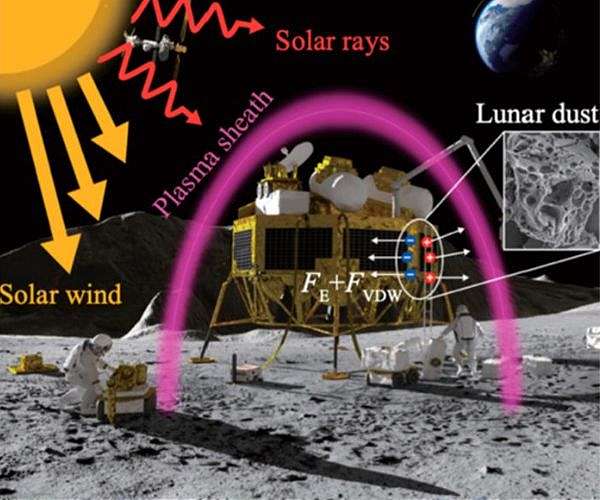
The study first formulates the electrostatic environment around the spacecraft and regolith on the lunar surface. On the sunlit dayside, solar ultraviolet and x-ray radiation generate photoelectrons that typically charge both spacecraft and lunar regolith positively, forming a photoelectron sheath above the surface, while on the nightside, electron collection from the ambient plasma generally drives spacecraft and regolith to negative potentials and produces a Debye sheath because electrons have higher thermal velocities than ions. Additional charging arises from exposure to the solar wind, the lunar plasma wake, and plasma in the magnetotail lobes and plasma sheet, but the model restricts attention to interactions between charged particles and the spacecraft within the plasma sheath and neglects direct dust-plasma coupling.
Given the large size contrast between spacecraft and dust grains, the spacecraft is approximated as an infinite conducting plane coated with a dielectric layer, and a single dust particle is treated as a dielectric sphere of radius Rp, uniform surface charge density sp, and permittivity ep located at distance d above the coating. The distance from the coating surface to the outer sheath boundary is set to three times the Debye length Rd, the shell potential ? is used as the reference, and the potential in the sheath decays exponentially as f0 = ? exp[-(z - 3Rd)/Rd] with the corresponding electric field E0 = ?/Rd-exp[-(z - 3Rd)/Rd] for 0 = z = 3Rd. The total electrostatic force FE on the particle is expressed as the sum of the electric field force FEF, a dielectrophoretic force FD formulated with dyadic tensors, and a multipole image force FI acting on induced multipole moments, with FEF obtained by evaluating E0 at x = 0, y = 0, z = d + Rp and multiplying by the free charge Qp.
The second part of the work addresses the adhesive-elastic-plastic collision mechanics that control whether grains stick after impact. Despite the small size, irregular shapes, and high hardness of lunar dust, the particles are represented as spheres for the normal contact problem, while the spacecraft coating is modeled as a Kapton layer. Using a dimensionless discriminant parameter uT, the authors adopt the Johnson-Kendall-Roberts (JKR) model, widely used for soft materials with high interface energy, to describe adhesion, and then incorporate plastic deformation of the coating via Thornton's adhesive-elastic-plastic framework to capture energy losses during low-velocity collisions.
Within this collision framework, the impact process is divided into three stages: an adhesive-elastic loading stage, an adhesive-elastic-plastic loading stage, and an adhesive-elastic unloading stage. The pressure distribution p(r) over the contact area between dust and coating evolves through these stages, with the first stage relating JKR pressure, relative compression d, and the contact force P1, the second stage defining a normal contact force P2 that accounts for plasticity, and the unloading stage expressing the contact force P3 as a function of contact radius a following the JKR relation but with an irrecoverable displacement dp.
Parametric calculations then explore how coating properties and particle characteristics shape the electrostatic force and post-collision outcomes. The results indicate that using a dielectric coating with greater thickness and lower permittivity reduces FE between charged dust and spacecraft, and comparisons of theory and simulation for different particle parameters show that for dimensionless separations d/Rp = 1 the electrostatic attraction can be approximated as F " K Rp2 sp2 / (1 + d/Rp)2. The analysis also finds that surface charge density has a stronger influence on electrostatic interaction than spacecraft potential, and that larger particles tend to achieve higher maximum coefficients of restitution under low-velocity impact conditions.
The study distinguishes the roles of electrostatic and van der Waals forces during low-speed encounters. When the dust surface charge density sp is below 0.1 mC/m2, adhesive van der Waals forces dominate over electrostatic attraction in controlling whether lunar dust adheres during collision, and coatings with low interface energy, achieved by selecting low-surface-energy materials and increasing surface roughness, lower the difficulty of dust removal from spacecraft surfaces. For charged grains, long-term adhesion depends not just on the initial impact but also on whether the particle's initial velocity lies between critical adhesion and escape thresholds delineated by the combined electrostatic and contact mechanics model.
Beyond lunar applications, the authors propose that the theoretical framework can be extended to other systems where charged dust accumulates on solid boundaries. The model can be used to examine dust deposition in electrostatic precipitators and adhesion of energetic powders to mixer walls, and to support design strategies that mitigate dust buildup. Future work will incorporate realistic irregular dust shapes, more detailed plasma environments, and solar radiation effects into the interaction model to better capture natural conditions on the Moon and in related dusty plasmas.
Research Report:Modeling of electrostatic and contact interaction between low-velocity lunar dust and spacecraft
Related Links
Beijing Institute of Technology Press Co., Ltd
Mars News and Information at MarsDaily.com
Lunar Dreams and more
| Subscribe Free To Our Daily Newsletters |
| Subscribe Free To Our Daily Newsletters |








