





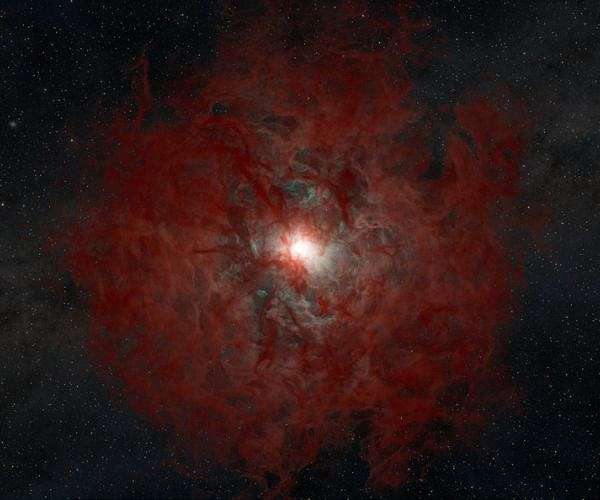
The object, cataloged as M31-2014-DS1, sits about 2.5 million light years from Earth in the neighboring Andromeda galaxy. A typical massive star death produces a powerful shockwave that blasts away the outer layers and generates a supernova that can briefly outshine an entire galaxy. In this case, however, the star simply faded from view, leaving behind a veil of hot gas and dust and strong evidence that a new black hole formed at its core.
The team drew heavily on archival data from NASA's Near-Earth Object Wide-field Infrared Survey Explorer, or NEOWISE, which has surveyed the sky in infrared wavelengths since its original mission began as WISE. By combining NEOWISE measurements with observations from other space telescopes and ground based observatories spanning 2005 to 2023, researchers reconstructed a detailed timeline of the star's final years. That record shows that in 2014 the star suddenly brightened in infrared light, signaling a dramatic change in its outer layers.
According to the analysis, the infrared brightening was caused by the star expelling a thick shell of gas and dust from its outermost layers as its core ran out of nuclear fuel. With the internal energy supply exhausted, the star could no longer support its own weight. Rather than driving a powerful explosion, a relatively weak shockwave failed to eject most of the stellar material. Under the pull of the star's own gravity, that material fell back inward.
By 2023 the source had dimmed in visible light by more than a factor of 10 compared to its earlier state, effectively disappearing in optical images. At the same time, the lingering infrared emission traced the hot, expanding cloud of gas and dust left behind. The combination of a sudden infrared outburst, extreme optical fading, and the missing stellar core points strongly to a collapse into a black hole rather than a conventional supernova.
This event has been described as a failed supernova, a type of stellar death that theorists have long predicted but that is difficult to catch in the act. In a failed supernova, the core of a massive star collapses directly into a black hole and only a modest amount of material is expelled, producing a faint or even undetectable optical signature. Infrared surveys such as NEOWISE can pick up the glow from newly heated dust, offering a way to identify these otherwise hidden deaths.
The new study, supported by NASA's Astrophysics Data Analysis Program and published in the journal Science, provides one of the clearest observational cases yet of this quiet pathway to black hole formation. By following M31-2014-DS1 over many years, astronomers obtained what amounts to a before and after record of a star that failed to explode but still underwent catastrophic collapse.
Researchers have now pinpointed another massive star that may have undergone a similar fate, suggesting that these quiet endings could be more common than previously recognized. If so, many black holes in nearby galaxies may have formed without the spectacular fireworks normally associated with stellar death. Continued monitoring of galaxies with both infrared and optical instruments should reveal more examples and clarify how often stars collapse in this way.
The findings highlight the value of long term sky surveys and well curated data archives. Infrared missions like NEOWISE not only track near Earth asteroids, but also capture slow, subtle changes in distant stars and galaxies that can take years to interpret. As new facilities come online, astronomers expect to uncover additional failed supernova candidates and build a more complete picture of how massive stars live and die.
Related Links
NEOWISE at NASA
Understanding Time and Space
| Subscribe Free To Our Daily Newsletters |
| Subscribe Free To Our Daily Newsletters |








