





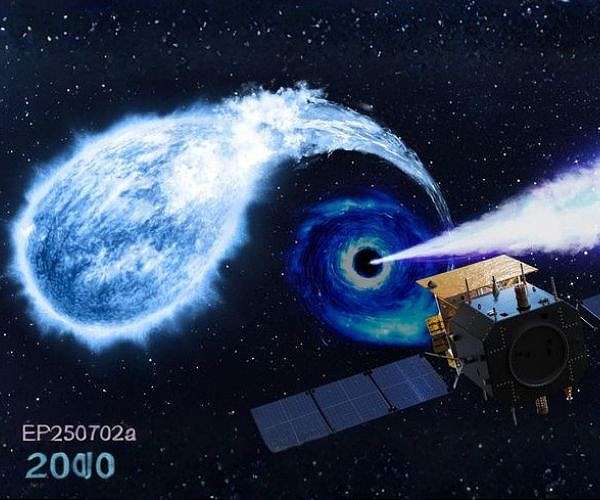
During a routine sky survey on July 2 2025 the mission's Wide field X ray Telescope detected a rapidly varying X ray source that immediately stood out from ordinary cosmic objects and triggered a global observing campaign. Almost simultaneously NASA's Fermi Gamma ray Space Telescope recorded a sequence of gamma ray bursts from the same region of the sky.
Subsequent analysis of earlier Einstein Probe data showed that the telescope had already seen steady X ray emission from the site about a day before the gamma ray bursts. That sequence is rarely observed in high energy transients and pointed to an event unlike standard gamma ray bursts. Roughly 15 hours after the first signal the source erupted into powerful X ray flares reaching a peak luminosity of about 3 x 10^49 erg per second placing it among the brightest known instantaneous outbursts in the universe.
Thanks to precise coordinates from the wide field instrument ground based and space based telescopes around the world quickly joined the follow up effort. Observations across multiple wavelengths located the source in the outskirts of a distant galaxy rather than at its centre further distinguishing it from typical high energy explosions. The Einstein Probe Follow up X ray Telescope then tracked the source for around 20 days during which its brightness dropped by more than a factor of one hundred thousand and its emission shifted from higher energy hard X rays to lower energy soft X rays.
When scientists compared all the data sets they found that the transient designated EP250702a sometimes also referred to as GRB 250702B showed a combination of traits that existing models struggled to explain. The early and extremely bright X ray signal, the rapid evolution and the off centre galactic location did not fit neatly into standard scenarios for gamma ray bursts or known tidal disruption events.
Teams from the Department of Physics at The University of Hong Kong and the Hong Kong Institute of Astronomy and Astrophysics played key roles in interpreting the phenomenon. Working within the broader international collaboration they proposed that an intermediate mass black hole ripping apart a white dwarf star could naturally account for both the energy output and the fast evolution. Professor Lixin Dai, a co corresponding author from HKU, noted that the white dwarf intermediate mass black hole model most naturally explains the observations.
Postdoctoral fellow Dr Jinhong Chen of HKU, a co first author of the paper, carried out detailed numerical simulations to test this idea. Our computational simulations show that the combination of the tidal forces of an intermediate mass black hole, combined with the extreme density of a white dwarf, can produce jet energies and evolutionary timescales that are highly consistent with the observational data, he said. The results support the notion that a relativistic jet launched during the disruption produced the observed high energy emission.
Other members of the collaboration emphasised the broader scientific importance of the event. Professor Bing Zhang, Director of the Hong Kong Institute of Astronomy and Astrophysics and a co author, highlighted Hong Kong's internationalised research vision and technical expertise in astronomy and said the team's deep involvement in the discovery underscores the value of the region's scientific capabilities at the frontiers of global research. Professor Dai added that intense debate among multiple international teams proposing competing explanations for the transient underlines its scientific impact.
Einstein Probe mission scientist Professor Weimin Yuan of the National Astronomical Observatories of China described the event as a demonstration of the satellite's core purpose. The mission of the Einstein Probe is to capture unpredictable and extreme transient phenomena in the universe, he said. The discovery of EP250702a fully demonstrates our capability to be the first to capture the universe's most extreme moments and further exemplifies China's ability to make decisive contributions to international astronomical exploration.
If the interpretation is confirmed EP250702a would offer the first clear and direct evidence of an intermediate mass black hole tearing apart a white dwarf and generating a relativistic jet. Such a finding would help fill a long standing gap in the census of black holes by illuminating the elusive intermediate mass population between stellar mass and supermassive objects. It would also provide new ways to study how black holes grow, the ultimate fate of compact stars and the connections between high energy photons, gravitational waves and other messengers in the cosmos.
The research effort brought together more than 300 scientists from over 40 universities and research institutes worldwide. Partners include The University of Hong Kong, the National Astronomical Observatories of China, Anhui Normal University, Sun Yat sen University and the University of Science and Technology of China among many others. Key international collaborators on the Einstein Probe mission include the European Space Agency, the Max Planck Institute for Extraterrestrial Physics in Germany and the French National Centre for Space Studies, underscoring the role of large scale global cooperation in tackling frontier astrophysical problems.
Research Report: A fast powerful X-ray transient from possible tidal disruption of a white dwarf
Related Links
The University of Hong Kong
Understanding Time and Space
| Subscribe Free To Our Daily Newsletters |
| Subscribe Free To Our Daily Newsletters |








