24/7 Space News
ROCKET SCIENCE
Europe's most powerful rocket carries 32 satellites for Amazon Leo network into space

Europe's most powerful rocket carries 32 satellites for Amazon Leo network into space

by AFP Staff Writers
Kourou (AFP) Feb 12, 2026
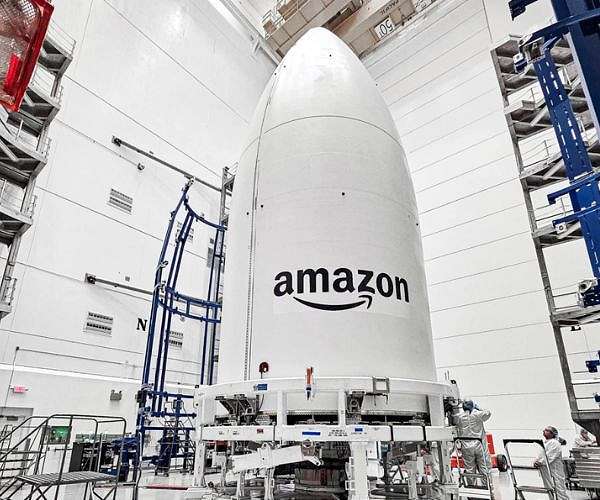
The most powerful version of Europe's Ariane 6 rocket Thursday carried 32 satellites into space for the Amazon Leo network, which aims to rival Elon Musk's Starlink.

The launch from Europe's spaceport in Kourou, French Guiana, on the northeastern coast of South America, is a first for Amazon Leo.

The largest number of satellites ever carried by an Ariane rocket successfully separated and set off toward their final orbit to applause from those following the event live at the control centre.

"What a day, what a launch!" exclaimed Arianespace CEO David Cavailloles, who said the operation proved the launcher's ability to "carry out the most complex missions".

"Amazon, your package has been delivered," French President Emmanuel Macron wrote on X, speaking of a "European success".

US firm Amazon, founded by billionaire Jeff Bezos, is the main commercial partner for the Ariane 6 despite the latter being touted as a symbol of European sovereignty in the sector.

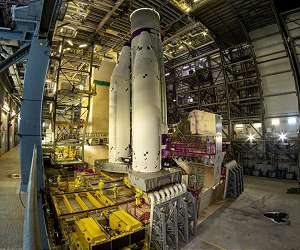
To take on the 32 satellites, the Ariane 6 was upgraded with four strap-on boosters, instead of the two used on the first five flights.

The increased number marks "our largest payload that we have launched to date," Martijn Van Delden, head of commercial development for Europe at Amazon Leo, told AFP.

With 175 satellites already in orbit, Amazon Leo aims to expand its constellation to 3,200.

Rival Starlink, meanwhile, has nearly 9,400 satellites.

"We're looking to then increase the payload every time we have a new mission, especially as more powerful boosters come online on Ariane 6," Van Delden said.

"Ariane 6 is a perfect launcher for constellations" of satellites, said Arianespace CEO Cavailloles during a press briefing.

He said the Amazon launches would help in training for a flagship multi-orbital constellation project of the European Union aimed at ensuring secure and sovereign connectivity, with deployment slated to begin in 2029.

- 'Build market confidence' -

Ludwig Moeller, director of the European Space Policy Institute (ESPI), warned that "over time a sovereign European launcher cannot be primarily dependent on foreign markets".

Foreign partners "may negotiate priority handling backed by economic power or which may become unpredictable or inaccessible without notice, given the current geopolitical environment and trade wars," he told AFP.

But in the absence of European commercial customers -- many of whom work with Musk's SpaceX -- the Amazon partnership is crucial.

Four out of five anticipated launches took place in 2025 following Ariane's inaugural 2024 flight, unprecedented for a new launcher, according to ArianeGroup president Marc Sion.

Although Ariane 6 is eventually expected to carry out 10 launches per year, Pierre Lionnet, Eurospace research director, noted that at this stage this would not be possible without commercial customers like Amazon.

Long-term investment is expected to amount to billions of euros to the European space sector.

"If things go well here, it will help build market confidence," said Philippe Clar, ArianeGroup's head of launchers.

neo/cc/ach

Amazon.com

X

Related Links
Rocket Science News at Space-Travel.Com

Subscribe Free To Our Daily Newsletters
RELATED CONTENT
ROCKET SCIENCE
Ariane 6 four booster launcher completes on schedule mission
Paris, France (SPX) Feb 13, 2026
Europe's Ariane 6 launcher has completed its first mission using a four booster configuration, delivering a full suite of payloads to orbit in a demonstration of its maximum performance variant. Designated flight VA267, the mission lifted off from Europe's Spaceport in Kourou, French Guiana, during a launch window between 16:45 and 17:13 GMT, carrying 32 satellites for Amazon's Leo constellation to low Earth orbit. The flight profile from liftoff to the final satellite separation ran for 114 minut ... read more

ROCKET SCIENCE
Texas AM partners with Aegis to orbit TAMU SPIRIT research hub on ISS

Sophie Adenot, the second French woman to fly to space

International crew arrives at space station

NASA announces overhaul of Artemis lunar program amid technical delays

ROCKET SCIENCE
Prometheus starts work on new Indiana solid rocket motor campus

NASA prepares Artemis II rocket for rollback after upper stage issue

Superconducting thruster cuts power and mass for space propulsion

Lithium trace in upper air linked to Falcon 9 rocket breakup

ROCKET SCIENCE
Perseverance rover now self-locates precisely on Mars

Curiosity Blog, Sols 4798-4803: Back for More Science

Mars relay orbiter seen as backbone for future exploration

UAE extends Mars probe mission until 2028

ROCKET SCIENCE
Dragon spacecraft gears up for crew 12 arrival and station science work

China prepares offshore test base for reusable liquid rocket launches

Retired EVA workhorse to guide China's next-gen spacesuit and lunar gear

Tiangong science program delivers data surge

ROCKET SCIENCE
Infleqtion lists shares on NYSE as neutral atom quantum firm

AAC Clyde Space adds Sedna satellites to boost maritime data services

China tests AI satellite swarm for space-based computing

BlackSky expands Gen 3 Assured deals with new defense customer

ROCKET SCIENCE
India chases 'DeepSeek moment' with homegrown AI models

Swift observatory changes operations ahead of planned orbit reboost

Pale Blue opens Tsukuba site to scale satellite propulsion production

AST SpaceMobile deploys record low orbit cellular array on BlueBird 6

ROCKET SCIENCE
Cheops spots inside out exoplanet quartet

Study questions assumptions about hidden alien technosignals

Study revisits chances of detecting alien technosignatures

Hydrogen sulfide detected in distant gas giant exoplanets for the first time

ROCKET SCIENCE
Simple collapse may build cosmic snowman worlds

Jupiter size refined by new radio mapping

Polar weather on Jupiter and Saturn hints at the planets' interior details

Europa ice delamination may deliver nutrients to hidden ocean


The content herein, unless otherwise known to be public domain, are Copyright 1995-2026 - SpaceDaily.com. All websites are published in Australia and are solely subject to Australian law and governed by Fair Use principals for news reporting and research purposes. AFP, UPI and IANS news wire stories are copyright Agence France-Presse, United Press International and Indo-Asia News Service. ESA news reports are copyright European Space Agency. All NASA sourced material is public domain. Additional copyrights may apply in whole or part to other bona fide parties. All articles labeled "by Staff Writers" include reports supplied to Space Media Network by industry news wires, PR agencies, corporate press officers and the like. Such articles are individually curated and edited by Space Media Network staff on the basis of the report's information value to our industry and professional readership. Advertising does not imply endorsement, agreement or approval of any opinions, statements or information provided by Space Media Network on any Web page published or hosted by Space Media Network. General Data Protection Regulation (GDPR) Statement Our advertisers use various cookies and the like to deliver the best ad banner available at one time. All network advertising suppliers have GDPR policies (Legitimate Interest) that conform with EU regulations for data collection. By using our websites you consent to cookie based advertising. If you do not agree with this then you must stop using the websites from May 25, 2018. Privacy Statement. Additional information can be found here at About Us.
Subscribe Free To Our Daily Newsletters