





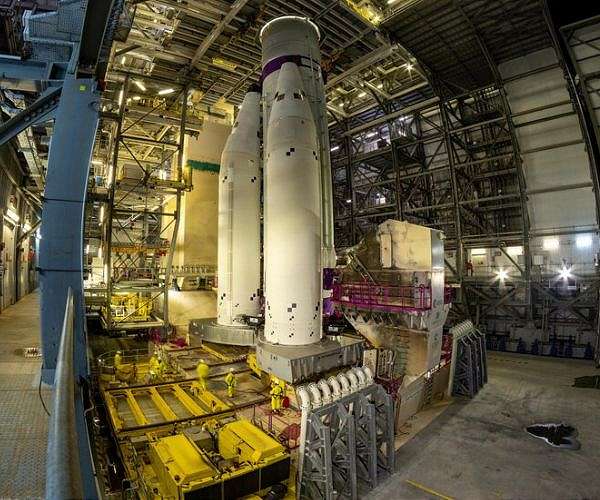
Designated flight VA267, the mission lifted off from Europe's Spaceport in Kourou, French Guiana, during a launch window between 16:45 and 17:13 GMT, carrying 32 satellites for Amazon's Leo constellation to low Earth orbit. The flight profile from liftoff to the final satellite separation ran for 114 minutes, concluding with deployment of the last spacecraft as planned.
Ariane 6 is a three stage launch vehicle that uses strap on boosters, a main stage and an upper stage that are expended in sequence to reach orbit. For this mission the rocket flew with four P120C solid boosters, coupled with its liquid fuelled core and upper stage, to provide the extra thrust required for the heavy payload.
The four booster configuration more than doubles the launcher performance compared to the two booster variant that has flown since the inaugural Ariane 6 mission in 2024. In this setup Ariane 6 can place around 21.6 tonnes into low Earth orbit, up from about 10.3 tonnes with two boosters, placing it in a higher class of heavy lift rockets.
The P120C boosters are among the most powerful one piece solid rocket motors currently in production, and flying four in combination with the main stage allowed engineers to validate their joint performance under operational conditions. The mission also exercised guidance, navigation and control systems tuned for the higher thrust and mass flow of the four booster stack.
For VA267 Ariane 6 flew with the long fairing option, which enclosed and protected the 32 satellites during ascent through the atmosphere. The fairing stands 20 meters tall with a diameter of 5.4 meters, providing volume sufficient to accommodate large multi satellite payloads and complex deployment hardware.
With the long fairing atop the four booster configuration, Ariane 6 reached its tallest assembled height to date on the pad at Kourou. The complete vehicle rose to about 62 meters, comparable to a 20 storey building, and required tailored ground handling and integration procedures inside the mobile gantry and on the launch table.
The mission showcased the operational collaboration behind Ariane 6. The European Space Agency manages development of the launcher and coordinates an industrial network spread across 13 European nations, with ArianeGroup acting as prime contractor and design authority. French space agency CNES oversees range and ground segment operations at Europe's Spaceport, while Arianespace provides launch services and customer integration.
With the four booster configuration now proven in flight, Ariane 6 expands its range of mission profiles for institutional and commercial customers. The launcher can now support heavier constellations, large single spacecraft and complex multi payload campaigns, reinforcing Europe's independent access to space in the heavy lift segment.
Related Links
Space Transportation at European Space Agency
Rocket Science News at Space-Travel.Com
| Subscribe Free To Our Daily Newsletters |

| Subscribe Free To Our Daily Newsletters |







